


Small vs large language models for enterprise AI
Hitesh Sondhi · May 20, 2026 · 12 min read
We watched a “state-of-the-art” giant model burn through budget for a customer support workflow, then lose to a much smaller model on the only metric that mattered: getting the refund policy right. The bigger model sounded smarter. It was also slower, more expensive, and weirdly more likely to freestyle when the docs were messy.
That’s the dirty little secret in enterprise AI.
A lot of teams are still treating model size like horsepower in a drag race. Bigger must be better, right? Not really. In production, small language models vs large language models is less like “compact car vs supercar” and more like “chef’s knife vs chainsaw.” One is versatile. One is dramatic. Only one belongs in most kitchens.
Key Takeaways
- Small models usually win when the task is narrow, latency matters, and you actually care about cost.
- Large models still earn their keep on messy reasoning, broad knowledge, and zero-shot generalization.
- Fine-tuned small models often beat generic large models on enterprise workflows with stable rules and domain language.
- On-device and privacy-sensitive use cases push the decision hard toward smaller models.
- If you don’t benchmark on your real tasks, you’re not choosing a model — you’re buying vibes.
Why this debate gets stupid fast
The internet loves parameter count because it’s easy to brag about. “We use a 70B model” sounds impressive in a board meeting. It’s the AI version of saying your espresso machine has 19 bars of pressure when all you wanted was coffee that doesn’t taste like regret.
But enterprises don’t buy parameters. They buy outcomes.
If your use case is contract clause extraction, call summarization, hotel front-desk voice interactions, or internal knowledge Q&A, the right question isn’t “what’s the biggest model we can afford?” It’s “what’s the smallest model that reliably does the job?”
That’s a very different question.
What small and large language models actually mean
A small language model usually means a model with far fewer parameters than frontier LLMs, often optimized for specific tasks, lower memory usage, and faster inference. A large language model is trained at much larger scale, usually on broader datasets, and tends to perform better on open-ended reasoning and general-purpose tasks.
There’s no single industry cutoff, which is annoying but normal. In practice, teams often treat models in the low single-digit billions or below as “small,” while models in the tens or hundreds of billions sit in “large.” The exact line matters less than the tradeoff profile.
And yes, the phrase small language models vs large language models sounds neat in a slide deck. In real systems, it’s really about capability density per dollar, per watt, and per millisecond.
Here’s the simple mental model: small models are like line cooks. Fast, focused, consistent. Large models are like celebrity chefs. Impressive range, expensive habits, and sometimes they’ll put foam on something that didn’t need foam.
Here’s how the decision usually flows in real enterprise projects:
flowchart TD
    A[Define the task] --> B{Narrow and repetitive?}
    B -->|Yes| C[Start with a small model]
    B -->|No| D{Needs broad reasoning or zero-shot skill?}
    D -->|Yes| E[Evaluate a large model]
    D -->|No| F[Try a fine-tuned small model]
    C --> G[Benchmark latency, cost, accuracy]
    E --> G
    F --> G
    G --> H[Pick the smallest model that clears the bar]
That last box is the whole game.
Where small models punch way above their weight
We’ve found that small models get underrated because people test them on broad benchmark-style prompts instead of actual business tasks. That’s like judging a forklift by how it handles Formula 1 corners. Wrong tool, wrong test.
For enterprise workloads with constrained outputs, stable vocabulary, and clear success criteria, small models can be absurdly effective. Think ticket classification, form extraction, policy-grounded chat, speech intent routing, FAQ answering with retrieval, and voice commands.
This is especially true when you can fine-tune or tightly constrain the task.
A smaller model trained or adapted for your domain often behaves better than a giant general model that “knows” everything but can’t stop improvising. We’ve seen this in voice workflows and edge deployments where response time matters more than philosophical depth. If you’re building on-device AI or voice AI, giant models are often the wrong starting point.
Not because they’re bad.
Because physics exists.
Inference cost, memory footprint, thermal limits, and network dependency don’t care about your model hype. If you need local inference on constrained hardware, or you can’t tolerate cloud round-trips, small models stop being a compromise and start being the only sane option.
Here’s what that tradeoff looks like at a high level:
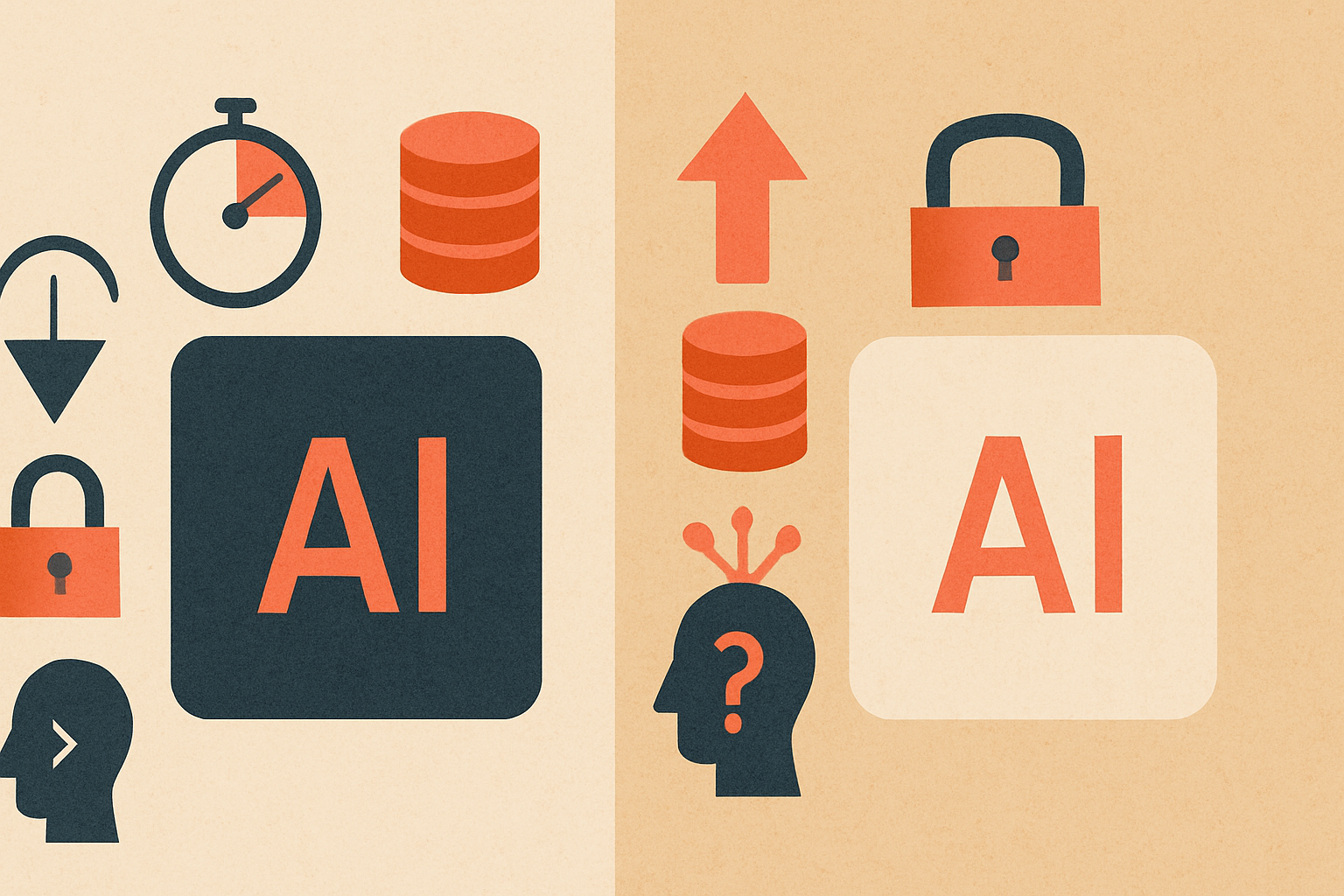
At Cropsly, this matters a lot in systems like RunHotel, where on-device voice interactions need to feel immediate and reliable. A model that’s “smarter” but takes too long to respond is not smarter in practice. It’s just annoying with better branding.
Why large models still matter
Now for the hot take that’ll annoy both camps: large models are neither overrated nor universally necessary. They’re just expensive specialists pretending to be default choices.
When the task is broad, ambiguous, and constantly changing, large models still have a real edge. They tend to perform better at zero-shot tasks, long-context synthesis, nuanced reasoning, and handling weird user inputs that don’t follow the script.
That matters if you’re building research copilots, multi-step agent systems, or tools where users ask unpredictable questions across many domains. It also matters when you don’t have enough labeled data or task structure to properly tune a smaller model.
This is where teams building AI agents get into trouble. They assume every agent needs the biggest model possible, then wonder why the cost graph looks like a ski jump. In reality, many agent pipelines work better with a layered approach: use a larger model for planning or exception handling, and smaller models for routing, extraction, summarization, or tool calls.
Big models are great quarterbacks.
They shouldn’t also be your water boy, mascot, and stadium lighting.
Cost is where the romance usually dies
We’ve seen teams fall in love with a large model in a prototype and then panic when they estimate production traffic. That’s a rite of passage now. Like deploying on Friday and spending Saturday with logs.
Training and inference economics are one of the clearest differences in small language models vs large language models. Smaller models generally require less compute to run, less memory to host, and less engineering pain to optimize. That means lower serving costs and more deployment options.
If you want a rough reality check before choosing architecture, use an AI cost estimator. Do it early. We’ve watched “cool demo” become “financial incident” because nobody modeled token volume, concurrency, fallback rates, and peak-hour traffic.
And cost isn’t just API pricing. It’s GPU availability, autoscaling complexity, observability overhead, and the engineering hours needed to tame the thing once it’s live.
The hidden bill is usually the biggest one.
Privacy, control, and the edge case that isn’t an edge case
A lot of enterprise buyers still treat privacy as a legal checkbox. That’s a mistake. Privacy and deployment control are architecture decisions.
If your data is sensitive, regulated, or operationally critical, smaller models become attractive because they’re easier to run in controlled environments — private cloud, VPC, on-prem, or directly on-device. IBM’s overview on small language models highlights their advantages in efficiency and deployment flexibility for targeted enterprise use cases (IBM).
This is one reason the small language models vs large language models conversation keeps showing up in healthcare, finance, field operations, and hospitality. The decision isn’t just about model intelligence. It’s about where inference happens, who controls the stack, and what happens when the network flakes out at the worst possible time.
We care about this because a lot of our work sits close to the user experience, not in some abstract benchmark lab. If the model powers a guest interaction, a staff workflow, or a mobile assistant, reliability beats theoretical capability every day of the week.
That’s also why custom models are often a better investment than chasing the newest giant release. Tailoring the system to your domain usually beats renting someone else’s general intelligence and hoping it behaves.
Accuracy isn’t one thing, and this is where teams fool themselves
A large model can be more “capable” overall and still be worse for your use case. That sentence should be obvious, but somehow it still ruins roadmaps.
General benchmarks measure broad abilities. Enterprise success usually depends on narrow precision: did the model extract the invoice total correctly, classify the complaint accurately, follow the escalation rule, or answer using only approved policy?
Those are not the same thing.
A smaller model with retrieval, constrained decoding, and task-specific tuning can outperform a larger model that has better raw language ability but weaker discipline. We’ve seen this especially in workflows where consistency matters more than creativity. Creativity is wonderful in novels. In compliance workflows, it’s a lawsuit generator.
Here’s where it gets weird.
Sometimes the “better” model fails because it knows too much. It pulls in outside world knowledge, fills gaps, and confidently blends your policy with internet soup. Smaller models, especially when tightly scoped, can actually be easier to keep honest.
Fine-tuning changes the math
This is the part competitors often wave at without explaining properly. Small models aren’t just cheaper because they’re smaller. They’re often faster to adapt.
Fine-tuning a small model is like seasoning food. Too little and it’s bland. Too much and you’ve ruined dinner. But when you get it right, you can make a focused model incredibly effective for a narrow domain without dragging an entire frontier stack into the kitchen.
That’s why a lot of enterprise AI projects should start with a task-specific baseline: a compact model, retrieval if needed, structured outputs, and ruthless evaluation. Then escalate only if the task truly demands broader reasoning.
If you need help deciding where that line is, that’s exactly the kind of thing AI consulting should do: save you from expensive architecture cosplay.
So which one should you choose?
Use a small model first if your task is narrow, repetitive, latency-sensitive, privacy-sensitive, or deploys in constrained environments. That includes many internal copilots, classification pipelines, extraction tasks, voice interfaces, and edge systems.
Use a large model when the task is open-ended, cross-domain, reasoning-heavy, or user behavior is wildly unpredictable. That includes advanced research assistants, complex planning agents, and systems where zero-shot flexibility matters more than deterministic behavior.
And if you’re honest, most enterprises need both.
Not everywhere. Not all at once. But in a well-designed stack, large models handle the hard exceptions and broad reasoning, while smaller models do the boring work cheaply and fast. That’s usually the winning pattern.
Because boring work is where the money goes.
A practical framework we’d actually trust
If you’re choosing between model sizes, don’t start with vendor demos. Start with a scorecard.
Measure:
- task success rate on your own dataset
- latency under realistic concurrency
- total cost at expected traffic
- hallucination rate under messy inputs
- deployment constraints like memory, privacy, and offline support
- ease of tuning, monitoring, and rollback
Then pick the smallest model that clears the business bar.
Not the coolest one. Not the newest one. Not the one your CTO saw on LinkedIn next to the word “agentic.”
The smallest one that works.
That’s the real answer to small language models vs large language models in enterprise AI. Not ideology. Not tribalism. Just engineering.
FAQ
Are small language models better than large language models?
Sometimes, yes. They’re often better for narrow enterprise tasks where speed, cost, privacy, and consistency matter more than broad reasoning.
When should an enterprise use a large language model?
Use a large model when you need strong zero-shot performance, complex reasoning, or flexibility across many unpredictable tasks. If users can ask almost anything, large models usually earn their keep.
Can small language models run on-device?
Yes, many can. That’s one of their biggest advantages for low-latency and privacy-sensitive applications, especially in on-device AI and voice systems.
Do small models need fine-tuning more often?
Usually, yes. Small models often benefit more from fine-tuning or task-specific adaptation because they have less broad general knowledge baked in.
Is a hybrid approach better than picking one model size?
Often, yes. A hybrid stack lets you use smaller models for routine tasks and reserve larger models for the hard cases, which is usually the best balance of cost and performance.
What to do next
Take one real workflow — not a demo prompt, a real one — and benchmark a small model against a large one on accuracy, latency, and cost. If you don’t have that harness yet, build it before you buy another model subscription.
And if you want a second opinion before your AI budget turns into performance art, contact us.
Because in enterprise AI, the model that wins the benchmark isn’t always the model that survives production.