


Agentic AI Fails When Teams Stay Static: Rethinking Organizational Design
Hitesh Sondhi · July 10, 2026 · 12 min read
We’ve seen companies buy the agent demo, wire up a few APIs, give the thing a Slack channel, and then act surprised when it behaves like an unsupervised intern with production access.
That’s the core problem.
Most companies don’t have an AI problem. They have an org-design problem wearing an AI nametag.
MIT Technology Review recently framed this well: the age of agentic AI isn’t just about better models, it’s about rethinking organizational design in response to systems that can plan, act, and coordinate across work that used to sit neatly inside human teams MIT Technology Review. We agree with the premise. We’d go one step further: if your company structure assumes software is a tool but agents behave more like semi-autonomous teammates, your rollout will stall, drift, or create expensive chaos.
Usually all three.
Key Takeaways
- Agentic AI fails less from model quality and more from bad ownership, weak governance, and broken workflows.
- If no team owns agent behavior end-to-end, your “AI initiative” will become a blame-passing machine.
- You don’t need a giant reorg, but you do need clear decision rights, escalation paths, and platform controls.
- The best enterprise agents start in narrow, measurable workflows with human override baked in.
- Platform readiness matters: identity, observability, permissions, audit logs, and cost controls aren’t optional.
The uncomfortable truth: most teams are built for software, not coworkers made of code
A normal SaaS feature is obedient. You click button, it does thing. If it breaks, the bug is usually deterministic enough to corner in logs.
Agents are different.
They interpret goals, choose tools, recover from partial failure, and sometimes make confident nonsense sound operationally reasonable. That means the old split — product writes requirements, engineering builds, ops handles exceptions, legal reviews later — starts to crack.
We’ve watched this happen in workshops. Everyone loves the idea of “an AI agent that handles onboarding” until you ask four boring questions:
- Who approves what the agent is allowed to do?
- Who gets paged when it loops or goes off-policy?
- Who owns prompt, policy, tools, and evaluation together?
- Who can shut it down at 2:13 a.m. without a committee meeting?
Silence.
That silence is your real architecture diagram.
Why your org chart is quietly sabotaging your agent rollout
Most enterprises are optimized around functional silos. Product owns requirements. Engineering owns systems. Security owns controls. Compliance owns risk. Operations owns reality after launch.
That setup is annoying but survivable for normal software.
For agentic systems, it’s bad.
An agent crosses boundaries by design. It might read a CRM, draft customer replies, trigger a refund workflow, update a ticket, and escalate edge cases. If each step belongs to a different team with different incentives, the agent becomes a political football. Nobody owns the whole behavior. Everybody owns a fragment. That’s how you get a system that technically works and operationally fails.
Like assembling a race car where the steering wheel, brakes, and tires are managed by different departments that only meet once a quarter.
The mistake we keep seeing: companies automate tasks instead of redesigning workflows
This is the hot take.
“Add agents to existing workflows” is usually the wrong first move.
If the workflow is already full of manual approvals, duplicate data entry, invisible tribal knowledge, and exception handling via Slack DMs, putting an agent on top is like hiring a Formula 1 driver and making them deliver pizzas in rush-hour traffic.
The better question is: what should this workflow look like if an agent becomes a first-class operator inside it?
That means rethinking:
- where decisions happen
- what requires human approval
- what context must be structured
- how exceptions are routed
- what “done” actually means
This is where rethinking organizational design in enterprise AI becomes practical instead of academic. You’re not debating management theory. You’re deciding whether your agent can issue credits, update records, or trigger downstream actions without creating a compliance horror show.
Start with work, not with roles
We’ve found the cleanest path is to map work before you map teams.
Pick one workflow. Not ten. One.
Good candidates are repetitive, high-volume, text-heavy, and painful enough that people already complain about them. Customer support triage. Sales qualification. Internal knowledge retrieval. Claims intake. Hotel guest voice requests. That last one is close to what we’ve learned building RunHotel, where the system has to behave reliably in messy, real-world interactions rather than in a polished conference demo.
Here’s the sequence we recommend:
- Map the workflow step by step.
- Mark where judgment is required.
- Identify systems the agent must read from or write to.
- Define hard stop conditions.
- Assign a human owner for the full workflow outcome.
That last part matters more than people think.
If your agent spans five teams, one person still needs operational accountability for the outcome. Not “shared ownership.” Shared ownership is often just a polite phrase for “nobody wants the pager.”
Here’s how the operating model should look at a high level:
flowchart TD
  A[Business Workflow] --> B[Agent Task Boundary]
  B --> C[Tool Access Layer]
  B --> D[Policy & Guardrails]
  B --> E[Human Escalation]
  C --> F[Observability & Audit Logs]
  D --> F
  E --> F
Simple on purpose.
If you can’t explain your agent control model in six boxes, it’s probably too messy to trust in production.
Governance isn’t bureaucracy. It’s how you avoid AI-shaped fires.
A lot of teams hear “governance” and imagine a steering committee that meets monthly to kill momentum.
That’s not what we mean.
Good governance is just clear decision-making under pressure. Who can approve a new tool connection? Who sets policy thresholds? Who reviews failures? Who can roll back a bad prompt or disable a tool? If those answers are fuzzy, your agent program will eventually hit a wall.
Or a regulator.
MIT Technology Review’s piece points toward this broader shift: as agents take on more coordination work, companies need structures that support supervision, delegation, and accountability differently than traditional software projects do MIT Technology Review.
We’d translate that into something less elegant and more useful:
Every production agent needs a named owner, a policy owner, and a platform owner.
Three hats. Sometimes one team wears two. But all three must exist.
- Named owner: accountable for business outcomes
- Policy owner: accountable for what the agent may and may not do
- Platform owner: accountable for runtime, logging, cost, identity, and reliability
Miss one, and things get weird fast.
The platform problems nobody wants to talk about
This is where enthusiasm goes to die.
You can’t run serious agents on vibes, a model endpoint, and hope.
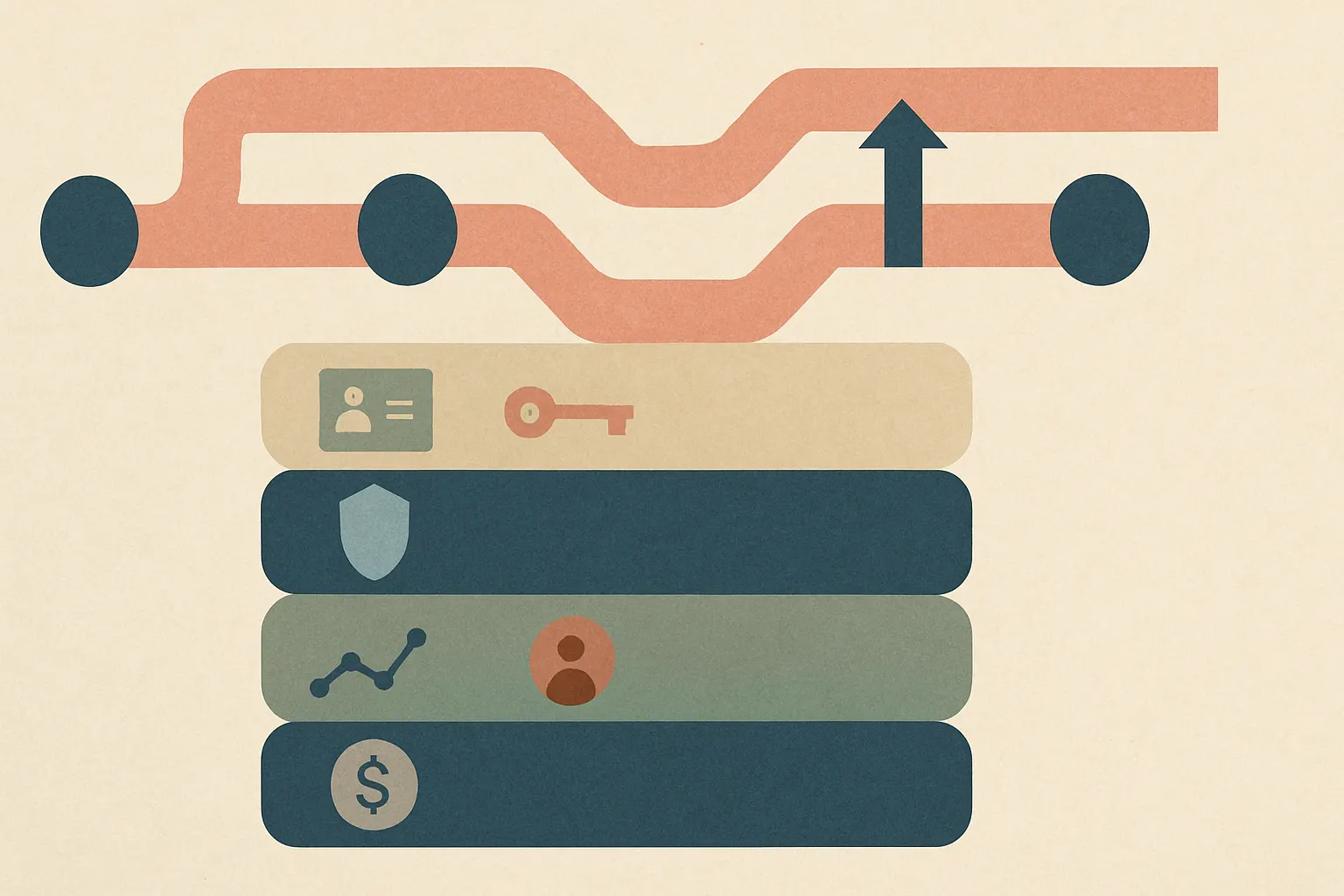
Platform readiness means the boring stuff is in place: identity, scoped permissions, tool registry, secrets management, environment isolation, audit logs, traceability, eval pipelines, and cost controls. If your agent can call tools but you can’t explain exactly what it called, why, and with what result, you don’t have a platform. You have a haunted house.
Here’s a useful gut check: could your security lead, ops lead, and CFO all inspect the same agent run and get answers they trust?
If not, you’re not ready.
This is also why we often push clients toward narrower deployments first — sometimes with custom models, sometimes with tightly scoped AI agents, sometimes with on-device AI or voice AI when latency, privacy, or reliability make cloud-only architectures a bad fit. The right architecture depends on the work. Not the hype cycle.
And yes, cost matters. A lot. Before you let an agent fan out across multiple tools and long-context model calls, estimate the blast radius. We built our AI cost estimator for exactly this reason: teams routinely under-budget agentic systems because they price the model call and ignore retries, tool use, context expansion, and supervision overhead.
That math gets ugly fast.
Here’s what platform readiness should feel like in practice:
Don’t build an “AI team” and call it solved
Another hot take.
A centralized AI team is useful for standards and platform work. It is not, by itself, a solution.
We’ve seen two bad versions of this:
First, the “wizard tower” model. A small AI team becomes the priesthood of prompts and model configs. They’re smart, overloaded, and disconnected from frontline workflow reality. Delivery slows. Trust drops. Business teams start buying random vendor tools on the side.
Second, the “every team does AI” model. Sounds empowering. Usually becomes chaos. Five agent frameworks, no shared evals, inconsistent security, and enough duplicated experimentation to fund a small yacht.
The better pattern is a hub-and-spoke model:
- a central platform and governance group
- embedded workflow owners in business domains
- shared evaluation, security, and runtime standards
- local experimentation inside controlled boundaries
Not sexy. Very effective.
Redesign the workflow before you scale the headcount story
A lot of executive conversations around agents jump straight to labor substitution. We think that’s premature and often dumb.
The first real win is usually not “replace X people.” It’s “remove waiting, handoff friction, and low-value review work.” Agents are often best at compressing the dead space between teams — the status chasing, document summarizing, routing, formatting, lookup, and follow-up work that makes organizations feel slower than they should.
That’s why rethinking organizational design in this context is less about deleting boxes on an org chart and more about redesigning interfaces between teams.
The handoff is the disease.
The agent is often the treatment.
But only if you prescribe it correctly.
A practical blueprint for enterprise agent readiness
If you’re serious, here’s the blueprint we’d use.
1) Pick one workflow with real pain and measurable outcomes
Not a showcase. Not a hackathon toy. Pick something with baseline metrics: cycle time, error rate, cost per case, escalation rate, customer satisfaction, or revenue impact.
If you can’t measure improvement, you’ll end up arguing from vibes.
2) Define the agent’s authority like you’d define a junior employee’s authority
This works shockingly well.
Can it draft? Can it decide? Can it execute? Can it spend money? Can it contact customers? Can it update systems of record?
Write it down. Be specific.
“Assist with support” is useless. “May classify inbound tickets, draft responses, and resolve password reset cases below defined confidence threshold with audit logging” is usable.
3) Build guardrails around actions, not around words
Too many teams obsess over prompt phrasing and ignore action control.
We care less about whether the agent says something slightly awkward and more about whether it can trigger a refund, delete a record, or expose private data. Guardrails should focus on permissions, policy checks, and approval thresholds around tool use.
Words matter.
Actions matter more.
4) Create an eval loop before broad rollout
If you only test agents in staging with happy-path examples, congratulations, you’ve built a demo.
Production agents need offline evals, shadow runs, live monitoring, and failure review. We usually recommend reviewing a sample of traces weekly at minimum during early rollout. Not forever. Just until the system stops surprising you in new and creative ways.
5) Make human escalation part of the design, not a fallback embarrassment
Some teams treat escalation as proof the agent failed.
Wrong.
Escalation is part of the system working correctly. A good agent knows when to stop, ask, or hand off. Designing that boundary well is half the job.
Here’s a simple maturity path:
flowchart LR
  A[Read Only Assistant] --> B[Draft with Human Review]
  B --> C[Scoped Actions with Approval]
  C --> D[Autonomous Actions in Low-Risk Cases]
  D --> E[Broader Autonomy with Continuous Audit]
Most companies should spend longer in the middle than they want to admit.
That’s fine. Better slow than spectacularly stupid.
What leadership actually needs to do
This part gets ignored because it’s less fun than model benchmarks.
Leadership has to decide what kind of organization it wants to be when agents become operators, not just tools. That means setting policy on autonomy, risk tolerance, workflow redesign, and capability building. It also means funding the platform layer that nobody claps for in demos.
If you’re a founder or engineering leader, your job isn’t to ask, “Which model should we use?”
That’s an important question, but it’s not the first one.
Ask this instead: what work are we redesigning, who owns the outcome, and what controls make this safe enough to trust?
Everything else follows from that.
If you need help sorting through that stack — workflow selection, governance, architecture, model strategy, deployment constraints — that’s exactly the kind of work we do in AI consulting. And if you’re already staring at a half-built agent pilot that feels promising but dangerous, contact us. We’ve seen enough of these to know where the bodies are buried.
The companies that win won’t have the flashiest agents
They’ll have the clearest operating model.
That’s the punchline nobody puts on the keynote slide.
The winners won’t just ship agents. They’ll redesign workflows, assign real ownership, build the platform underneath, and treat governance as an enabler instead of a tax. They’ll understand that agentic AI changes coordination costs inside the company, which means the org itself has to change too.
Otherwise you’re just stapling autonomy onto bureaucracy.
And bureaucracy always wins that fight.