


Why LLM Inference Breaks in Production Before GPU Limits Do
Hitesh Sondhi · June 1, 2026 · 12 min read
We’ve seen teams spend weeks obsessing over TFLOPS, KV cache math, and quantization settings — then get punched in the face by something much dumber: queueing, bad batching policy, tokenizer bottlenecks, or a single noisy tenant turning p99 latency into soup.
That’s the dirty secret of LLM serving. In production, inference usually breaks before the GPU is actually “full.”
If you’re evaluating TensorRT-LLM with Triton, that’s the right instinct. But it’s also where people get seduced by benchmark theater. A demo that screams on one prompt shape and one concurrency profile can still fall apart the moment real traffic shows up with uneven sequence lengths, streaming responses, retries, and product managers asking why one customer gets a reply in 700ms while another waits 11 seconds.
We’ve built enough AI systems to have scars here. The pattern is consistent: serving stacks don’t fail because the model can’t generate tokens. They fail because the system around token generation is badly scheduled, badly instrumented, or badly matched to the product.
That’s what these notes on serving llms are really about.
Key Takeaways
- TensorRT-LLM + Triton shines when you care about predictable high-throughput GPU serving, not when you just want the fastest way to get a demo live.
- Your first production bottleneck is often batching, queueing, or [memory pressure](/blog/hidden-43-llm-costs) — not raw GPU compute.
- Latency targets should be split into TTFT, tokens/sec, and p95/p99 under concurrency. “Average latency” is how teams lie to themselves.
- Triton gives you serious control over scheduling and deployment, but it also gives you more ways to hurt yourself.
- If your workload is small, spiky, or still changing weekly, a simpler stack may beat TensorRT-LLM + Triton on engineering efficiency.
First: what LLM serving actually means when money is involved
A lot of content explains “LLM serving” like it’s just exposing a model behind an API. Technically true. Also useless.
In practice, LLM serving means taking a model and making it survive production traffic with acceptable cost, latency, reliability, and observability. That means handling prefill and decode efficiently, managing KV cache, batching requests without making users hate you, streaming tokens, and keeping the whole thing debuggable when performance goes sideways.
The original DEV post on TensorRT-LLM and Triton is a useful starting point because it gets into the mechanics of deployment rather than hand-wavy “AI architecture” diagrams Source.
But here’s our hot take: most teams start optimizing kernels before they’ve even defined the product SLO.
That’s backwards.
If you don’t know whether you care more about time-to-first-token, steady-state decode speed, concurrency, or cost per 1M output tokens, you’re tuning a race car before deciding whether you’re entering Formula 1 or delivering groceries.
Why TensorRT-LLM plus Triton is attractive — and why it bites back
TensorRT-LLM exists to optimize LLM inference on NVIDIA GPUs, and Triton exists to serve models with production-grade scheduling, model management, and backend support Source.
That combination is attractive for a simple reason: when it works, it really works.
You can get strong throughput, good hardware utilization, and a deployment path that looks less like a science project and more like an actual serving platform. If you’re running sustained traffic on NVIDIA infrastructure and your model shapes are reasonably stable, TensorRT-LLM + Triton can beat simpler Python-heavy stacks on efficiency.
But there’s the catch.
It’s not “drop in model, print money.”
You’re dealing with engine builds, backend configuration, batching behavior, memory planning, version compatibility, and operational complexity that can absolutely punish a team that just wanted an inference endpoint. We’ve seen this movie before. The benchmark looked great. The production rollout looked like a kitchen fire.
The real enemy is scheduling, not math
People love talking about model size and quantization because it feels concrete. 8B vs 70B. FP16 vs INT8. Nice clean knobs.
Production pain is messier.
The real problem is that LLM serving is a scheduling problem wearing a GPU costume. Requests arrive with different prompt lengths, different max output lengths, different streaming behavior, and different urgency. If you batch them naively, one giant prompt can hold smaller requests hostage like a guy ordering 14 frappuccinos in front of you at the airport coffee line.
That’s why continuous batching matters so much in modern LLM serving discussions. It helps keep the GPU busy while reducing some of the waste from static batch assumptions. The DEV source touches on practical serving considerations around TensorRT-LLM and Triton, and this is one of the places where the stack can pay off if configured well Source.
Here’s how the production flow usually looks:
flowchart TD
  A[Client Request] --> B[Tokenizer + Validation]
  B --> C[Request Queue]
  C --> D[Dynamic/Continuous Batching]
  D --> E[TensorRT-LLM Engine]
  E --> F[KV Cache Management]
  F --> G[Streaming Tokens via Triton]
  G --> H[Metrics + Traces + Autoscaling Signals]
If you only measure “GPU utilization,” you’ll miss the actual failure mode. You can have high utilization and terrible user experience at the same time.
That’s not success. That’s just an expensive backlog.
The four metrics that actually matter
If you’re serious about production, stop reporting one latency number.
We care about four things:
1. Time to first token
This is what users feel first. If TTFT is bad, the app feels broken even if total generation time is acceptable.
For chat, voice, and copilot-style UX, TTFT is often more important than raw throughput. We’ve seen teams brag about tokens/sec while users are staring at a blank cursor for two seconds. Congratulations on your benchmark, I guess.
2. Decode throughput
Once generation starts, tokens/sec matters. This affects responsiveness, completion duration, and infrastructure efficiency.
TensorRT-LLM can improve this part of the pipeline substantially when the engine is well-optimized and the workload fits the hardware profile Source.
3. Tail latency under concurrency
p95 and p99 are where production truth lives.
A stack that looks brilliant at concurrency 4 can become chaos at concurrency 40, especially with mixed prompt lengths. If you’re not load testing with realistic distributions, you’re not testing. You’re roleplaying.
4. Cost per useful output
Not cost per hour. Not cost per GPU. Cost per successful, acceptable user interaction.
That includes retries, dropped requests, overprovisioning, and the hidden tax of engineering complexity. We often tell clients to use an AI cost estimator before they commit to a serving architecture, because “fastest benchmark” and “best business decision” are very often different things.
Where TensorRT-LLM and Triton beat simpler stacks
Here’s the opinionated version.
TensorRT-LLM + Triton is worth the pain when you have sustained load, NVIDIA GPUs, and enough traffic to justify squeezing real efficiency out of inference. It’s especially compelling when you need better utilization, tighter control over serving behavior, and a path to production operations that isn’t just “hope the Python server survives.”
This setup tends to make sense when:
- You have stable enough model choices to justify engine optimization
- You need high throughput on expensive GPUs
- You care about multi-model or production-grade serving infrastructure
- You want stronger control over batching and deployment behavior
- You have engineers who can own GPU inference as a system, not just as an API
For products like voice AI, response dynamics matter a lot. TTFT and stream smoothness can matter more than maximum throughput. For heavier centralized deployments, Triton’s serving features can be a real advantage. For AI agents, the picture gets weirder because tool calling, longer context, and bursty orchestration traffic can create nasty latency spikes.
And yes, this is where architecture choices stop being abstract.
Here’s a simple mental model:
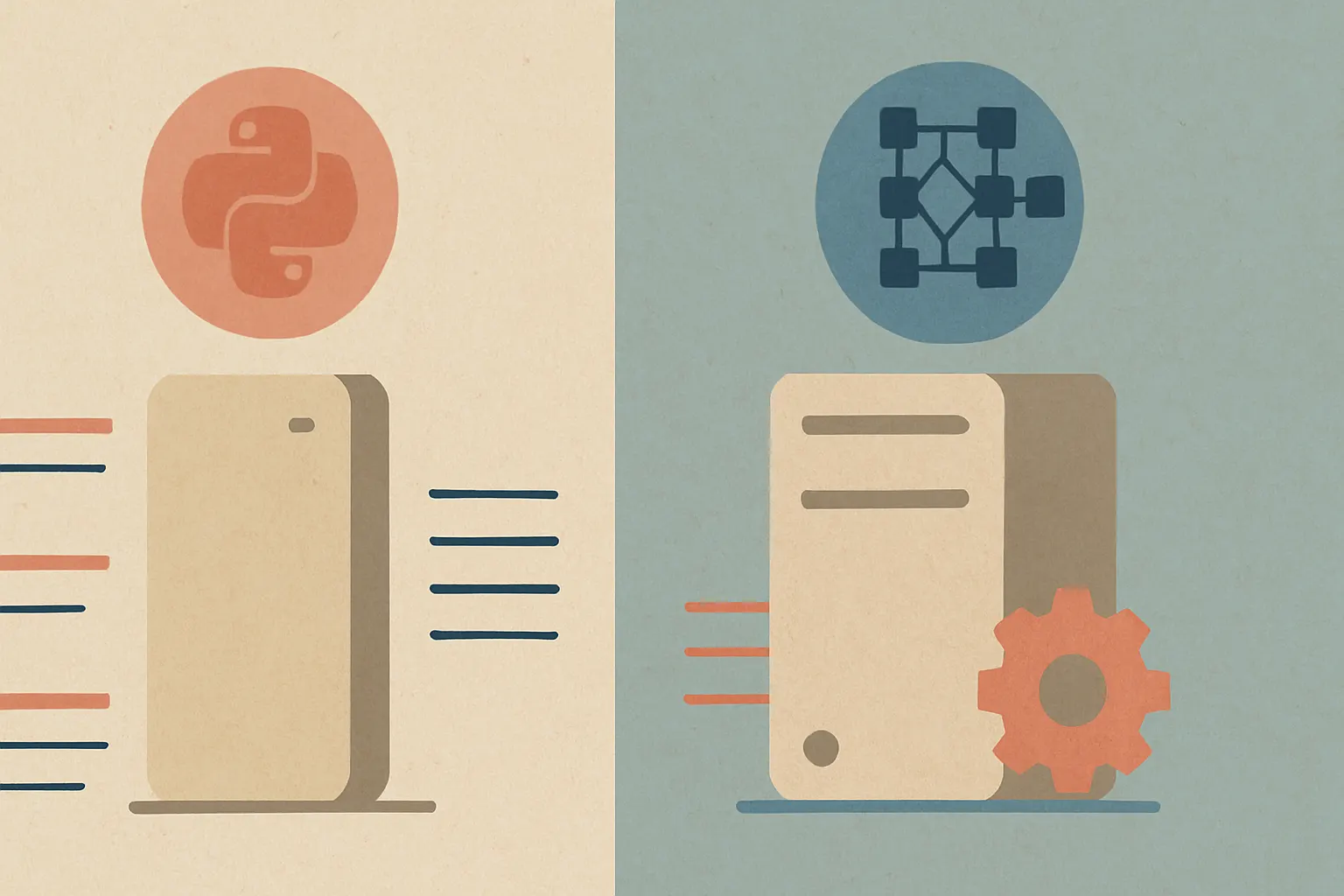
A simpler stack is like a food truck. Fast to launch, flexible, great for testing demand.
TensorRT-LLM + Triton is a commercial kitchen. Better output at scale, but if your team can’t run the kitchen, you’ll burn dinner faster and more expensively.
Where it’s overrated
Hot take: too many teams adopt heavyweight serving stacks before they’ve earned the complexity.
If your traffic is low, your models are still changing, or your product requirements are moving every week, TensorRT-LLM + Triton may be premature optimization with a nicer logo. A simpler serving engine can be the better move because iteration speed matters more than squeezing another chunk of throughput from the same GPU.
We’ve seen this with early-stage products and internal tools. The team wanted “production-grade inference infra.” What they actually needed was to validate whether users even cared about the feature.
Bad trade.
If you’re still figuring out prompts, model choice, output shape, and user interaction design, don’t build the inference equivalent of an airport before you know whether you need a runway or a bicycle rack.
But that’s only half the problem.
The hidden production traps nobody puts in the benchmark chart
Benchmarks are usually clean-room fiction. Production isn’t.
Here are the traps that matter more than most blog posts admit:
Tokenization and pre/post-processing overhead
If your tokenizer path is slow or serialized badly, your GPU can sit around waiting while the CPU does paperwork. That’s deeply stupid, and it happens all the time.
KV cache blowups
Long contexts and high concurrency can turn memory planning into a knife fight. Your model may “fit” on paper and still fail under real request distributions because cache behavior gets ugly fast.
Mixed workloads
One endpoint doing short chat completions and long-form generation is a recipe for queue contention. Separate them unless you enjoy chaos.
Bad batching policy
Aggressive batching can improve throughput while wrecking TTFT. Conservative batching can protect interactivity while leaving money on the table. There’s no universal right answer. There’s only what matches your product.
Streaming lies
Teams say they support streaming, but what they really mean is “we flush awkwardly after a giant prefill delay.” Users notice.
Weak observability
If you can’t break latency into queue time, prefill time, decode time, and stream duration, you’re debugging with a blindfold on.
Here’s a practical production split we like to instrument:
sequenceDiagram
  participant U as User
  participant G as API Gateway
  participant T as Triton
  participant E as TensorRT-LLM Engine
  U->>G: Prompt
  G->>T: Validated request
  T->>T: Queue + batch scheduling
  T->>E: Prefill
  E-->>T: First token
  T-->>U: Stream starts
  E-->>T: Decode tokens
  T-->>U: Stream continues
That breakdown tells you where the pain actually is.
Without it, teams blame the GPU for sins committed by the queue.
How we’d choose the stack in the real world
If you asked us whether to use TensorRT-LLM + Triton, we wouldn’t answer from ideology. We’d answer from workload.
We’d ask:
- What’s the target TTFT and p99?
- Is traffic bursty or steady?
- Are prompts short and chatty, or long and document-heavy?
- Do you need streaming?
- How often will the model change?
- Are you optimizing for engineering speed, infra cost, or both?
- Does the team know how to operate GPU inference in production?
If the workload is centralized, GPU-heavy, and stable enough to optimize, we’d seriously consider TensorRT-LLM + Triton.
If the workload is edge-oriented or device-constrained, we’d look at a different serving shape entirely. That’s a different sport. For some products, on-device AI is the better answer because network and privacy constraints dominate everything else. Our work on RunHotel pushed us hard into that reality: not every inference problem wants a giant centralized serving stack.
And if the team just needs to move fast and learn, we’d probably start simpler, then graduate when the bottlenecks are real instead of hypothetical.
That’s not cowardice. That’s engineering.
Practical deployment guidance that saves pain
A few blunt recommendations:
Start with SLOs, not architecture diagrams
Define acceptable TTFT, p95, p99, and throughput before tuning anything. If you skip this, every optimization discussion becomes religious.
Benchmark with ugly traffic
Use realistic prompt length distributions, output lengths, concurrency spikes, and streaming behavior. Synthetic uniform loads are comforting nonsense.
Isolate workloads
Separate interactive chat from long-generation jobs. Shared queues are where good latency goes to die.
Instrument queue time separately
If queue time isn’t visible, you’ll misdiagnose half your incidents.
Treat GPU utilization as a secondary metric
High GPU utilization with bad tail latency is failure wearing a KPI costume.
Don’t marry one model too early
If you’re still exploring model behavior, use a serving path that preserves flexibility. Save heavy optimization for when the workload has settled. That’s especially true for teams building custom models or experimenting with agent workflows.
Get help if this isn’t your core competency
This stack is powerful, but it’s not forgiving. If your team is trying to ship product and also become accidental GPU kernel archaeologists, outside AI consulting can be cheaper than learning through outages.
So, when should you use TensorRT-LLM and Triton?
Use it when inference is a real production system for you, not a side feature.
Use it when GPU efficiency, throughput, and serving control are worth engineering complexity.
Use it when you have enough traffic and enough stability to justify optimization.
Don’t use it because a benchmark chart made you feel inadequate.
If you’re working through these tradeoffs now, we can help you choose the boringly correct architecture instead of the flashy wrong one. See our work in AI agents, voice AI, and production AI systems, or just contact us and tell us what’s breaking.
Because something always is.