

Why Multi-Agent AI Inference Queues Collapse Under Load
Hitesh Sondhi · May 17, 2026 · 13 min read
We once watched a perfectly decent multi-agent demo turn into a small fire in under 20 minutes.
Eight agents. Two GPUs. One orchestrator. Everything looked fine in staging. Then real traffic hit, one “planner” agent started spawning retrieval and tool-calling jobs like a toddler smashing elevator buttons, and our p99 latency went from “pretty good” to “are we down?” The queue length kept growing, GPU utilization looked high, and yet users were getting slower answers. That combo is usually a bad sign. It means your system is busy, not productive.
This is the dirty secret of multi-agent AI systems: they don’t fail gracefully. They fail like a restaurant that keeps seating tables after the kitchen is already drowning.
And if you’re building this stack in Python alone, we’ll say it plainly: that’s often where the pain starts.
Key Takeaways
- Multi-agent systems collapse under load because they amplify queue contention, not because your GPU is “too small.”
- High GPU utilization can be a lie if batching, scheduling, and backpressure are wrong.
- The fastest fix usually isn’t a bigger model server — it’s better admission control and smarter queue design.
- Hot take: most teams should spend more time on schedulers than prompts.
rust concurrency for aimatters here because queue coordination, cancellation, and backpressure are exactly where memory safety and predictable concurrency pay off.
Why “More Agents” Usually Makes the Queue Worse
A single-agent pipeline is already annoying enough. You’ve got tokenization, retrieval, reranking, model inference, post-processing, maybe a tool call, and some streaming logic duct-taped together with optimism.
Now add multiple agents.
One agent plans. Another retrieves. Another critiques. Another calls tools. Another summarizes. Suddenly one user request isn’t one inference job anymore — it’s 6, 12, sometimes 30 smaller jobs with dependencies and wildly different latency profiles. That’s not a pipeline. That’s airport traffic during a thunderstorm.
Here’s where it gets weird.
Your GPU queue usually assumes jobs are mostly independent and roughly similar in cost. Multi-agent workloads break both assumptions. A short classification pass might sit behind a giant context-heavy generation request. A critical planner step can get blocked by ten low-priority summarizers. One user’s request can monopolize the queue because their agent graph fans out like crazy.
That’s how collapse starts.
The Real Bottleneck Isn’t Always Compute
NVIDIA has been very clear that throughput depends heavily on batching and request scheduling, not just raw hardware NVIDIA Triton Inference Server Documentation and NVIDIA TensorRT-LLM Documentation. The model server can be technically “busy” while doing a terrible job serving user-perceived latency.
We’ve seen this in production: GPU utilization looked healthy, but the queue was full of mismatched work. Long generations blocked short control inferences. Tool-calling agents kept retrying because upstream timeouts created duplicate work. The orchestrator was basically DDOSing its own inference layer.
That’s not a GPU problem. That’s a systems problem.
And systems problems don’t care how pretty your benchmark slides are.
Why Your Inference Queue Is Lying to You
Most teams track queue depth, average latency, maybe tokens per second. Fine. Helpful. Not enough.
A collapsing multi-agent system usually shows up first in second-order effects:
- queue age for “small” jobs starts rising
- cancellation rate increases because downstream dependencies expire
- retries create synthetic load
- batch efficiency drops because urgent jobs cut the line
- tail latency explodes while median looks acceptable
Median latency is a comforting lie.
If your p50 is 900ms and your p99 is 19 seconds, your users don’t care that the dashboard is mostly green. They care that every tenth request feels broken.
Here’s a simple mental model for what’s happening:
flowchart TD
  A[User Request] --> B[Planner Agent]
  B --> C[Retriever Agent]
  B --> D[Tool Agent]
  C --> E[GPU Queue]
  D --> E
  B --> E
  E --> F[Generation Output]
  F --> G[Critic Agent]
  G --> E
  E --> H[Final Response]
One request enters. Multiple GPU-bound steps pile into the same queue. Some of them spawn more work. Congratulations — you’ve built a feedback loop.
The Four Failure Modes We See Over and Over
1. Fan-Out Without a Budget
This one is common and ugly. The planner agent decides to call five tools, run three retrieval passes, and ask a critic to verify everything. Great for a benchmark. Terrible for production.
If every incoming request can expand into an unbounded number of sub-requests, your queue isn’t a queue anymore. It’s a hostage situation.
Set a per-request compute budget. Hard cap agent fan-out. If a task can’t justify another inference hop, it doesn’t get one.
We’ve found this matters more than shaving a few milliseconds off kernel execution.
2. FIFO Scheduling Is Too Dumb for Multi-Agent Workloads
First-in, first-out sounds fair. It’s also how you let a giant 12k-token generation block a tiny 40-token routing decision that 50 other requests are waiting on.
FIFO works when jobs are similar. Multi-agent inference jobs are not similar.
You need priority classes. Usually something like:
- control-path jobs: planner, router, critic gates
- user-visible generation jobs
- background or speculative jobs
- retries and low-value recomputations
If you don’t separate these, your critical path gets buried under junk.
Hot take: FIFO for multi-agent inference is the default because it’s easy, not because it’s good.
3. No Backpressure Between Orchestrator and GPU Workers
This is the classic “the producer never got the memo” bug.
Your agent orchestrator happily keeps spawning tasks because from its point of view, sending a request is cheap. The GPU worker, meanwhile, is drowning. Without backpressure, the orchestrator behaves like a manager who solves warehouse delays by ordering more trucks into a traffic jam.
This is where rust concurrency for ai becomes more than a trendy phrase. Backpressure, bounded channels, cancellation propagation, and ownership of shared state are exactly the kind of things Rust handles with less drama than Python thread soup. We’ve seen teams bolt together async Python systems that work fine until cancellation races and queue leaks show up under load. Then it gets expensive.
4. Batching That Optimizes Throughput and Wrecks Latency
Dynamic batching is useful. It’s also easy to abuse.
The bigger the batch window, the better your throughput can look — until urgent work waits too long to be grouped. For multi-agent systems, this gets nasty because some requests are tiny but latency-critical, while others are huge and throughput-oriented.
Think of it like public transport. A bus that waits until every seat is full is efficient on paper. It’s also infuriating if you’re trying to get to the hospital.
Use separate queues or batch policies by job class. Don’t force planner decisions to wait behind bulk summarization.
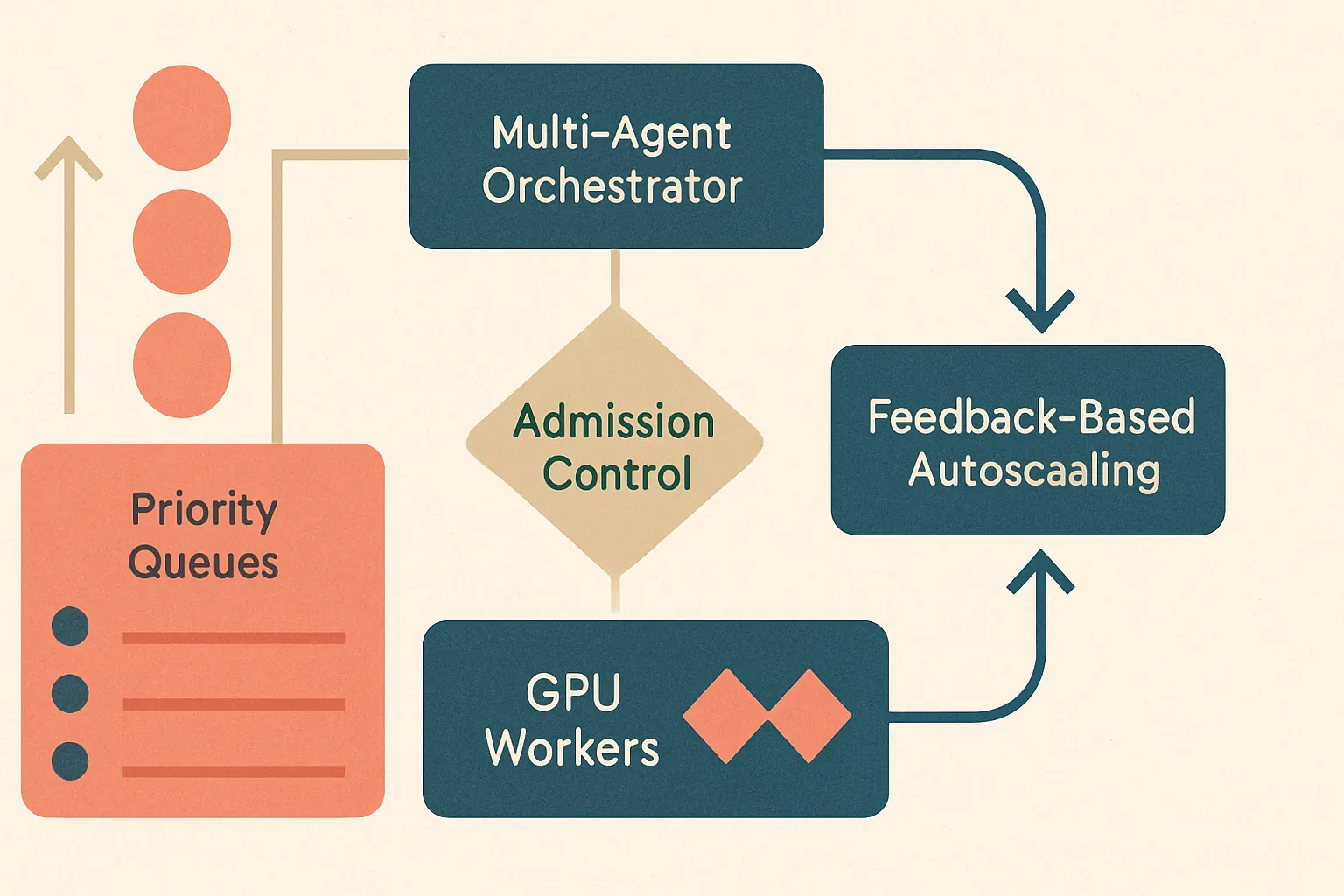
Before we talk fixes, here’s the architecture pattern we recommend most often:
What Actually Works in Production
There’s no silver bullet, which is annoying but true. What works is a pile of boring, disciplined controls.
Admission Control First, Autoscaling Second
A lot of teams reach for autoscaling immediately. That’s understandable. It feels like action.
It’s also often the wrong first move.
If your system allows unbounded fan-out and duplicate retries, autoscaling just helps you fail at a larger monthly cloud bill. We prefer admission control first: reject, defer, downgrade, or simplify work before it hits the GPU.
For example:
- drop speculative critic passes under high load
- route low-priority jobs to smaller models
- cap concurrent sub-agents per user request
- disable expensive tools when queue age crosses a threshold
This is exactly the kind of decision logic we build in AI agents systems when clients need something that survives real traffic, not just demo day.
Split Queues by Job Type
Don’t put every inference request into one giant bucket.
At minimum, separate:
- short control inferences
- long-form generations
- embedding/reranking workloads
- retries or background jobs
These workloads have different service-level expectations and different batching behavior. Treating them as one class is like putting ambulances, school buses, and cement trucks in the same lane and hoping manners will sort it out.
They won’t.
Use Deadlines, Not Just Priorities
Priority alone is crude. Deadlines are better.
A planner step that arrives later may still be more urgent than a summary job that’s been waiting longer. Deadline-aware scheduling helps avoid wasting GPU cycles on work whose downstream consumer has already timed out or moved on.
This is another place where rust concurrency for ai is genuinely useful. Deadline propagation, cancellation tokens, bounded work queues, and efficient state machines are much easier to reason about when the compiler refuses to let you be sloppy. That doesn’t make Rust magical. It just makes certain classes of production bugs less likely.
And in queueing systems, “less likely” is worth money.
Why We Keep Reaching for Rust in the Control Plane
We’re not saying you need to rewrite your model stack in Rust tomorrow. That would be a weird religion, and we’re not starting one.
But for the control plane — schedulers, queue managers, cancellation propagation, request accounting, circuit breakers — Rust is often a very practical choice. The Rust community and industry writing around AI keeps pointing to the same strengths: memory safety, explicit concurrency, and predictable performance for parallel workloads Springer Nature Link and The Rust Programming Language Book, Concurrency.
Python is still great for model experimentation. We use it constantly. But when you’ve got 400 concurrent user sessions, each spawning agent graphs with deadlines and retries, “mostly fine” async code becomes a liability.
That’s why rust concurrency for ai keeps coming up in serious systems discussions. Not because it’s fashionable. Because queue collapse is usually a coordination problem, and coordination bugs are where unsafe assumptions go to multiply.
If you’re doing hybrid stacks, Rust + Python can be a very sane split: Python for model logic, Rust for orchestration and performance-critical concurrency. PyO3 is a common bridge here PyO3 User Guide.
A Practical Queue Design We Actually Like
Here’s the shape of a system that tends to survive:
- The orchestrator assigns every sub-task a class, deadline, and cost estimate.
- Admission control checks current queue age and per-request budget.
- Tasks enter bounded priority queues, not one global queue.
- GPU workers pull with fairness rules, not raw FIFO.
- Cancellation propagates aggressively when upstream steps fail or expire.
- Metrics track queue age by class, not just overall depth.
- Load shedding kicks in before the system starts timing out.
Simple. Not easy.
Here’s how that flow looks:
flowchart LR
  A[Agent Orchestrator] --> B[Admission Control]
  B --> C[Priority Queue: Control]
  B --> D[Priority Queue: Generation]
  B --> E[Priority Queue: Background]
  C --> F[GPU Scheduler]
  D --> F
  E --> F
  F --> G[Inference Workers]
This isn’t glamorous architecture. It’s the plumbing. But bad plumbing ruins nice houses too.
Metrics That Matter More Than GPU Utilization
If you only track utilization, tokens/sec, and request count, you’re driving with half a windshield.
Track these instead:
- queue age by job class
- expired work percentage
- retry-generated load vs original load
- cancellation propagation success rate
- per-request fan-out count
- useful tokens/sec, not just raw tokens/sec
- p95 and p99 latency by agent stage
Useful tokens/sec is our favorite ugly metric. If your system generates lots of tokens for work that gets canceled, superseded, or discarded, your throughput number is vanity.
Vanity metrics are how bad architectures get promoted.
For teams also trying to control spend, this ties directly into cost planning. If you’re estimating infrastructure for multi-agent workloads, our AI cost estimator is a decent place to start before the queue starts eating your margins.
Where On-Device and Voice Systems Make This Even Harder
If you’re deploying on-device AI or voice AI, the queueing problem changes shape but doesn’t disappear.
On-device systems have tighter memory and thermal constraints. Voice systems care brutally about turn-taking latency. A 700ms delay in a chat app is annoying. A 700ms delay in speech feels like the assistant forgot your name mid-conversation.
We’ve seen this clearly in systems like RunHotel, where voice interactions have to feel immediate and dependable. In those environments, queue discipline matters even more because the user notices hesitation instantly. You don’t get to hide behind a spinner.
And if your workload really needs model specialization, custom models can reduce queue pressure by shrinking context sizes or offloading narrow tasks to smaller, faster models. Bigger models aren’t always smarter system design.
Usually they’re just bigger.
FAQ
Frequently Asked Questions
Why do multi-agent AI systems create more queue pressure than single-agent systems?
Because one user request often expands into many dependent inference jobs. Planning, retrieval, tool use, critique, and summarization all compete for the same GPU resources unless you separate them.
Is high GPU utilization a good sign?
Not always. High utilization can mean your GPU is busy doing useful work, or it can mean it’s buried under badly scheduled requests and wasted retries. You need queue-age and tail-latency metrics to tell the difference.
When should we use Rust for inference infrastructure?
Use Rust when concurrency, safety, and predictable performance matter in the control plane. rust concurrency for ai is especially relevant for schedulers, queue managers, cancellation propagation, and services where Python async complexity starts causing production incidents.
Should we solve queue collapse by adding more GPUs?
Sometimes, but not first. If your scheduling, fan-out control, and admission logic are broken, more GPUs just increase the burn rate while preserving the same architectural mistake.
What’s the best first fix for a collapsing inference queue?
Add admission control and split queues by job type. That usually gives faster, cheaper wins than tuning kernels or scaling hardware immediately.
If You’re Building This Now, Do This Next
Start by instrumenting queue age by job class and fan-out per request. If you can’t see which agent behaviors are flooding the GPU, you’re guessing.
Then cap fan-out, add bounded queues, and stop pretending FIFO is good enough.
If you want help designing the orchestration layer, debugging queue collapse, or deciding where Rust belongs in your stack, talk to us through AI consulting or contact us. We’ve stepped on enough rakes here that you don’t have to.
Because when multi-agent systems fail, they don’t fail like software.
They fail like a kitchen printer that never stops screaming.