
How to scope an AI proof of concept for production
Hitesh Sondhi · May 12, 2026 · 12 min read
We’ve seen this movie too many times: a team builds a flashy demo in 10 days, everyone claps, the CEO says “ship it,” and six weeks later the thing is timing out, hallucinating, and quietly eating cloud budget like a labrador left alone with an open bag of food.
That’s the dirty secret of the average ai proof of concept. It’s not a proof of concept. It’s a proof that a smart engineer can make a nice demo under ideal conditions.
Production is where the lies get exposed.
If you want an AI system that survives contact with real users, bad inputs, compliance reviews, and finance asking why inference costs doubled, you have to scope the PoC differently from day one. Not bigger. Not fancier. Just less delusional.
Key Takeaways
- Scope the business decision, not the model demo.
- If you can’t define success in numbers before building, your PoC is already drifting.
- Data quality and operational constraints kill more AI projects than model quality does.
- A production-worthy PoC must test failure modes, latency, cost, and ownership — not just accuracy.
- The best PoC is often boring on purpose. Boring is what survives.
Most AI PoCs fail before a single model call
The biggest mistake we see is starting with the technology.
“We want an AI chatbot.” “We want an agent.” “We want voice.” “We want computer vision.”
Fine. And we want six-pack abs without giving up dessert. The point is: that’s not a problem statement.
A real ai proof of concept starts with a narrow business decision that currently hurts. Think: “reduce average hotel front-desk call load during peak check-in hours” or “cut manual invoice classification time for the finance team.” Something painfully specific. Something a skeptical operator would care about.
At Cropsly, when we work on AI consulting engagements, the first useful conversation is usually not about models at all. It’s about bottlenecks, ugly workflows, and where humans are wasting time doing repetitive nonsense.
That’s where the value is hiding.
Scope ruthlessly or prepare for a very expensive science fair
A good PoC is small. A bad PoC is “small” in the way a wedding budget is “just a few line items.”
Here’s our hot take: most first-phase AI agent projects are wildly overscoped. Teams try to prove retrieval, orchestration, tool use, memory, analytics, multilingual support, admin controls, and human handoff in one shot. That’s not a PoC. That’s three quarters of a product roadmap wearing a fake mustache.
We tried this kind of breadth years ago on early conversational systems. It was a mistake. Too many moving parts means when something breaks, you don’t know whether the issue is prompt design, retrieval quality, bad source data, tool latency, or the model just having a weird day.
You want one painful workflow. One user type. One success metric. One fallback plan.
Here’s a simple way to think about it: scoping an AI PoC is like packing for a weekend hike. If you bring the espresso machine, cast-iron pan, and three jackets “just in case,” you’re not prepared. You’re carrying junk uphill.
Start with the business problem, then define the kill criteria
Before architecture, before vendor selection, before anyone says “multi-agent,” write down four things:
- The exact business problem
- The user who feels it
- The measurable success metric
- The reason you’ll kill the project if it doesn’t work
That last one matters more than people admit.
A PoC without kill criteria becomes undead software. Nobody loves it, nobody trusts it, but it keeps shambling through sprint planning because too much has already been spent. We hate those projects. They drain morale.
A useful example:
- Problem: support team spends too much time answering repetitive order-status questions
- User: customer support agents handling tier-1 requests
- Success: deflect 25% of repetitive tickets while maintaining CSAT parity
- Kill criteria: if hallucination rate exceeds acceptable threshold or deflection only works with heavy manual supervision, stop
That’s a PoC with teeth.
Here’s how the decision flow should work:
flowchart TD
  A[Business pain identified] --> B[Choose one narrow workflow]
  B --> C[Define success metric and kill criteria]
  C --> D[Assess data and operational constraints]
  D --> E[Build limited PoC]
  E --> F[Test with real users and bad inputs]
  F --> G{Meets business + technical bar?}
  G -- Yes --> H[Plan production architecture]
  G -- No --> I[Kill, pivot, or rescope]
Simple beats clever.
Why your data readiness matters more than your model shortlist
This is where a lot of “AI strategy” decks fall apart.
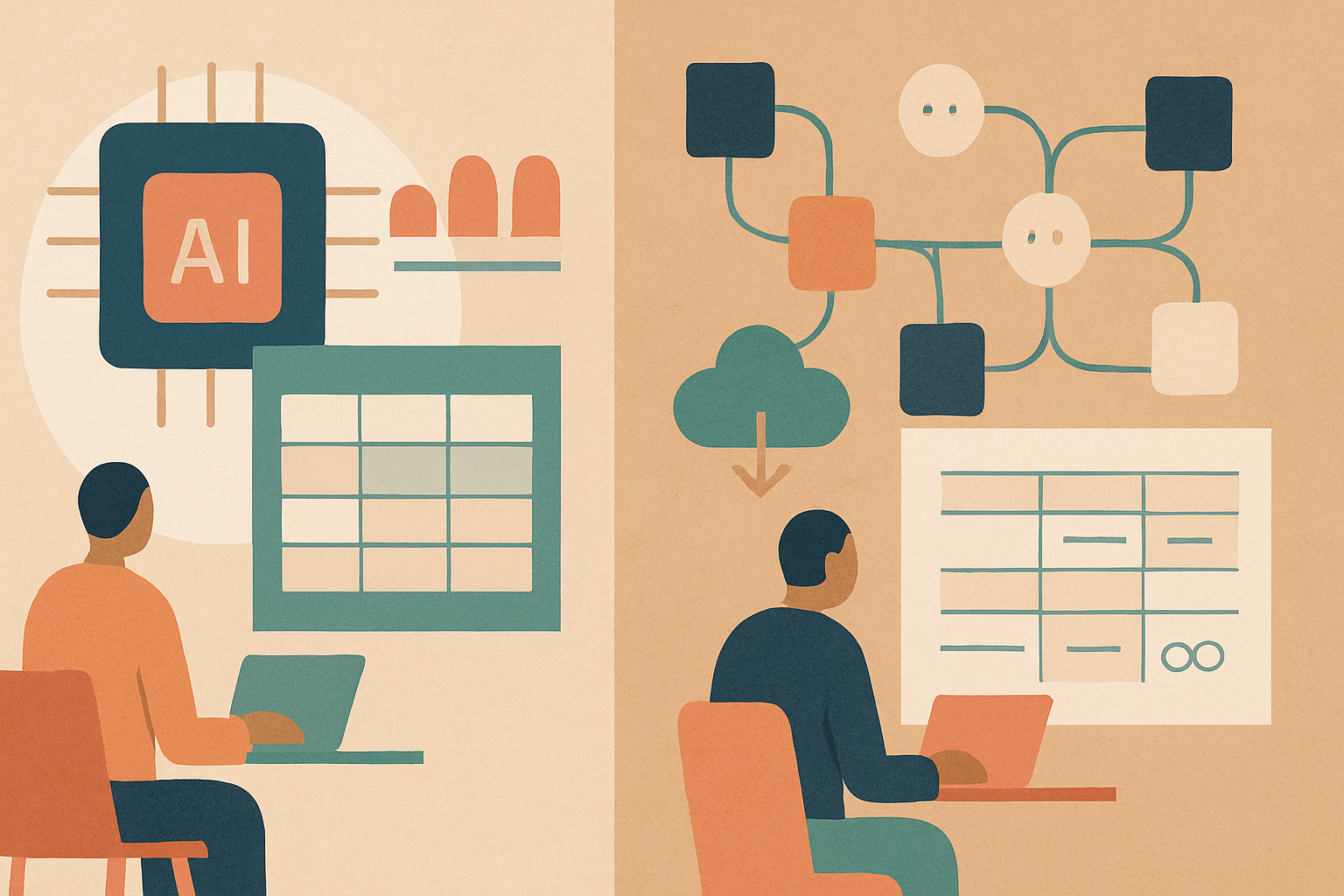
Teams obsess over whether to use GPT, Claude, Gemini, Qwen, Mistral, or some custom fine-tuned model, while their underlying data is duplicated, stale, unlabeled, inaccessible, or trapped in a vendor system that exports CSVs like it’s 2009. The model isn’t the fire. It’s the smoke.
According to Gartner, poor data quality costs organizations an average of $12.9 million per year Gartner. That stat gets quoted a lot because it stings, and because everyone who’s touched enterprise data believes it immediately.
If your PoC depends on pristine documents, perfectly tagged conversations, or APIs that rate-limit every third call, you need to test those constraints in the PoC itself. Not later. Later is where budgets go to die.
We’ve found that a mediocre model with clean, accessible, well-structured context often beats a stronger model fed garbage. That’s not romantic, but it’s true.
Here’s what that looks like in practice:
Don’t just test “can it work?” Test “what breaks first?”
This is the difference between a lab demo and a production-minded ai proof of concept.
A serious PoC should answer questions like:
- What happens with incomplete input?
- What’s the fallback when confidence is low?
- What’s the p95 or p99 latency under realistic load?
- What does each successful task cost?
- Who monitors failures?
- Can a human override bad output quickly?
- What data can’t leave the device, region, or tenant boundary?
If you skip these, you’re not reducing risk. You’re hiding it.
For example, in voice systems, happy-path demos are easy. Quiet room, clear accent, stable network, short query. Great. Now try a noisy lobby, overlapping speakers, weak Wi‑Fi, and a guest asking for late checkout in the middle of three unrelated sentences. That’s the actual exam.
That’s exactly why production-minded voice projects often need different architecture than the demo version. In some cases, on-device AI or hybrid inference is the only sane choice. In others, central inference is fine, but only if you’ve measured the tradeoff honestly.
And yes, we’re opinionated here: if latency, privacy, or connectivity are core constraints, pretending they’re “phase two concerns” is bad engineering.
Pick the smallest architecture that can prove the hard part
A lot of teams build the architecture they wish they had, not the architecture they need to answer the PoC question.
That’s how you end up with vector databases, event buses, orchestration layers, observability stacks, and three different model providers before you’ve validated whether users even want the thing. It’s like buying a restaurant-grade kitchen to find out nobody likes your pasta.
For many PoCs, the right stack is painfully modest:
- one model
- one retrieval source
- one workflow
- one feedback loop
- one dashboard for evaluation
That’s enough.
If the hard part is domain accuracy, focus on retrieval and evaluation. If the hard part is low-latency interaction, focus on model size, streaming, and infrastructure. If the hard part is task completion across tools, then maybe you need AI agents. But don’t force an agentic architecture into a problem that’s really just search plus formatting.
Hot take: “agent” is now the most overused word in enterprise AI. Half the time people want a deterministic workflow with two API calls and a confidence threshold.
Success metrics should be boring, measurable, and slightly annoying
If your PoC success metric is “users liked it,” you’re in trouble.
You need numbers. Not vanity numbers either. Real operational numbers.
Depending on the use case, that could be:
- task completion rate
- deflection rate
- first-response time
- average handle time reduction
- extraction accuracy on messy documents
- escalation rate
- p95 latency
- cost per successful interaction
- human review rate
The National Institute of Standards and Technology has been pushing rigorous evaluation and risk management for AI systems through its AI Risk Management Framework NIST AI RMF. Good. Because “it looked promising in the demo” is not a measurement strategy.
We usually tell clients to define one primary metric, two guardrail metrics, and one operational metric.
Example:
- Primary: 30% reduction in manual triage time
- Guardrails: less than 3% critical misclassification rate, no increase in customer complaints
- Operational: under 2.5 seconds median response time
That’s enough to make decisions without drowning in dashboards.
But that’s only half the problem.
If nobody owns the system after the PoC, don’t build it
This one gets ignored because it’s awkward.
Who owns prompt updates? Who checks drift? Who reviews bad outputs? Who decides whether a model upgrade is safe? Who gets paged when the vendor API starts returning nonsense at 2 a.m.?
If the answer is “the innovation team, probably,” you don’t have a production path. You have a temporary exhibit.
We’ve seen PoCs die not because the model was weak, but because there was no operational owner. No team wanted the maintenance burden. No one budgeted for evaluation. Legal had unresolved concerns. Security wanted auditability the prototype never considered.
That’s why production scoping includes governance and handoff from the start. Not in a giant enterprise-theater document. Just enough clarity so the system has a future.
If you’re exploring something more specialized like voice AI, custom models, or a productized on-device experience like RunHotel, ownership matters even more because the operational footprint is different from a simple internal text assistant.
Budget for inference before finance ruins your Friday
A PoC that “works” at 20 requests a day can become absurd at 20,000.
Inference cost is where optimism goes to get slapped. Token-heavy prompts, repeated retrieval, oversized models, verbose outputs, and unnecessary tool calls stack up fast. We’ve seen teams discover too late that their elegant architecture was basically a money printer running in reverse.
OpenAI’s pricing, Anthropic’s pricing, and every other provider’s pricing pages exist for a reason. You should model rough economics before you celebrate. If you want a quick sanity check, use our AI cost estimator.
And if your use case has strict privacy or latency requirements, compare cloud cost against on-device AI or hybrid deployment early. Don’t assume cloud-first is automatically cheaper. Sometimes it is. Sometimes it absolutely isn’t.
A practical scope for an AI proof of concept that can survive production
If you want the short version, here’s the scope we’d recommend for most teams:
1. Pick one narrow workflow
Not a department. Not a platform. One workflow with clear pain.
2. Define success before building
One business metric, two guardrails, one operational metric.
3. Audit data reality
Where does the data live, how messy is it, who owns it, and what can legally be used?
4. Design the fallback path
When the AI is unsure, what happens? Human review, deterministic rules, escalation?
5. Test under ugly conditions
Bad inputs, realistic load, edge cases, latency spikes, incomplete context.
6. Measure cost and operability
Can you afford it, monitor it, and maintain it without heroic effort?
7. Decide fast
Scale, pivot, or kill. Don’t let the PoC become a haunted house everyone avoids.
That’s a real ai proof of concept. Small enough to learn. Sharp enough to matter.
FAQ
What is an AI proof of concept?
An AI proof of concept is a small, focused experiment to test whether an AI solution can solve a specific business problem under realistic constraints. The key word is “focused” — if it tries to prove everything, it usually proves nothing.
How long should an AI PoC take?
Usually 4 to 10 weeks is plenty for a meaningful PoC. If you’re still “exploring” after that without hard metrics, the scope is probably bloated or the ownership is fuzzy.
What should an AI PoC include to be production-ready?
It should include business metrics, data validation, failure handling, latency and cost measurement, and a clear ownership plan. Accuracy alone isn’t enough.
What’s the biggest mistake in scoping an AI PoC?
Starting with a technology idea instead of a business bottleneck. “We need an agent” is not a scope. It’s a vibe.
Should we use off-the-shelf models or custom models for a PoC?
Usually start with off-the-shelf unless domain specificity, privacy, or deployment constraints make that unrealistic. If those constraints are central, it’s worth exploring custom models earlier.
The PoC should earn the right to become a product
That’s the standard.
Not “the demo looked cool.” Not “leadership is excited.” Not “we already announced it internally.” The PoC has to earn the right to survive production by proving value under real constraints.
If you’re scoping one now, keep it narrow, measurable, and slightly boring. Boring is good. Boring ships.
And if you want help scoping an AI system that won’t collapse the moment real users touch it, talk to us through AI consulting or contact us. We like messy problems.
Probably because we’ve cleaned up enough disasters to know where the bodies are buried.