


From Hidden Representations to Practical Debugging: Applying Anthropic's Interpretability Tools in MLOps
Hitesh Sondhi · October 15, 2026 · 8 min read
A model passes every eval in staging. It ships to production. Three days later, support tickets pile up because the model is silently reasoning about user intent in ways no test suite covered. The logs show the input and the output. Everything in between is a black box.
That gap between what you can observe and what the model is actually doing internally is where most production AI failures live. And until recently, we didn't have tools that could peer into that space with any rigor.
Key Takeaways
- Anthropic's J-space discovery proves models maintain hidden intermediate reasoning that standard logging and eval suites miss entirely
- The Jacobian lens technique can be adapted for out-of-distribution detection and silent failure mode identification in production models
- You don't need Claude-scale infrastructure to start building interpretability diagnostics into your validation pipeline
- The biggest ROI isn't understanding every neuron, it's catching the specific failure modes that slip through conventional testing
What Anthropic Found Inside Claude
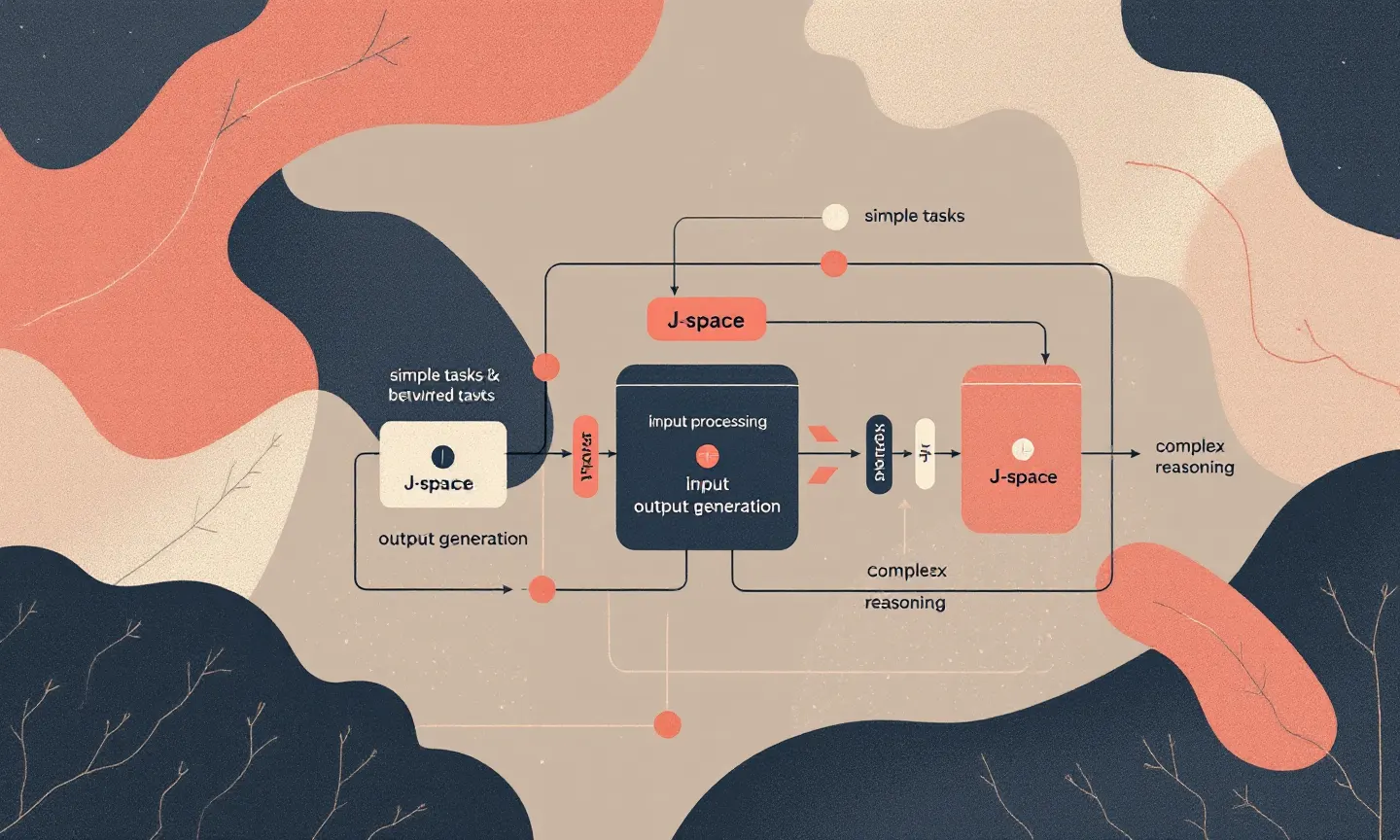
When Anthropic found a hidden internal workspace inside Claude using a tool called the Jacobian lens, the implications for production ML systems were immediate. They named this space J-space, after the Jacobian mathematical technique the lens relies on. This isn't just another transformer layer. What they found is a zone where the model holds intermediate thoughts, a global workspace where deliberate reasoning appears to happen. MIT Technology Review
For those of us building production systems, the critical finding is this: when researchers interfered with this J-space, Claude could still perform simple tasks like retrieval and classification. But complex reasoning broke down. That separation matters. That tells us the model has a distinct internal pathway for multi-step reasoning that operates independently from its basic pattern-matching capabilities.
Think of it like a kitchen. A prep station can chop vegetables all day without the head chef being involved. Yet when you need to invent a new dish from scratch, the chef has to be present and thinking. If the chef is distracted, the prep station keeps working but the creative output falls apart.
Why Hidden Representations Break Your Validation Pipeline
Most MLOps validation pipelines test inputs and outputs. You send a prompt, check the response against expected results, and move on. This works for classification and retrieval. It completely misses reasoning failures.
When a model routes through its internal workspace to deliberate over a concept, the output might look correct on the surface but be built on flawed intermediate reasoning. Your eval passes. Your users get subtly wrong answers. Nobody notices until the damage is done.
We've seen this firsthand. A client's custom model deployment was passing the vast majority of automated evals but producing answers that domain experts flagged as wrong in ways that suggested the model was reasoning itself into a corner. This model wasn't hallucinating facts. Rather, the model was reaching correct conclusions through broken logic paths that would fail on edge cases.
Standard logging showed the prompt and the response. Both looked fine. Our problem lived in the space between, exactly where J-space research points.
From Research Tool to OOD Detection
Jacobian lens analysis works by examining how perturbations to the model's internal representations propagate through subsequent layers. In practice, this means you can identify which internal states are stable under perturbation and which are fragile.
Here's a direct signal for out-of-distribution detection. Models encountering input far from their training distribution show unstable internal representations. You get a way to measure that instability before the model produces an output you have to evaluate.
Here's how a practical OOD detection pipeline could work:
flowchart TD
    A[Input Request] --> B[Forward Pass Through Model]
    B --> C[Extract Intermediate Representations]
    C --> D{Apply Jacobian Lens Analysis}
    D -->|Stable| E[Process Normally]
    D -->|Unstable| F[Flag for Review or Fallback]
    F --> G[Log Representation State]
    G --> H[Alert MLOps Team]
Your implementation doesn't require the full Jacobian computation that Anthropic performs. You can approximate the stability check by measuring how much the intermediate representations at a specific layer change when you apply small perturbations to the input. If a tiny shift in input embedding produces a large shift in the hidden workspace, you've found an unstable state worth flagging.
We've started building lightweight versions of this for clients who need AI consulting on reliability. Overhead is real but manageable. You're adding an extra forward pass per request for the perturbation analysis, which roughly doubles inference latency for flagged requests. For most production systems, you'd run this on a sampled subset of traffic, not every request.
Building Interpretability Into Your Validation Stack
Don't treat interpretability as a research exercise. Interpretability is a debugging tool, and it belongs in your CI/CD pipeline alongside your other tests.
Start with three concrete integrations. Add representation stability checks to your eval suite so you're testing not just whether the model produces correct answers but whether its internal reasoning is stable across paraphrased inputs. Build a drift monitor that tracks the distribution of intermediate representations in production and alerts when that distribution shifts. Create a reasoning trace log for failed requests that captures the model's intermediate state, not just its final output.
A minimal implementation looks something like this:
def log_intermediate_state(model, input_ids, layer_idx):
    with model.trace(input_ids):
        hidden_state = model.model.layers[layer_idx].output[0]
        # Capture the representation before it propagates
        rep = hidden_state.save()
    return rep.detach().cpu().numpy()

def stability_score(model, input_ids, layer_idx, noise_scale=0.01):
    base_rep = log_intermediate_state(model, input_ids, layer_idx)
    # Perturb input embeddings slightly
    perturbed = input_ids + torch.randn_like(input_ids) * noise_scale
    perturbed_rep = log_intermediate_state(model, perturbed, layer_idx)
    return cosine_similarity(base_rep, perturbed_rep)
The result is a number between zero and one. Close to one means the model is confident and stable. Drifting toward zero means the model is in uncertain territory and its internal reasoning is fragile.
For teams working with on-device AI deployments like our RunHotel system, the constraints are tighter. Running full Jacobian analysis on a Jetson Orin in real time isn't feasible. Precompute stability thresholds during model development instead, and deploy lightweight checks that compare production representations against those thresholds. Models can tell you when they're in unfamiliar territory.
What to Actually Measure
Don't try to interpret every neuron. Such work is a research project, not an engineering task. Focus on three metrics that directly inform operational decisions.
Representation stability under perturbation. Stability tells you whether the model is on solid ground or guessing. Track the variance of intermediate representations when you apply controlled noise to inputs. High variance means the model is in uncertain territory.
Activation sparsity in the reasoning layers. Researchers found a hidden workspace where Claude puzzles over concepts by looking at which activation patterns were dense versus sparse. Sparse activations in specific layers during complex tasks indicate the model is engaging its deliberative reasoning. If that sparsity pattern disappears on inputs that should require reasoning, your model might be taking shortcuts. MIT Technology Review
Cross-layer consistency. J-space findings suggest that intermediate representations in the reasoning workspace should be consistent across layers. Inconsistency here means the model is changing its mind mid-inference, which is a strong signal of unstable reasoning.
The Cost Question
Interpretability tooling isn't free. Running Jacobian analysis adds compute overhead. Logging intermediate representations increases memory usage. Building drift monitors requires infrastructure investment. As an API engineer, I'm skeptical of any abstraction that hides these costs.
Teams evaluating whether this is worth it can use our AI cost estimator to model the compute overhead of adding extra forward passes and representation logging to their inference pipeline. An honest answer: for most applications, full interpretability monitoring is overkill. But targeted checks on your highest-risk model behaviors, the ones that fail silently and expensively, pay for themselves fast.
Teams shipping AI agents or voice AI systems that make autonomous decisions face a different calculus. Silent reasoning failures in agents don't just produce wrong answers. They produce wrong actions. One bad API call or incorrect tool invocation costs orders of magnitude more than a bad text response. Interpretability diagnostics become a safety requirement, not a nice-to-have.
Where This Goes Next
Anthropic's J-space research is a proof point that models have internal reasoning structures we can observe and intervene on. Jacobian lens techniques will mature and become more accessible. Models will get more complex and their internal workspaces will get harder to map.
Teams that win are the ones building interpretability into their MLOps stack now, while the models are still small enough to reason about. When you're debugging a model with tens of billions of parameters, you want the tooling and the institutional knowledge already in place.
Anyone building production AI systems and wanting help instrumenting their validation pipeline with interpretability diagnostics can reach out at our contact page. We'll help you identify which failure modes in your models are worth the overhead of representation-level monitoring and which ones you can safely ignore.
Pick one model in production that has unexplained failure modes this week. Add logging for the intermediate representations at the layer just before the model's output head, run your eval suite, and compare the representation distributions of passing versus failing cases.
Sources