


Why a Tiny LLM Inference Engine Outruns Full-Stack Serving
Hitesh Sondhi · July 2, 2026 · 11 min read
We’ve all seen this movie.
A team wants “production-grade LLM serving,” so they assemble the whole buffet: Python server, orchestration layer, metrics sidecars, autoscaling, a queue, a fancy gateway, maybe vLLM, maybe Triton, maybe three things that all think they’re in charge. Two weeks later, they’ve built a beautiful cathedral that still chokes on bursty traffic and costs more than the model is worth.
Then something annoying happens: a tiny C++/CUDA project shows up and embarrasses the whole stack.
That’s why show hn: tiny-vllm – caught our attention. Not because tiny projects are automatically better. Usually they’re not. But because every so often, a stripped-down engine exposes an uncomfortable truth: a lot of “LLM infrastructure” is overhead wearing a Kubernetes badge.
Key Takeaways
- Tiny inference engines can beat full-stack serving when your bottleneck is software overhead, not raw GPU math.
- If you care about throughput, batching strategy and memory layout matter more than adding another platform layer.
- Full-stack serving is great for multi-tenant chaos, observability, and enterprise controls — but it’s often overkill for a focused workload.
- For edge, embedded, or tightly scoped deployments, simpler engines are usually cheaper to run and easier to reason about.
- Our hot take: many teams don’t need “more serving platform.” They need fewer moving parts and better workload discipline.
What Tiny-vLLM Gets Right
The project behind Show HN: Tiny-vLLM – high performance LLM inference engine in C++ and CUDA is exactly what the name suggests: a smaller, educational implementation inspired by vLLM, focused on core inference ideas rather than platform sprawl GitHub: jmaczan/tiny-vllm.
That matters.
Because if you strip away the marketing gloss, high-performance LLM serving comes down to a few brutally practical concerns:
- keeping the GPU busy
- not wasting memory
- batching requests without turning latency into soup
- avoiding framework overhead where it actually hurts
Everything else is secondary until those are solved.
Tiny-vLLM is interesting because it puts those mechanics in the foreground. It’s written in C++ and CUDA and positions itself as a smaller version of vLLM for learning and experimentation GitHub: jmaczan/tiny-vllm. That doesn’t mean it replaces a mature serving platform. It means it reveals where the performance comes from.
And here’s the part a lot of teams don’t want to hear: the performance often doesn’t come from the giant stack. It comes from a handful of low-level decisions made correctly.
The Dirty Secret: Full Stacks Lose to Overhead All the Time
We’ve seen this firsthand.
A client wants an internal copilot, or a voice assistant, or a domain-specific agent. Traffic is predictable. Model choices are constrained. The prompts are repetitive. The hardware is fixed. This should be easy.
Instead, the serving layer turns into a Russian nesting doll of “best practices.”
By the time the token leaves the GPU, it’s traveled through enough software to qualify for frequent flyer miles.
Here’s where it gets weird.
The more controlled your workload is, the less benefit you get from a giant general-purpose serving stack. If you know your model, your batch profile, your context window, your concurrency ceiling, and your deployment target, a tiny engine can absolutely outrun a “full stack” because it’s doing less useless work.
That’s not edgy. That’s just systems engineering.
Why Tiny Engines Win on Throughput
Throughput is where small inference engines can punch above their weight.
Not because C++ is magical. Not because Python is evil. But because every extra abstraction layer has a cost, and LLM inference is already a knife fight over memory bandwidth, kernel launch efficiency, and scheduling.
A lightweight engine has three advantages:
1. Less runtime baggage
A tiny engine can avoid a lot of interpreter overhead, framework glue, and generalized request plumbing. If the code path from request to decode loop is short, you spend more time generating tokens and less time managing the machinery around them.
That’s especially true when the workload is narrow and repetitive.
2. Tighter control over batching
Projects like Tiny-vLLM are valuable because they force you to look at the real lever: batching. Continuous batching and efficient KV-cache handling are where modern LLM serving earns its keep. Even the “mini-vLLM” projects floating around exist to explain exactly those ideas — especially PagedAttention and continuous batching [mini-vLLM mention in SERP context provided by user].
If your full stack batches poorly, no amount of enterprise architecture will save you.
3. Better fit for fixed deployments
When you’re serving one or two models in a known environment, generic flexibility becomes tax. A smaller engine tuned for the exact hardware and request pattern can simply move faster.
It’s like bringing a track bike to a velodrome instead of a fully loaded touring bike with saddle bags and a cup holder.
Useful in one context. Ridiculous in the other.
Before we go further, here’s the architecture difference that usually decides the winner:
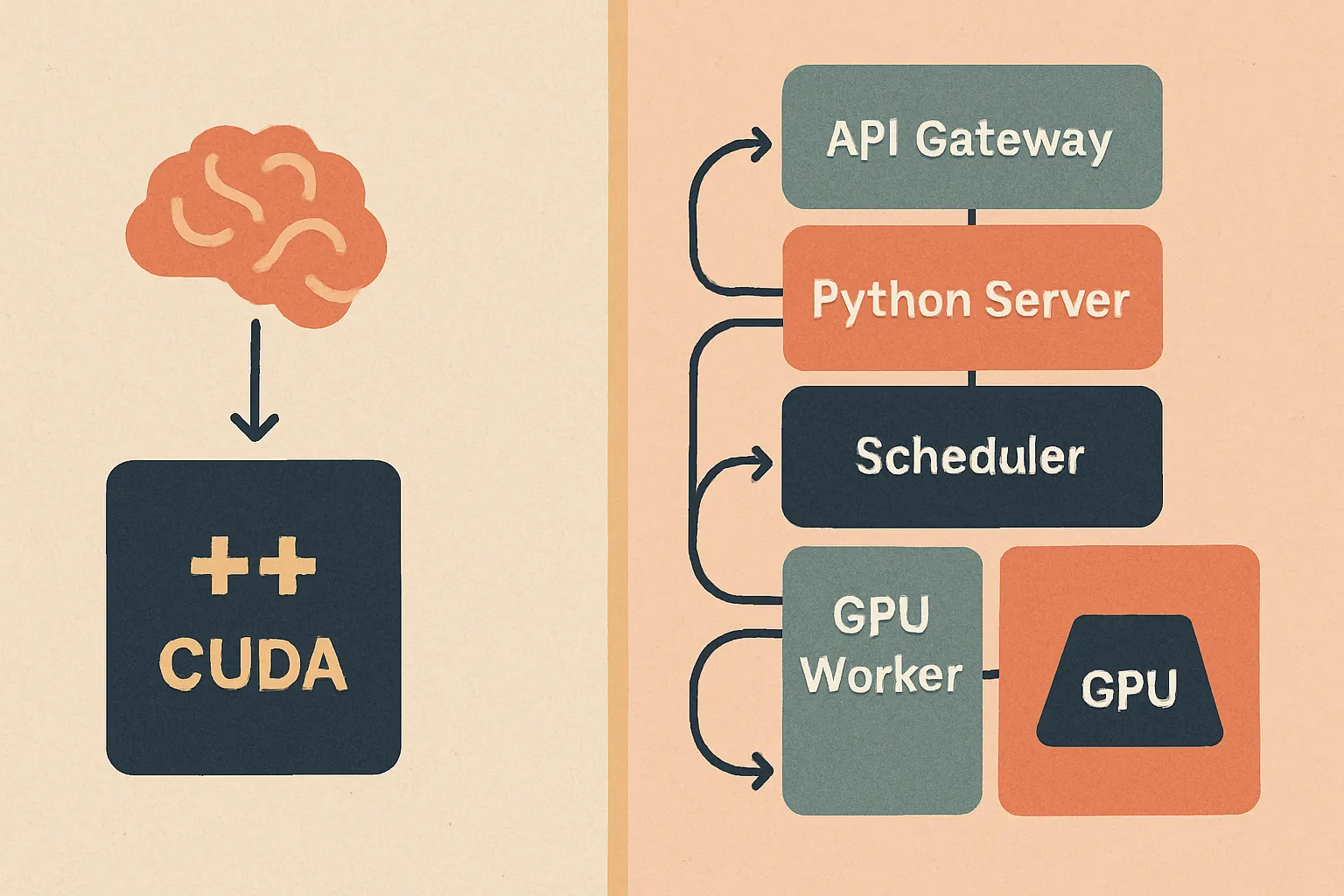
Why Batching Is the Real Boss Fight
Most teams obsess over model size and ignore scheduler behavior.
Bad move.
If you’re decoding autoregressively, the game is won or lost on how you admit requests, merge them, maintain KV cache state, and keep the GPU fed without exploding tail latency. Tiny-vLLM is useful as a learning artifact precisely because it focuses on the engine room rather than the cruise ship buffet GitHub: jmaczan/tiny-vllm.
Here’s the simplified flow:
flowchart TD
  A[Incoming requests] --> B[Request queue]
  B --> C[Continuous batching scheduler]
  C --> D[KV cache management]
  D --> E[CUDA decode kernels]
  E --> F[Token outputs]
  F --> C
That loop is the whole business.
If your scheduler is timid, throughput collapses. If your cache strategy is sloppy, memory falls apart. If your stack adds too much coordination overhead, the GPU sits there like an expensive intern waiting for instructions.
We’ve found that many teams are solving the wrong problem. They think they need “production serving.” What they actually need is a scheduler that doesn’t behave like it’s filling out paperwork in triplicate.
Cost: The Part Finance Notices Before Engineering Does
Nobody complains about infrastructure complexity until the bill arrives.
Then suddenly everyone becomes a minimalist.
A tiny inference engine can reduce cost in a few very unglamorous ways:
- fewer services to run
- fewer containers to maintain
- lower CPU overhead around the GPU
- simpler deployment targets
- less engineering time spent debugging stack interactions
That last one is huge, and it never shows up nicely on a benchmark chart.
We’ve had projects where the infra around the model was harder to stabilize than the model itself. That’s backwards. If your “serving platform” needs a support group, your architecture is too heavy.
If you’re trying to estimate whether a leaner deployment would save money, use our AI cost estimator. It’s a much better exercise than pretending every workload needs hyperscaler-grade serving.
Deployment Complexity Is Where Full Stacks Start Looking Silly
This is our hot take: for many teams, full-stack LLM serving is the new microservices in 2018.
Everyone wants the prestige. Nobody wants the pager.
A mature full-stack setup absolutely has a place. If you need multi-model routing, tenancy isolation, auth layers, deep observability, fallback orchestration, compliance controls, and dynamic scaling across messy workloads, yes, use the grown-up stack. That’s what it’s for.
But if you’re shipping one focused assistant, one voice workflow, one edge deployment, or one internal domain model, the giant platform can be self-inflicted pain.
We see this a lot in AI agents, voice AI, and on-device AI work. The deployment target often matters more than theoretical flexibility. A hotel voice assistant running on constrained hardware doesn’t need a philosophical debate about service mesh purity. It needs predictable latency and a system that won’t fall over during breakfast rush.
That’s one reason products like RunHotel force a different mindset. Once you care about local execution, constrained compute, and operational simplicity, bloated serving stacks stop looking sophisticated and start looking irresponsible.
Different battlefield. Different weapons.
Where Full Stacks Still Win
To be fair, tiny engines have limits.
A lot of them.
Tiny-vLLM is compelling because it teaches core ideas and strips serving down to the essentials GitHub: jmaczan/tiny-vllm. But a minimal engine isn’t automatically ready for every production environment. You may still need:
- authentication and rate limiting
- model versioning and rollout controls
- observability and tracing
- autoscaling
- multi-tenant isolation
- fault tolerance across heterogeneous hardware
- integrations with your app platform and data plane
This is where full stacks earn their keep.
If your environment is chaotic, your organization is large, or your workload mix changes every week, the operational features matter. A tiny engine can be fast and still be the wrong choice.
Speed isn’t the only requirement.
But we’d argue this is exactly why tiny projects are useful: they force you to separate inference performance from serving platform requirements. Those are related, but they are not the same thing. Too many teams buy both when they only need one.
The Best Use Cases for a Tiny Inference Engine
If you’re wondering when a small engine is the smart move, here’s our blunt answer.
Use it when the workload is boring.
That’s a compliment.
A “boring” workload has a stable model, known hardware, predictable request shapes, clear latency targets, and a narrow product surface. In those cases, simplicity compounds.
Tiny engines make the most sense for:
Focused internal copilots
You control access patterns, prompts, and concurrency. You don’t need a circus tent.
Embedded or edge deployments
This is especially relevant for on-device AI and custom hardware-adjacent systems, where every dependency is another thing to break.
Voice systems with tight latency budgets
Voice punishes bloated stacks. Users notice awkward pauses instantly. If your serving path is too fat, the product feels dumb even when the model is good. That’s why lean inference matters in voice AI.
Custom model serving
If you’re running specialized fine-tuned models and want exact control over memory, quantization, and runtime behavior, a lightweight engine can be a better fit than a generic platform. That’s often the case in custom model work.
What We’d Recommend Instead of Blindly Copying Hacker News
Hacker News has a special talent for making every clever prototype look like the future.
Sometimes it is. Sometimes it’s just a very smart weekend project with no ops story.
So here’s the sane approach.
Start by asking four questions:
- Is your bottleneck actually in inference, or is it in orchestration and app logic?
- Do you have a narrow, stable workload or a messy, evolving one?
- Are you optimizing for raw throughput, tail latency, deployment simplicity, or compliance?
- Will your team maintain low-level serving code happily, or resent it by month two?
That last question matters more than people admit.
A tiny engine is like a race car. Fantastic on the right track. Terrible for school pickup.
If you want help deciding where your system should sit on that spectrum — tiny engine, production stack, or some hybrid in between — that’s exactly the kind of mess we handle in AI consulting. We usually save clients money by deleting architecture, not adding it.
That’s not always what they expect to hear.
It’s often what they need.
So, Does Tiny-vLLM “Beat” a Full Stack?
Sometimes, yes.
And not in a cute, academic sense. In a very practical sense: lower overhead, tighter batching, simpler deployment, lower cost, fewer failure modes.
But only when the problem is constrained enough for that simplicity to matter.
The mistake is thinking this is a religion. It isn’t. Tiny engines and full stacks solve different problems. What Tiny-vLLM makes painfully obvious is that many teams are paying full-stack complexity tax without getting full-stack value in return GitHub: jmaczan/tiny-vllm.
That’s the real lesson from show hn: tiny-vllm –.
Not “rewrite everything in C++.”
Not “Python is dead.”
Just this: if your serving architecture is bigger than your actual serving problem, you’ve already lost.
If you’re building an LLM product and want a second opinion before you deploy a small planet’s worth of infrastructure, talk to us. We like fast systems, boring ops, and architectures that don’t need a therapist.