


False Positives Derailed Chrome's AI Bug Finder: google says it fixed
Hitesh Sondhi · August 4, 2026 · 7 min read
When Google tells you AI found over a thousand security bugs in a single month, the natural impulse is to ask which model they used and whether you can replicate the setup. That's the wrong question. The right one: how many of those findings were real, and what did it cost in engineer hours to separate signal from noise?
Google says it fixed 1,072 security bugs across Chrome 149 and Chrome 150, both released in June. That figure surpasses the total fixed across the previous 23 Chrome milestones combined. Source: TechCrunch
The headline is impressive. Mechanics behind the headline are where engineering teams should focus.
What Google Actually Did
Google used AI to scan Chrome's codebase for security vulnerabilities. The system flagged potential bugs, and human engineers triaged and fixed them. That 1,072 count represents confirmed fixes, not raw AI output. Source: TechCrunch
This distinction matters enormously. Raw AI output is the number you get before anyone verifies. Confirmed fixes are what survives triage. If an LLM flags five thousand potential issues and roughly a thousand turn out to be real, your false positive rate is around four-fifths. That's not a failure if your triage pipeline is fast enough. A catastrophe if it isn't.
Where False Positives Eat Your Pipeline
LLM bug finders share a structural problem with static analysis tools: they generate volume. The difference is that static analysis tools produce deterministic, rule-based findings you can categorize and suppress. LLM findings are probabilistic, contextual, and harder to deduplicate.
We've seen this pattern in our /services/ai-consulting work. A team hooks up an LLM to scan their codebase, gets thousands of potential issues in the first run, and then spends a couple of weeks trying to triage them. By week three, the findings pile up, nobody trusts the system, and the whole effort gets shelved.
Better prompts won't fix this. What works is a triage pipeline that measures precision continuously.
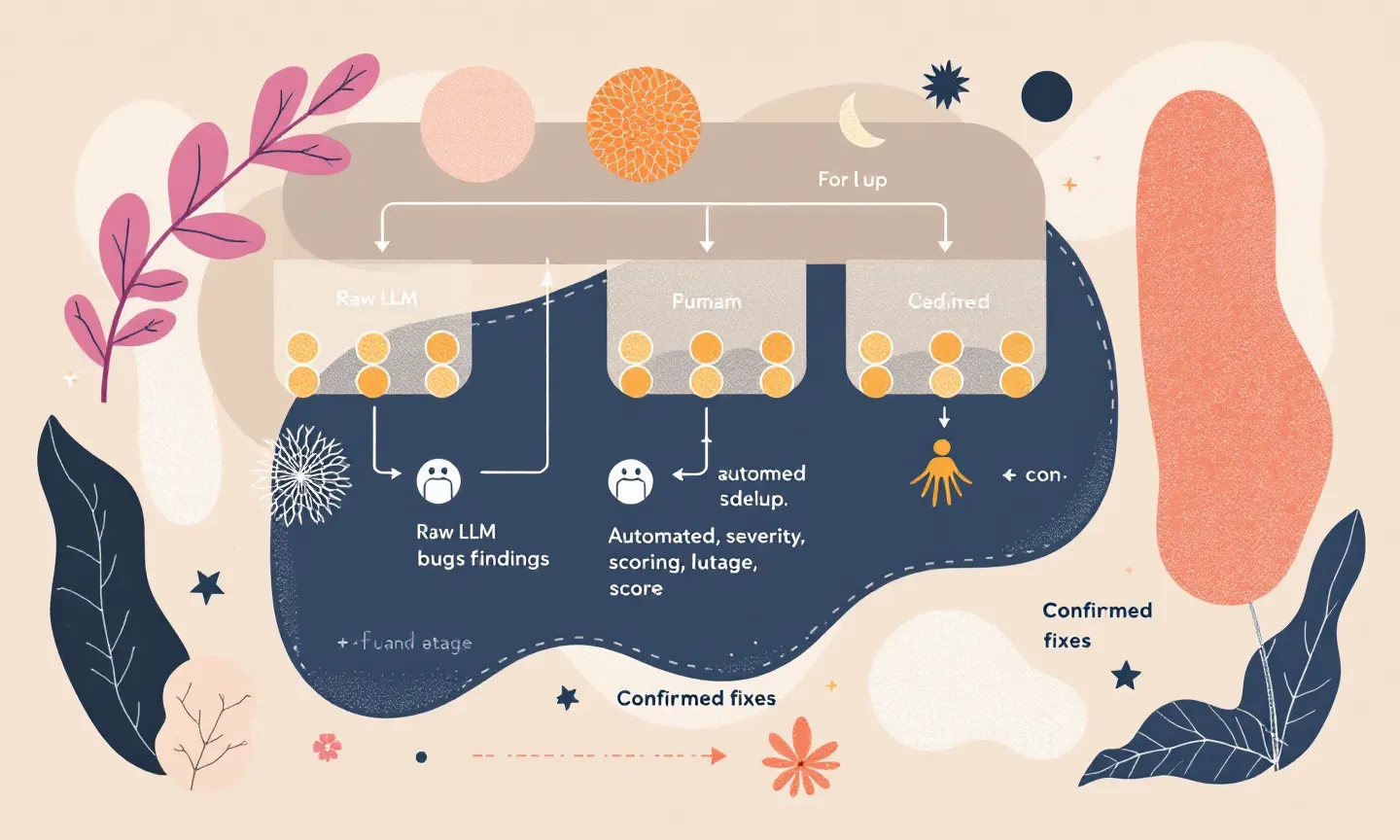
Build a Precision Feedback Loop
You need three numbers tracked over time: raw findings, triaged findings, and confirmed real bugs. Raw-to-confirmed gives you effective precision. Triage-to-confirmed gives you reviewer accuracy.
If your effective precision is below a fifth, your LLM is generating more noise than a poorly configured linter. Above half means you're in useful territory. Google's Chrome team likely operates somewhere in between, but they have the engineer bandwidth to absorb the triage cost. Most teams don't.
What works is gating LLM findings behind a second model that re-evaluates each finding against the actual code. We've used /services/custom-models approaches where a smaller, faster model acts as a verifier on top of the primary scanner. This cuts raw volume by roughly two-thirds before a human ever sees a ticket.
Don't Let AI Replace Your Test Harness
What's most dangerous isn't false positives. The assumption that AI bug finding replaces structured testing.
It doesn't. LLMs find bugs by pattern matching against training data. They're good at spotting code that looks like known vulnerability classes: use-after-free, buffer overflows, injection points. They're bad at finding bugs that require understanding your specific data flow, API contracts, or business logic.
Google's Chrome codebase has an enormous existing test infrastructure. AI bug finders sit on top of that, not in place of it. When Google says it fixed 1,072 bugs, those fixes went through Chrome's existing review, testing, and release pipeline. Source: TechCrunch AI accelerated discovery. It didn't replace verification.
If you're running /services/ai-agents for code analysis without a parallel CI pipeline that catches regressions, you're building on sand. Your AI will find bugs you didn't know about. Bugs your tests would have caught will also slip through.
Measuring What Actually Matters
Track these metrics from day one:
- Raw findings per scan (volume)
- Confirmed real bugs per scan (precision)
- Engineer hours per confirmed bug (cost)
- Bugs found by AI that tests missed (incremental value)
- Bugs found by tests that AI missed (coverage gap)
That last one is the metric nobody tracks. This tells you whether the AI is finding things your existing tools can't, or just rediscovering what you already catch. When the overlap is nine out of ten, the AI isn't adding much value. Drop below a third and you've got a genuinely complementary tool.
In our experience, the incremental value metric is what justifies or kills the investment. Teams that only track raw volume end up impressed by numbers and disappointed by outcomes. Teams that track incremental value make sober decisions about whether to keep the pipeline running.
Use our /tools/ai-cost-estimator to model the compute cost of your scanning pipeline against the engineer hours saved. Math often surprises people. A scanning setup that costs a few hundred dollars in API calls can easily consume tens of thousands in engineer triage time if precision is low.
The API Contract Problem
LLM bug finders have a specific blind spot that matters for web and API engineers: they don't understand contracts.
If your API specifies that a field accepts integers between 1 and 100, and your code accepts any integer, a human reviewer or a contract test catches that immediately. An LLM might flag it if it's seen similar patterns in training data, but it might not. Your model doesn't have OpenAPI specs or protobuf definitions in context unless you explicitly provide them.
This means the highest-value integration isn't just pointing the LLM at the repo. What works is feeding the model your API specs, type definitions, and schema constraints alongside the code. We've done this in /services/on-device-ai and /services/voice-ai work where the constraint set is small enough to fit in context. For /products/runhotel, our on-device voice AI for hotels, the API surface is bounded enough that we can pass full contract definitions to the scanner.
For larger codebases, you need a retrieval layer that pulls relevant contracts for each file being scanned. More engineering work, but the difference between finding real bugs and finding generic code smells.
What to Do With Google's Numbers
Google's 1,072 confirmed fixes are real and the AI contribution is genuine. Via TechCrunch But Google has thousands of engineers, a mature fuzzing infrastructure, and a release pipeline that can absorb high-volume findings. Your team probably doesn't.
What you should take away isn't "AI found a thousand bugs, so it works." The real lesson is "AI found a thousand bugs after passing through an existing verification pipeline that most teams haven't built."
Start smaller. Pick one service, one repo, or one API surface. Run the LLM scanner against it. Measure precision. Measure cost per confirmed bug. Compare against what your existing tests catch. Numbers holding up after three runs means expand. Otherwise, you've lost a week, not a quarter. If you need help designing the pipeline, /contact us and we'll walk you through it.
This week, run an LLM bug scan on your most critical API endpoint and manually verify every finding. Count how many are real. That ratio is your baseline, and every improvement you make to the pipeline should move it.