


Why AI Coding Agents Need the Same Guardrails as CI
Hitesh Sondhi · July 29, 2026 · 13 min read
We’ve seen this movie before.
A team adds an AI coding agent to speed up delivery. For a week, everybody’s thrilled. PRs appear faster, boilerplate evaporates, and someone says the dangerous sentence: “Honestly, it’s better than half our junior dev tasks.”
Then the weird stuff starts.
A dependency gets added without review. A migration script quietly touches the wrong table. A “helpful” refactor rewrites auth middleware across six services. Nothing is catastrophically broken at first. That’s what makes it sneaky. The code compiles. Tests mostly pass. And now you’ve got a non-human contributor with commit power and the software equivalent of a forklift in a porcelain shop.
That’s why governing ai agents in codebases shouldn’t be treated like a prompt-writing problem. It’s a CI policy problem.
Key Takeaways
- AI coding agents should be governed like untrusted automation, not like smart teammates.
- The right control point is CI: permission boundaries, policy checks, and merge enforcement.
- Agents need scoped authority: what they can read, what they can change, and what they can never touch.
- “Human in the loop” is not a governance model by itself. It’s a bumper sticker.
- A practical blueprint starts with policy-as-code, audit trails, and failure-by-default for sensitive changes.
Most teams are still governing AI agents with vibes.
That’s bad.
If your coding agent can open PRs, modify infrastructure, regenerate tests, or touch customer-facing logic, then you’ve delegated operational authority. And once you’ve delegated authority, you need controls that are boring, enforceable, and automatic. The same way you already govern CI pipelines, branch protections, secrets access, and deployment gates.
This isn’t theoretical hand-wringing. The core argument in Serif Colakel’s piece is exactly the right instinct: govern AI agents in codebases like a linter or policy engine, not like an employee you “trust” after a few good commits Source.
That framing matters because it changes the whole implementation.
The Big Mistake: Treating Agents Like Fancy Autocomplete
A lot of teams still act like coding agents are just Copilot with ambition.
They’re not.
Autocomplete suggests. Agents act. They inspect files, infer intent, modify code across boundaries, generate shell commands, and sometimes chain actions together in ways nobody explicitly approved. That’s a different risk class.
It’s the difference between a spellchecker and an intern with production credentials.
When we talk to engineering leaders about AI agents, the first conversation usually starts with productivity. Fair enough. The second conversation, if they’ve deployed anything real, is governance. Who approved this change? Why did the agent touch this folder? Can it access secrets? Why is it opening infra PRs? Can we prove what context it used?
That’s where the romance dies and the engineering starts.
Why CI Is the Right Mental Model
CI already solves a version of this problem.
Your CI pipeline doesn’t get “trusted” because it passed last week. It gets constrained. It runs in a known environment. It has explicit permissions. It triggers specific checks. It logs what happened. And if it tries to do something outside policy, it fails.
That’s exactly how AI coding agents should operate.
Not “please be careful.”
Not “we added a review step.”
Not “the prompt says don’t touch payments.”
Prompts are not policy. Prompts are wishes.
Here’s the model we recommend: treat the agent as a policy-subject inside your delivery system. It can propose changes, but every meaningful action gets filtered through the same kind of enforcement layer you’d use for CI, security scans, or deployment approvals.
Here’s the simple version of that flow:
flowchart TD
  A[Agent proposes code change] --> B[Scope check]
  B --> C[Policy engine]
  C --> D[Test and security checks]
  D --> E[Human approval if sensitive]
  E --> F[Merge or reject]
That’s not glamorous. It’s effective.
What You Actually Need to Govern
Most governance advice gets mushy right here. It starts talking about “responsible AI” in the abstract and never gets down to the repo level where the bodies are buried.
So let’s make it concrete.
1. File-system and repo scope
An agent should not have blanket write access across the repo unless you enjoy chaos.
Scope it by directory, service, or ownership boundary. Let the frontend agent touch /apps/web/components, but not /infra/terraform. Let a documentation agent edit /docs, but not /services/billing. If the agent needs broader access, make that a temporary, explicit exception.
We’ve found this is where teams either get serious or start hand-waving.
And hand-waving is how your chatbot ends up editing IAM policy.
2. Action permissions
Reading code is one thing. Running scripts, opening PRs, modifying lockfiles, changing CI config, or executing database migrations is another.
These should be separate permissions.
If an agent can:
- write code
- run shell commands
- change dependencies
- modify CI workflows
- alter infrastructure
- trigger deployments
…then you don’t have an assistant. You have a junior platform engineer who never sleeps and occasionally hallucinates.
That’s useful. Also terrifying.
3. Sensitive zones
Some parts of a codebase should be treated like a bank vault, not a coworking space kitchen.
Examples:
- authentication and authorization
- payment logic
- secrets handling
- compliance logging
- infrastructure as code
- data deletion workflows
- PII access paths
For these zones, default to no autonomous merges. Full stop. The agent can draft, annotate, or suggest. But merge requires named human approval plus passing policy checks.
4. Provenance and auditability
If an agent touched code, you should know:
- which agent acted
- what prompt or task triggered it
- what files it read
- what tools it used
- what commands it ran
- what policy checks passed or failed
This “agent ID and attribution” idea shows up repeatedly in broader governance discussions because it’s foundational. If you can’t attribute actions, you can’t govern them. And if you can’t audit them, your postmortem will read like fan fiction.
Human Review Is Necessary — and Still Not Enough
Here’s a hot take: “human in the loop” is overrated when people use it as a substitute for system design.
Yes, you need human review for risky changes. No, that doesn’t save you if the review surface is too large, the diff is too noisy, or the reviewer assumes the machine already “did the careful part.”
We’ve all seen this with generated tests and giant refactors. The PR is 1,200 lines. The reviewer skims. The agent added three excellent improvements and one catastrophic bug in a helper nobody noticed. Congrats, you now have supervised failure.
Humans are good at judgment.
Humans are bad at reviewing endless sludge on a deadline.
That’s why governance has to start before review:
- constrain what the agent can touch
- force smaller diffs
- require issue linkage
- run policy checks before PR creation or merge
- auto-reject changes in forbidden paths
Review should be the final checkpoint, not the only one.
The Governance Blueprint We’d Actually Deploy
If you want a practical system for governing ai agents in engineering teams, start here.
Step 1: Classify your codebase by risk
Don’t begin with the model. Begin with the blast radius.
Split the repo into zones:
- Low risk: docs, UI copy, test fixtures, internal tooling
- Medium risk: app features, API handlers, non-critical services
- High risk: auth, billing, infra, data access, compliance logic
This sounds obvious, but many teams skip it and go straight to “which agent platform should we buy?” That’s backwards.
Governance starts with what can go wrong.
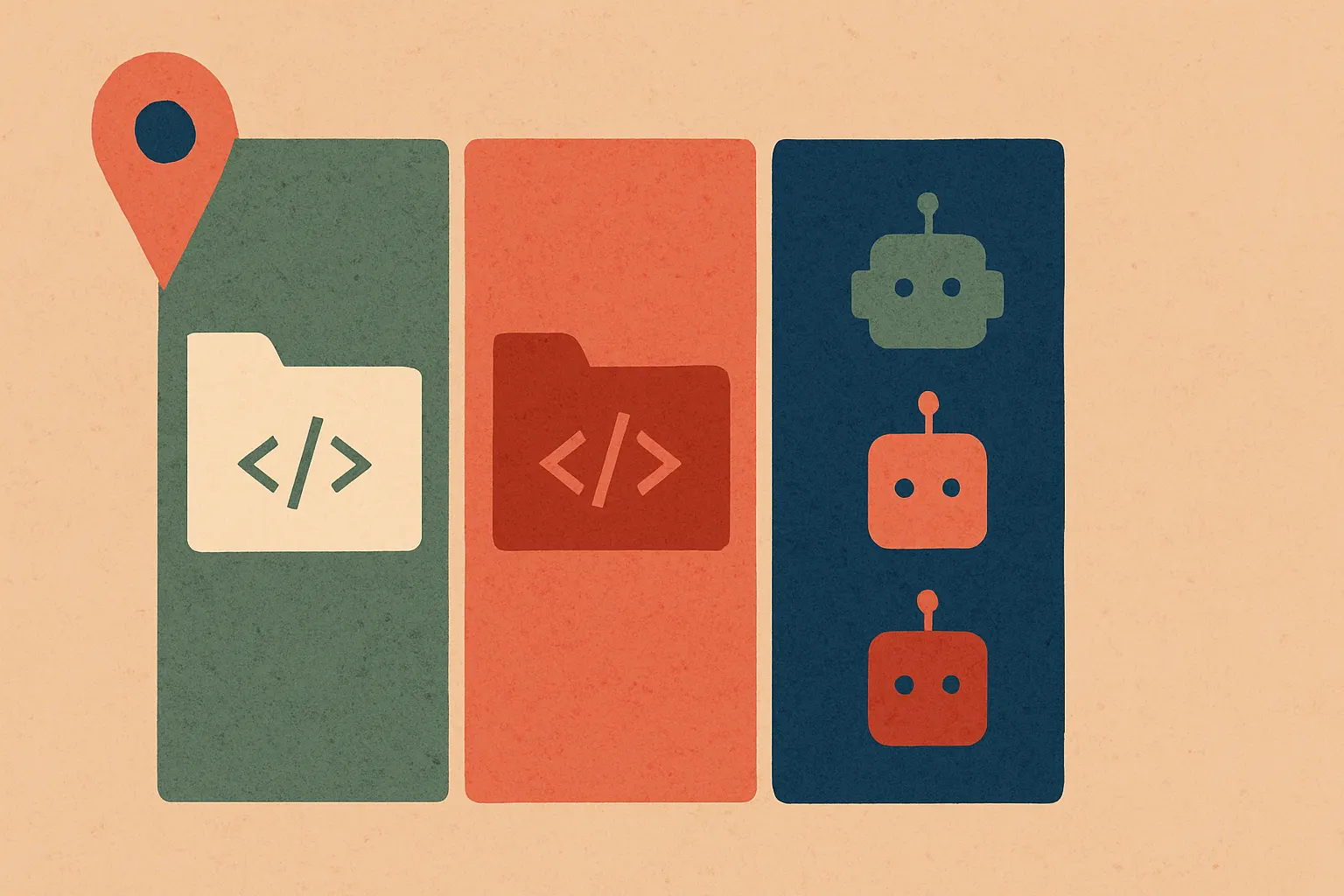
Before we get into enforcement, here’s the kind of access map you want to define:
Step 2: Define agent roles like service accounts
Don’t create “one agent to rule them all.” That’s how you get accidental superuser behavior.
Create narrow roles:
- Docs agent: read most files, write docs only
- Frontend refactor agent: write only in web app directories, no shell
- Test agent: generate tests, cannot modify production code
- Dependency update agent: update allowed packages, cannot merge without approval
- Infra assistant: propose Terraform changes, never auto-merge
Think Kubernetes service accounts, not magic coworkers.
If you need help designing those boundaries, this is exactly the kind of work we do in AI consulting and custom delivery systems for custom models. The hard part usually isn’t model output. It’s operational containment.
Step 3: Put policy checks in CI, not in a wiki
A wiki page saying “agents shouldn’t edit billing” is adorable.
CI enforcement is better.
Use policy-as-code to block:
- changes to restricted paths
- dependency additions from unapproved registries
- modifications to workflow files
- secrets appearing in diffs
- shell-generated artifacts outside allowed directories
- PRs exceeding size thresholds for autonomous changes
You can implement this with existing CI plus a policy engine, custom scripts, or repo rules. The tool matters less than the enforcement point.
If the agent can bypass CI, your governance is cosplay.
Step 4: Require structured metadata on every agent change
Every agent-generated PR should include machine-readable metadata:
- agent name and version
- task ID or ticket link
- execution timestamp
- files read
- tools invoked
- confidence or risk label
- policy results
This makes triage faster and audit trails real.
It also kills the worst kind of meeting: the one where everyone squints at a PR and asks, “Wait, was this written by a person?”
Step 5: Add escalation rules for sensitive actions
Not every action deserves the same friction.
That’s the whole point.
A docs typo fix shouldn’t need two staff engineers and a compliance officer. A change to password reset logic probably should not be merged because the agent “seemed confident.”
A simple escalation policy works well:
- low-risk changes: auto-merge if checks pass
- medium-risk changes: human review required
- high-risk changes: code owner review + security/policy gate
Boring? Yes.
Useful? Extremely.
What This Looks Like in a Real Pipeline
Here’s a more realistic operating model for teams shipping software fast without losing their minds:
sequenceDiagram
  participant A as AI Agent
  participant R as Repo
  participant P as Policy Check
  participant C as CI
  participant H as Human Reviewer

  A->>R: Open PR with metadata
  R->>P: Validate scope and permissions
  P-->>R: Pass or fail
  R->>C: Run tests, security, lint, secret scan
  C-->>R: Results
  R->>H: Request review if risk >= threshold
  H-->>R: Approve or reject
This is where mature teams end up anyway. The difference is whether you arrive there deliberately or after an expensive mess.
Don’t Ignore Cost and Runtime Boundaries
Governance isn’t just about security. It’s also about spend and operational behavior.
We’ve seen teams focus so hard on “can the agent do the task?” that they forget to ask:
- how many tokens did it burn?
- how many retries did it run?
- how much context did it ingest?
- how long did it hold a CI runner?
- did it trigger expensive tests unnecessarily?
An unconstrained agent can waste money the way a toddler wastes toothpaste: with startling speed and zero remorse.
Set budgets. Set runtime limits. Set retry caps. Set context ceilings. If you’re evaluating the economics of agent workflows, our AI cost estimator is a good starting point for rough planning.
This matters even more when you’re deploying specialized systems like on-device AI or voice AI, where resource constraints are not theoretical. We learned that the hard way building RunHotel: once software has to behave reliably in the real world, “the model will probably be fine” becomes a very expensive sentence.
The Agency Problem Nobody Wants to Talk About
The broader governance literature keeps circling one central issue: delegation.
That’s the real story.
Once an organization allows an AI system to take actions on its behalf, questions of authority, liability, oversight, and attribution stop being philosophical and become operational. The “Governing AI Agents” discussion in research and policy circles is useful because it pushes people to think beyond model capability and into delegated power structures. That’s exactly the right move for engineering leaders too, even if your version of the problem is less “legal theory” and more “why did this bot rewrite our deployment YAML?”
Different vocabulary. Same fire.
And that’s why the CI analogy is so strong. CI is already delegated automation with bounded authority. Your coding agents should inherit that discipline.
Our Strong Opinion: Autonomous Merge Should Be Rare
Here’s the part some people won’t like.
Autonomous merge is mostly overrated outside tightly scoped, low-risk tasks.
Yes, it looks impressive in demos. Yes, it can work for docs, formatting, dead test snapshots, or carefully constrained dependency bumps. But if your agent is autonomously merging feature logic into production systems, you’re not being bold. You’re outsourcing caution to probability.
That’s not innovation. That’s gambling with better branding.
Use autonomy where the blast radius is tiny and the policy envelope is strict. Everywhere else, optimize for controlled acceleration, not machine heroics.
A Simple Rollout Plan for the Next 30 Days
If you’re serious about governing ai agents in codebases, don’t start with a giant platform migration. Start with one repo and one policy layer.
Week 1:
- classify repo risk zones
- define 2-3 agent roles
- block sensitive paths
Week 2:
- require PR metadata for agent actions
- add CI checks for scope, secrets, and workflow changes
- enforce human review thresholds
Week 3:
- cap PR size and runtime
- add cost and retry budgets
- log all agent tool use
Week 4:
- review failures
- tighten permissions
- decide what can safely auto-merge
That’s enough to go from “we’re experimenting” to “we actually know what this thing is allowed to do.”
Which is a much nicer place to be.
Final Thought
AI coding agents are useful. We’re not anti-agent. We build these systems. We like them. They can save real time and remove a lot of tedious work.
But giving an agent repo access without CI-style guardrails is like hiring a demolition crew because you wanted help hanging a picture frame.
If you want to put agents into a real engineering organization, treat them like automation with authority, not coworkers with vibes. Put policy in the path. Make permissions explicit. Audit everything. Fail closed on risky changes.
That’s how you get speed without turning your codebase into a crime scene.
If you want help designing agent permissions, CI enforcement, or a governance blueprint that works in a real repo instead of a slide deck, talk to us at Cropsly.
Sources
- Serif Colakel, “Governing AI Agents in Codebases Like a Linter” — https://dev.to/serifcolakel/governing-ai-agents-in-codebases-like-a-linter-2g6o