

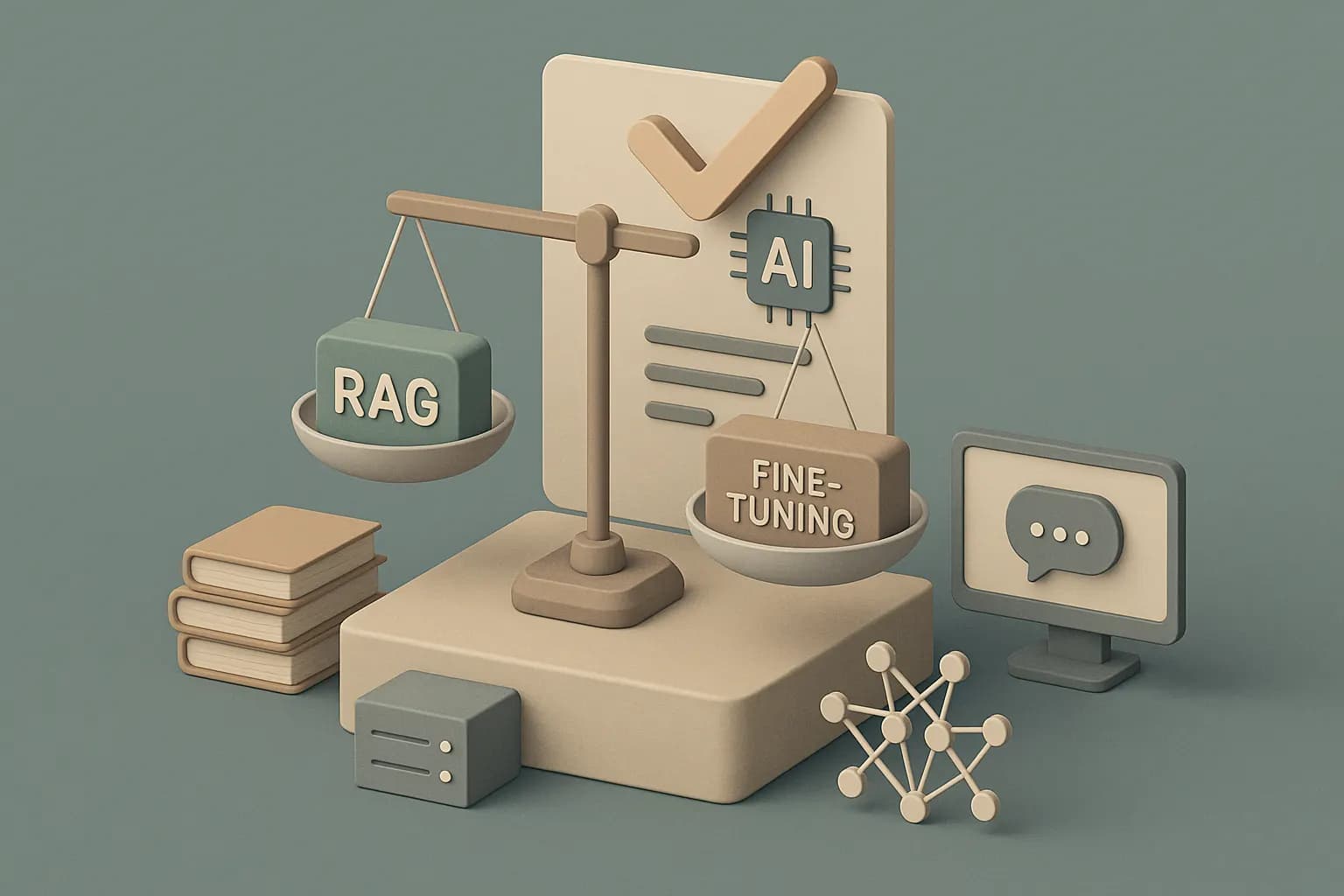
RAG vs Fine-Tuning: Which Actually Wins for Enterprise AI?
Hitesh Sondhi · April 24, 2026 · 11 min read
We’ve seen teams burn three months and a six-figure budget fine-tuning a model to answer HR policy questions… only to realize the policy changed every two weeks and the model kept confidently quoting dead documents. That’s not an AI strategy. That’s laminating a menu in a restaurant that changes dishes every Friday.
If you’re stuck on rag vs fine tuning, here’s the blunt answer: most enterprise teams should start with RAG, and a surprising number should stop there. Fine-tuning is powerful, but it’s also the thing people reach for when they want to feel like they’re doing “real AI” instead of solving the actual problem.
That’s the hot take.
And yes, we’ve seen both work brilliantly. We’ve also seen both fail in ways that were painfully predictable.
Key Takeaways
- RAG usually wins when your knowledge changes often, needs citations, or lives across messy enterprise docs.
- Fine-tuning wins when you need consistent behavior, domain-specific style, structured outputs, or lower prompt overhead at scale.
- If you use fine-tuning to “teach” a model facts that change weekly, you’re probably building a very expensive liar.
- The smartest enterprise setups often combine both: RAG for fresh knowledge, fine-tuning for behavior and format.
- Pick based on failure mode, not hype: do you need retrieval accuracy, or do you need the model to behave differently?
Why This Debate Gets Messy Fast
The problem with rag vs fine tuning is that people compare them like they’re substitutes. They’re not. It’s closer to arguing whether a restaurant needs a pantry or a trained chef.
RAG gives the model access to external knowledge at runtime. Fine-tuning changes the model’s behavior or internal tendencies through additional training. One is “look it up before you answer.” The other is “change how you think.”
Those sound similar in a sales deck. In production, they’re wildly different.
We’ve watched enterprise teams fine-tune because they hated building retrieval pipelines. That’s like removing your smoke alarm because you hate the beeping.
What RAG Actually Buys You
RAG is usually the practical answer when your company knowledge is large, ugly, and constantly changing. Think contracts, SOPs, product catalogs, compliance docs, support tickets, internal wikis, and PDFs that should’ve been retired during the Obama administration.
If the answer needs to come from source material, RAG is hard to beat. You can update the knowledge base without retraining the model, and you can attach citations so users can verify where the answer came from.
That last part matters more than people admit.
In enterprise AI, trust often matters more than eloquence. A slightly awkward answer with a source link beats a polished hallucination every day of the week.
Here’s a simple way to think about it: RAG is like giving a smart employee access to the filing cabinet. They might still misunderstand a document, but at least they’re reading the current version instead of reciting last quarter’s rumor.
Here’s what that pipeline usually looks like:
flowchart TD
  A[Enterprise Documents] --> B[Chunking & Cleaning]
  B --> C[Embeddings]
  C --> D[Vector Database]
  E[User Query] --> F[Retriever]
  D --> F
  F --> G[LLM with Context]
  G --> H[Answer with Citations]
Simple on paper. Messy in real life.
Chunking is where a lot of RAG systems quietly die. Too small, and the model loses context. Too large, and retrieval gets muddy. We’ve found that teams obsess over model choice while their chunking strategy is basically “split every 500 tokens and pray.”
That’s not engineering. That’s vibes.
Why Your RAG Pipeline Is Lying to You
A bad RAG system doesn’t fail loudly. It fails politely.
It retrieves the second-best document, misses the latest revision, or pulls a chunk that contains the right keywords but the wrong answer. Then the model stitches together something plausible, and now your “grounded” system is confidently wrong with a citation attached. Which is somehow worse.
We’ve seen this in support and operations workflows, especially when document versions are duplicated across SharePoint, Confluence, Google Drive, and somebody’s cursed local export folder. The retrieval layer becomes a scavenger hunt with a law degree.
Here’s where it gets weird.
Teams often blame the model when the retriever is the real criminal. If your top-k retrieval is weak, metadata is sloppy, or reranking is missing, switching from one frontier model to another won’t save you.
This is also why RAG projects benefit from boring infrastructure discipline: document hygiene, access control, ingestion monitoring, and evaluation sets. Not sexy. Extremely necessary.
If you’re building enterprise assistants or internal copilots, this is exactly the kind of thing we help untangle in [/services/ai-agents] and [/services/ai-consulting].
What Fine-Tuning Actually Buys You
Fine-tuning shines when the problem isn’t “the model doesn’t know our documents.” It shines when the problem is “the model keeps behaving the wrong way.”
Maybe it rambles when you need strict JSON. Maybe it can’t follow your support tone. Maybe it misses domain-specific phrasing. Maybe your agents need consistent call summaries, classification labels, or extraction formats across millions of requests.
That’s where fine-tuning earns its keep.
A good fine-tune is like training a barista to make your house drink exactly the same way every time. You’re not teaching them the history of coffee. You’re teaching consistency, speed, and judgment under pressure.
This is especially useful when prompt engineering starts looking like tax fraud. If your system prompt is 2,000 tokens of “always do this, never do that, format like this, classify like that,” you may be compensating for a model that should’ve been tuned instead.
We’ve found fine-tuning particularly valuable for:
- Structured extraction
- Domain-specific classification
- Voice workflows with strict turn behavior
- Brand or compliance-sensitive response style
- Reducing prompt size for high-volume inference
That last one gets ignored. It shouldn’t.
Prompt bloat is expensive. OpenAI notes that token usage directly affects cost for API models OpenAI Pricing. If fine-tuning lets you replace a huge instruction prompt with a shorter one across millions of calls, the economics can change fast.
Still, fine-tuning facts into a model is often a mistake.
Not always. Usually.
Fine-Tuning Is Overrated for Fresh Knowledge
Here’s the opinion some people won’t like: fine-tuning is overrated for enterprise knowledge injection.
If your pricing sheet, compliance rules, inventory, legal language, or product catalog changes regularly, baking that into weights is like tattooing your grocery list on your arm. It works for about a day, then you look ridiculous.
OpenAI’s fine-tuning guidance explicitly frames it around improving reliability for specific tasks, formatting, tone, and complex instruction following, not as the default solution for frequently changing external knowledge OpenAI Fine-Tuning Guide. Anthropic makes a similar distinction by emphasizing tool use and retrieval for access to current information Anthropic Documentation.
That doesn’t mean fine-tuning is bad. It means using it as a substitute for retrieval is bad.
And expensive.
Where Fine-Tuning Wins Anyway
There are real cases where fine-tuning beats RAG cleanly.
If you need low-latency, repeatable behavior on-device, you often can’t afford a heavyweight retrieval stack. In those cases, a tuned smaller model can be the right move, especially for constrained workflows. We care about that a lot in [/services/on-device-ai] and voice interfaces in [/services/voice-ai], because every extra moving part shows up as delay, battery drain, or both.
For example, if you’re building a hotel voice assistant like [/products/runhotel], you may want the model to follow strict dialogue policies, extract intent cleanly, and keep responses short and natural. That’s less about retrieving a giant knowledge base and more about behavior shaping.
Latency changes the answer.
If your app can tolerate a slower, retrieval-heavy path, RAG is fine. If you need snappy responses on constrained hardware, a smaller tuned model can punch above its weight.
This is one reason enterprises exploring private deployments and specialized workflows often end up looking at [/services/custom-models].
The Real Winner: Hybrid Systems
The best answer in rag vs fine tuning is often “both, but for different jobs.”
Use RAG to fetch current facts. Use fine-tuning to make the model behave predictably once it has those facts. That hybrid setup is usually more robust than trying to force one technique to do everything.
Think of it like a trial lawyer. RAG is the paralegal bringing the right documents into the room. Fine-tuning is the courtroom training that keeps the argument tight, structured, and on-message.
Here’s a practical split:
- RAG handles current policies, product specs, contracts, account data, and changing knowledge
- Fine-tuning handles output format, refusal style, tone, classification logic, and workflow behavior
That division saves a lot of pain.
Here’s a visual for the hybrid pattern:
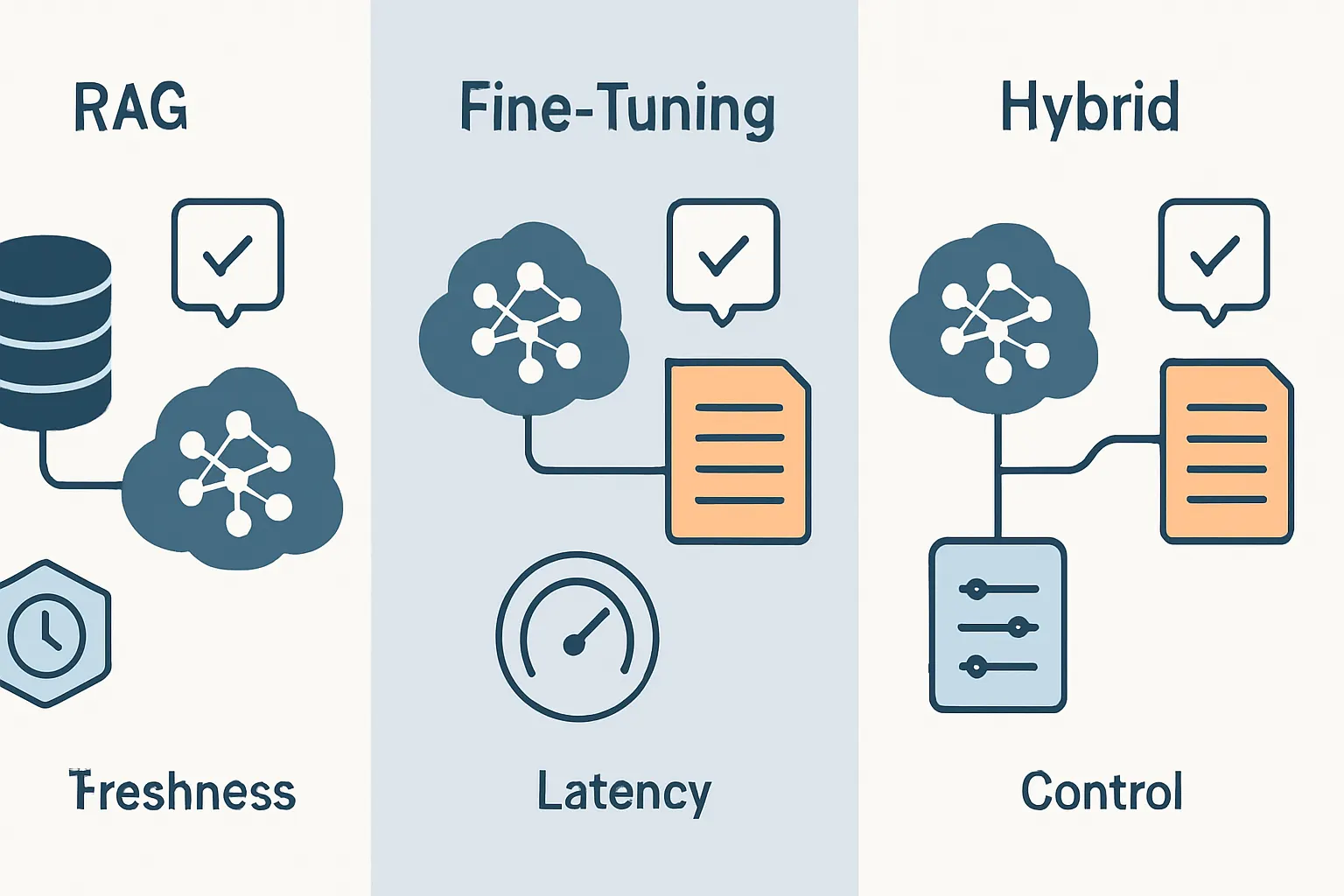
When teams ignore this split, they usually end up with one of two disasters: a brittle RAG system trying to fix behavior with prompts, or a beautifully tuned model confidently answering from stale memory.
Neither is fun on a Monday.
How to Decide Without Starting a Religious War
If you’re deciding between rag vs fine tuning, don’t ask which one is “better.” Ask which failure would hurt more.
If the worst-case failure is using outdated information, choose RAG first.
If the worst-case failure is inconsistent behavior, bad formatting, or weak domain-specific performance, fine-tuning deserves a serious look.
If both failures matter, welcome to enterprise AI. You probably need a hybrid.
Here’s the rough decision logic we use:
Start with RAG if...
- Your knowledge changes weekly or daily
- Users need citations or traceability
- You have lots of internal docs
- You need quick updates without retraining
- Compliance or auditability matters
Start with fine-tuning if...
- The task is narrow and repetitive
- Output format must be extremely consistent
- Prompt size is getting absurd
- You need lower latency on smaller models
- The model’s behavior matters more than broad knowledge access
Use both if...
- You need current facts and strict behavior
- You’re deploying AI into regulated or customer-facing workflows
- You want smaller models to perform reliably with retrieved context
That’s the practical answer. Not glamorous, but useful.
If you want to pressure-test the economics before building, run the numbers through [/tools/ai-cost-estimator]. We’ve seen architecture debates disappear the second someone calculates token costs, retrieval overhead, and expected request volume.
Funny how math does that.
The Cost Trap Nobody Mentions Enough
People talk about model quality like cost is some boring procurement detail. It isn’t. Cost shapes architecture.
RAG has infrastructure overhead: ingestion pipelines, embeddings, vector storage, reranking, access control, and retrieval evaluation. Fine-tuning has dataset prep, training runs, validation, versioning, and retraining when behavior drifts or requirements change.
Both can get expensive in dumb ways.
We’ve seen teams save money with fine-tuning because they slashed prompt tokens and used a smaller model. We’ve also seen teams waste money fine-tuning a problem that was really just bad document retrieval. Same budget. Opposite outcomes.
This is why “just fine-tune it” is dangerous advice. It sounds sophisticated while skipping the part where you define the job.
FAQ
Is RAG better than fine-tuning for enterprise AI?
Usually, yes for changing knowledge. RAG is better when your answers must come from current documents, policies, or databases rather than whatever the model absorbed during training.
When should we fine-tune instead of using RAG?
Fine-tune when behavior is the problem. If you need consistent formatting, classification, tone, or low-latency task performance, fine-tuning is often the cleaner tool.
Can RAG and fine-tuning work together?
Yes, and they often should. RAG provides fresh context, while fine-tuning makes the model use that context in a consistent, domain-appropriate way.
Does fine-tuning reduce hallucinations?
Sometimes, but not in the way people hope. It can improve task reliability and instruction following, but it won’t magically make stale or missing knowledge current; that’s where retrieval helps.
What’s cheaper: RAG or fine-tuning?
It depends on usage patterns. RAG adds retrieval infrastructure, while fine-tuning adds training and maintenance costs; high-volume workloads with huge prompts may benefit from fine-tuning, but knowledge-heavy apps often justify RAG quickly.
So, Which Actually Wins?
For most enterprise knowledge applications, RAG wins first.
For behavior-heavy, narrow, high-volume workflows, fine-tuning can absolutely win.
For serious production systems, the winner is usually a hybrid architecture with clear boundaries between “what the model should know right now” and “how the model should behave every time.”
That’s the part people skip. They want a silver bullet. What they need is architecture.
If you’re sorting through rag vs fine tuning for a real product, not a conference demo, we can help you choose the boring, effective answer instead of the flashy mistake. Start with [/services/ai-consulting], explore [/services/ai-agents] or [/services/custom-models], or just talk to us directly at [/contact].
Build the system that fails gracefully, not the one that demos well for five minutes and lies for the next five years.