

Why Millions of AI Agents Could Create a New Supply-Chain Blind Spot
Hitesh Sondhi · July 9, 2026 · 13 min read
A lot of teams are acting like AI agents are spooky new coworkers.
They're not.
Most of the time, they're just software supply chains wearing a chatbot costume.
That sounds harsh, but here's why we're saying it: if your agent can read email, call tools, touch customer records, write tickets, hit your CRM, and trigger workflows, then your risk isn't just "the model might hallucinate." Your risk is that the whole stack underneath that agent — Python packages, JavaScript dependencies, containers, plugins, MCP servers, browser automation libraries, model wrappers, and half-baked GitHub repos someone added at 11:47 p.m. — becomes an attack path.
And now that we're heading toward millions of AI agents operating inside companies, this stops being a cute engineering concern and starts looking a lot like a supply-chain problem with a better UI.
The warning shot is already here. Ars Technica reported on a critical vulnerability in an open-source package that could imperil millions of AI agents Ars Technica. If your first reaction was, "Well, that's just one package," we've got bad news: that's exactly how software supply-chain incidents always start.
One package. One transitive dependency. One plugin. One "temporary" exception.
Then your Friday gets interesting.
Key Takeaways
- AI agents inherit classic OSS supply-chain risk, but with more permissions and worse blast radius.
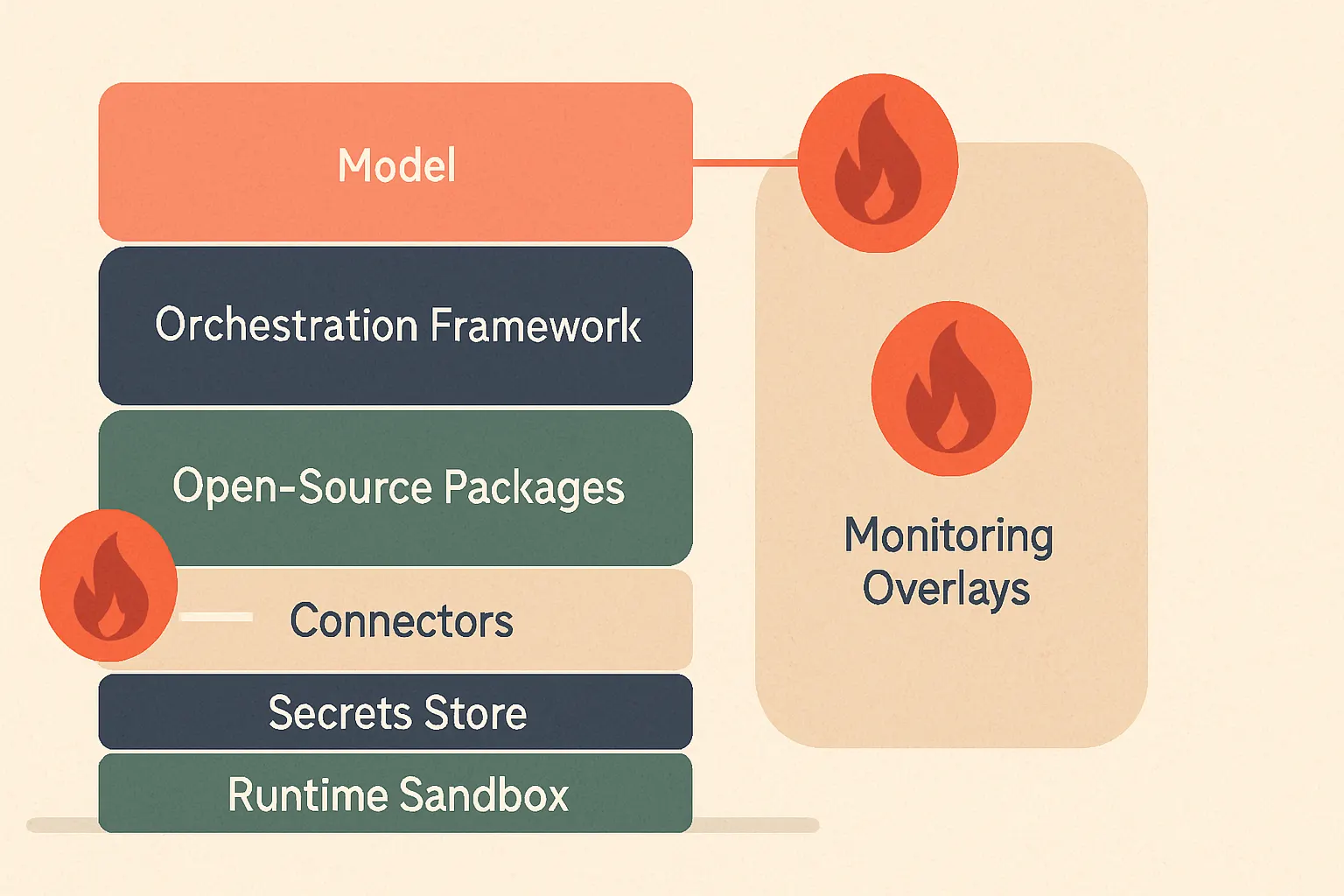
- The dangerous part isn't just the model — it's the toolchain around it: packages, connectors, plugins, containers, and secrets.
- Package provenance, sandboxing, secrets isolation, and runtime monitoring should be your baseline, not your "phase two."
- If an agent can take actions, it needs the same threat modeling discipline you'd apply to a production microservice with admin access.
- The teams that win won't be the ones with the most agents. They'll be the ones who can prove what those agents are allowed to do.
The Blind Spot: People Threat-Model the Prompt, Not the Plumbing
We've seen this pattern a few times now.
A team spends weeks debating prompt injection, jailbreaks, and output filters. Good. They should. Then they wire the agent into five external tools, install a couple of community packages, mount broad environment secrets into the runtime, and give the process outbound internet access because "the agent needs flexibility."
That's not flexibility.
That's how you accidentally build a very enthusiastic insider threat.
The industry keeps talking about agent reasoning, memory, orchestration, and autonomy. Fine. Those things matter. But if you're deploying agents in production, the boring plumbing is where the real damage usually starts. Supply-chain risk isn't glamorous, which is probably why so many teams keep ignoring it.
Bad move.
Here's the mental model we use: an AI agent is less like a "smart assistant" and more like a junior operator with root access, terrible judgment under ambiguity, and a backpack full of third-party code.
Would you onboard that person without controls?
Exactly.
Before we get into the checklist, here's the shape of the problem.
Why Agent Stacks Make Old OSS Problems Worse
Classic software already has dependency risk. Everyone knows that. We all pretend our SBOMs are cleaner than they are, and we all have at least one service held together by a package nobody wants to touch.
Agents make this worse for four reasons.
1. They sit closer to sensitive actions
A vulnerable dependency in a brochure website is annoying.
A vulnerable dependency in an agent that can read support tickets, pull invoices, reset passwords, generate refunds, or query internal docs is a different class of problem. The issue isn't just code execution. It's action execution.
If the agent can do things, compromise has leverage.
2. They pull in weird, fast-moving dependencies
Agent stacks are magnets for experimental tooling. Frameworks, browser drivers, tool adapters, vector DB clients, model SDKs, plugin systems, MCP servers, scraping libraries, eval harnesses — a lot of this software is useful, young, and not exactly battle-hardened.
We've tried some of these stacks ourselves. Some were solid. Some felt like installing a vending machine inside your production network and hoping nobody notices.
Hot take: the average agent demo repo is dramatically less trustworthy than the average backend service dependency tree.
And yet teams are giving those demos access to real systems.
3. They often run with broad secrets by default
This one is painfully common.
A team puts OPENAI_API_KEY, NOTION_TOKEN, SLACK_BOT_TOKEN, GITHUB_TOKEN, CRM_API_KEY, and a cloud credential in one runtime because it's "easier for the agent." Easier, yes. Also terrible.
Once the runtime is compromised, your blast radius becomes "everything the process can see."
4. They create messy transitive trust
Your agent trusts its framework.
That framework trusts a tool package.
That tool package trusts a parser.
That parser trusts a helper library.
That helper library was maintained by one person who hasn't slept since 2023.
You get the idea.
Why "Millions of AI Agents" Changes the Math
One vulnerable package affecting one internal bot is manageable.
The same package embedded across customer support agents, sales copilots, finance workflow bots, internal knowledge assistants, voice agents, and edge-deployed assistants is a multiplier. The more agents you deploy, the more duplicated trust assumptions you create.
This is the part a lot of leadership teams miss. Scale doesn't just increase usage. It increases interaction surfaces and failure replication.
If you have ten agents, a bad dependency is a problem.
If you have thousands, it's a fleet issue.
If we're really heading toward millions of AI agents across enterprises, then dependency governance stops being a DevSecOps side quest and becomes core operational infrastructure. That's especially true for teams building customer-facing systems like AI agents, voice AI, or on-prem and on-device AI, where the runtime environment and trust boundaries vary wildly.
And here's where it gets weird.
The more "autonomous" your agent becomes, the less obvious the compromise may look. A traditional breach might trigger obvious alarms. An agent compromise can look like normal work: querying documents, making API calls, updating records, summarizing data, sending messages.
It can fail quietly.
Like a forklift driving through a warehouse at 3 a.m. with the lights off.
The Four Controls We'd Implement First
If you're looking for a practical hardening plan, don't start with some giant enterprise security opera. Start with four controls and do them properly.
Here's how the pipeline should work:
flowchart TD
  A[Approved package sources] --> B[Build with provenance checks]
  B --> C[Isolated agent runtime]
  C --> D[Scoped secrets broker]
  D --> E[Tool calls with policy checks]
  E --> F[Runtime monitoring and kill switch]
1. Lock Down Package Provenance
If you don't know where your agent dependencies came from, you're already behind.
At minimum, we recommend:
- Pin exact versions for direct dependencies
- Generate and store SBOMs per agent service
- Verify package provenance and signatures where supported
- Restrict installs to approved registries and mirrors
- Block ad hoc
pip installornpm installin production runtimes - Review transitive dependencies for high-risk toolchains
- Rebuild images from clean CI, not developer laptops
This sounds basic because it is basic. That's the point.
The failure mode we keep seeing is teams treating agent code like "experimental glue" instead of production software. Then six months later, that glue is handling customer operations.
We'd also strongly recommend splitting experimental agent prototypes from production agent runtimes entirely. Different repos. Different registries. Different credentials. Different blast radius.
Yes, it's more work.
No, you shouldn't skip it.
If you're building custom agent infrastructure or custom models, this is one of those places where bespoke work is actually worth it. Generic scaffolds are fast until they aren't.
2. Sandbox the Runtime Like You Mean It
A lot of "sandboxing" is fake.
People put an agent in a container, give it network access, mount secrets, allow shell execution through a tool wrapper, and call it isolated. That's not a sandbox. That's a studio apartment with the front door open.
Real isolation means making the runtime boring and constrained:
- Run agents in separate workloads by trust level
- Deny outbound network by default; allowlist what they need
- Remove shell access unless there's a very specific reason
- Use ephemeral filesystems where possible
- Restrict filesystem mounts
- Limit CPU, memory, and execution time
- Separate browser automation workloads from core business logic
- Use different sandboxes for untrusted content processing
We've found this matters even more for voice and edge systems. With products like RunHotel and other low-latency assistants, the temptation is to collapse everything into one runtime to keep things simple. Sometimes that's fine. Sometimes it's a disaster.
If the agent needs to hear guests, query hotel systems, and trigger actions, then isolation boundaries matter even more because latency pressure makes people cut corners.
And security shortcuts made for latency are still security shortcuts.
Secrets Isolation: Stop Handing the Agent the Master Key Ring
This is the control most teams know they should fix and somehow never do.
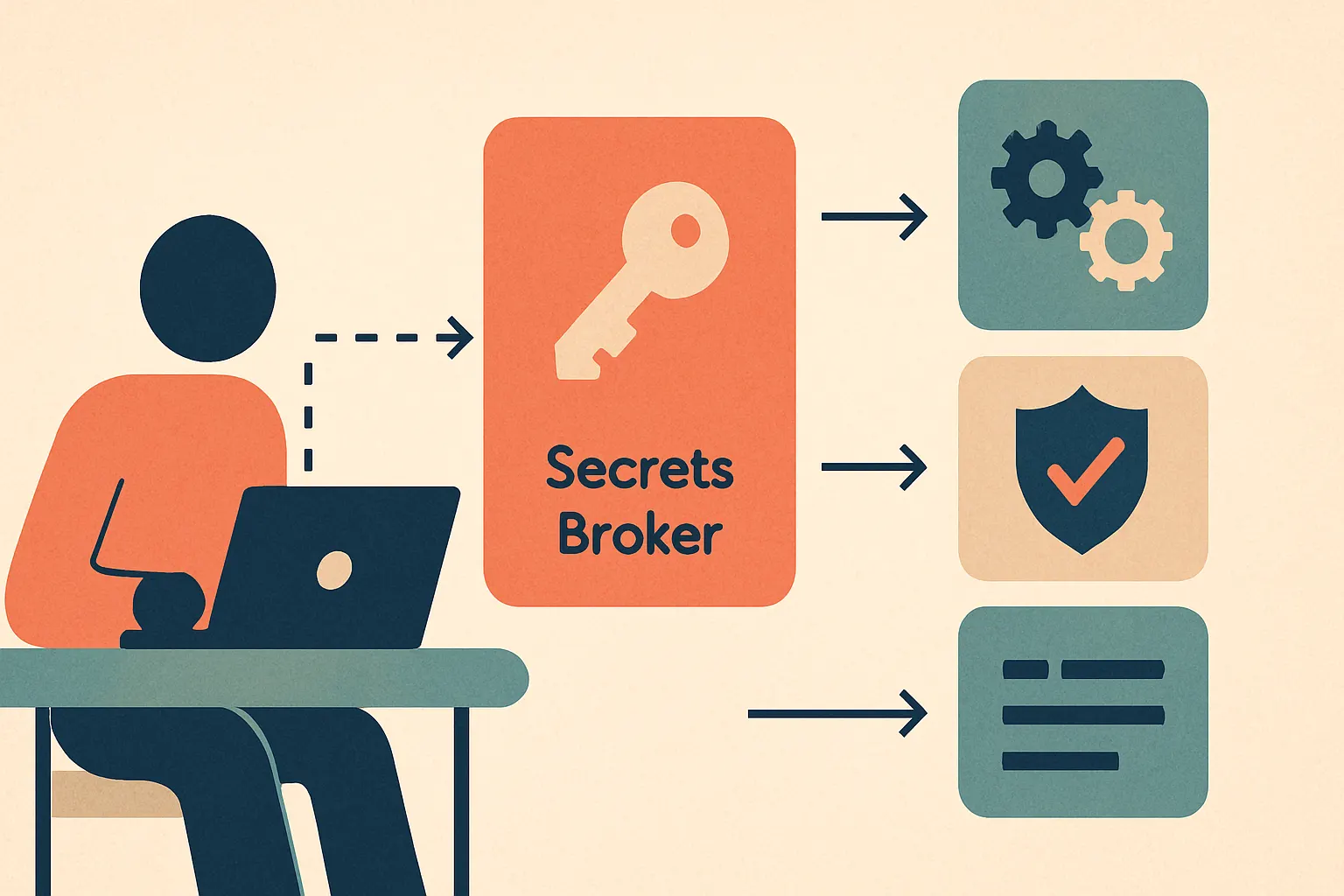
An agent shouldn't receive a bag of long-lived credentials and "figure it out." It should request narrow, short-lived access to a specific tool for a specific action under a policy.
Think valet key, not house key.
Here's the model we prefer:
- The agent runtime gets no broad environment secrets
- Tool access goes through a secrets broker or policy gateway
- Credentials are short-lived and scoped to one system or action
- High-risk actions require secondary approval or policy checks
- Read and write permissions are separated whenever possible
- Every secret issuance is logged with agent identity and purpose
This is where a lot of teams need AI consulting, honestly. Not because the idea is hard, but because retrofitting least-privilege into a messy agent stack is like trying to install seatbelts after the car is already on the highway.
Possible? Sure.
Fun? Not remotely.
Here's a simple reference pattern:
A strong opinion, because somebody has to say it
If your agent process can directly read all production secrets from environment variables, your architecture is bad.
Not "could be improved." Bad.
Fix that first.
Runtime Monitoring: Because Prevention Fails
You won't prevent everything. Nobody does.
So the next question is whether you'll notice when an agent starts acting strange.
This is where traditional application monitoring isn't enough. CPU, memory, and response times are useful, but they won't tell you that an agent suddenly started calling a finance API 400 times in ten minutes after ingesting a poisoned document.
You need agent-specific telemetry:
- Tool call frequency by agent and tenant
- New destination domains and blocked egress attempts
- Secret issuance patterns
- Prompt and context source lineage
- Action approval failures
- Unusual read/write ratios
- Drift in task completion patterns
- Spikes in retries, loops, or self-correction chains
We also recommend a hard kill switch per agent class. Not a Jira ticket. Not a "we'll roll back after standup." A real operational control.
If an agent starts behaving like it drank three espressos and found your production database, you should be able to stop it fast.
This matters for every deployment model, but especially for distributed systems and on-device AI, where central visibility is harder. If part of your fleet runs locally, your monitoring design needs to account for delayed telemetry, partial connectivity, and local policy enforcement.
Otherwise you'll be flying blind.
The Checklist We'd Actually Use
Most security checklists are padded nonsense. Here's the shorter version we'd actually put in front of an engineering team.
Package provenance
- Pin exact dependency versions
- Use approved registries only
- Generate SBOMs on every build
- Verify signatures/provenance where available
- Block production installs outside CI
- Review high-risk transitive dependencies
Sandboxing
- Isolate agent runtimes by trust level
- Default-deny outbound network
- Remove shell and filesystem access unless required
- Use ephemeral execution environments
- Set strict compute and time limits
- Separate browsing/scraping from internal tool execution
Secrets isolation
- No broad environment secret injection
- Use a broker for short-lived scoped credentials
- Log every credential issuance
- Separate read from write scopes
- Require approval for sensitive actions
- Rotate credentials aggressively
Runtime monitoring
- Track tool calls, egress, retries, and loops
- Alert on unusual access patterns
- Capture action lineage and policy decisions
- Maintain per-agent kill switches
- Test incident response with simulated compromise
Governance
- Inventory every agent, tool, and connector
- Assign an owner to each production agent
- Define allowed actions explicitly
- Review third-party packages like production dependencies, because they are
If you're budgeting this work, use something like our AI cost estimator for the operational side — but don't make the classic mistake of modeling only inference and infrastructure. Security controls cost time and money too. Ignore that, and your "cheap" agent rollout gets expensive the first time you have to unwind a bad deployment.
What Founders and Engineering Leaders Should Do This Quarter
If you're a founder, ask one uncomfortable question: which of our agents can take actions in systems that affect money, customer data, or access control?
Then ask who owns the dependency and credential policy for those agents.
If the answer is fuzzy, that's your problem.
If you're an engineering leader, don't wait for a security team to magically solve this later. Put a baseline in place now:
- Inventory every production and near-production agent
- Classify each by action capability and data sensitivity
- Lock dependency sources and generate SBOMs
- Move secrets behind a broker
- Add egress controls and runtime telemetry
- Create a kill switch and test it
This isn't glamorous work. Nobody posts a launch thread about "we finally removed broad environment secrets from our agent runtime."
They should, honestly.
Because that's the stuff that keeps your company out of incident review hell.
And if you're still in the build phase, this is exactly the right moment to get help designing the stack properly. We've done that kind of work across AI systems, voice workflows, and production software delivery, and it's much easier to harden architecture early than to clean up after an incident. If you want a second set of eyes on your agent design, talk to us.
The Real Risk Isn't the Model
Here's the punchline: the scary part of agent deployments usually isn't the model.
It's the stack around the model.
The wrappers. The connectors. The packages. The secrets. The permissions. The runtime. The assumptions.
That's the blind spot.
And the more companies race to deploy millions of AI agents, the more that blind spot starts to look like the next big supply-chain mess — except this time the compromised component may not just leak data. It may take action on your behalf while looking completely normal.
Which is a pretty ugly trick.
So harden the plumbing now.
Because "our agent was very helpful right up until the breach" is a terrible postmortem title.