


We watched an agent ace the benchmark, then faceplant on a real invoice
Hitesh Sondhi · April 14, 2026 · 12 min read
A while back, we had an agent that looked fantastic on paper. It crushed the eval set, posted neat little success numbers in the dashboard, and made everyone feel smart for about 48 hours. Then we put it in a real workflow with messy PDFs, contradictory policies, and one user who wrote instructions like they were texting from a roller coaster — and the thing fell apart.
That’s the dirty secret of AI agent benchmarks: a lot of them reward test-taking, not working.
And if you’re shopping for enterprise agents, or building them yourself, you need to understand how we broke top benchmark scores in our heads before production broke us in reality. Because once you see how easy benchmark gaming is, you stop treating leaderboard wins like proof of competence.
Key Takeaways
- Benchmark scores often measure familiarity with the test, not reliability in production.
- Agents fail in production because real environments are noisy, stateful, adversarial, and full of ugly edge cases.
- If you want useful evaluation, test for latency, recovery, tool misuse, cost, and consistency — not just task completion.
- How we broke top scores mentally was by realizing the benchmark itself was the problem, not just the model.
- Production-grade agent testing should look more like chaos engineering than a school exam.
Why benchmark wins feel good — and mean less than you think
Benchmarks are seductive because they give you a number. Humans love a number. It feels like progress, like certainty, like you can point at a chart and say, “See? We’re winning.”
But most agent benchmarks are too clean.
The tasks are often short, the tools are predictable, the success criteria are narrow, and the environment doesn’t fight back. Real enterprise systems do. APIs timeout. Permissions are weird. Internal docs contradict each other. Somebody renamed a field six months ago and forgot to tell anyone.
That’s where it gets weird.
A benchmark asks, “Can the agent complete this task?” Production asks, “Can it complete this task on a Tuesday, with partial context, stale memory, one tool degraded, and a finance team that will absolutely notice if it gets one decimal wrong?”
Those are not the same exam.
The benchmark gaming problem nobody likes to admit
Here’s the hot take: a lot of agent evaluation today is just overfitting with better PR.
Not always intentionally. Sometimes teams tune prompts, tool descriptions, retry logic, and routing until the benchmark score climbs. That’s normal engineering. We do that too. The problem starts when the benchmark becomes the product strategy.
Then you get systems optimized to pass a known obstacle course, like a dog trained to sprint through orange cones but unable to cross a crowded street.
We’ve seen a few common ways this happens:
1. The eval set becomes sacred scripture
If your team runs the same 200 tasks every week, your stack starts memorizing them indirectly. Prompt templates drift toward those cases. Tool wrappers get patched for those failure patterns. Routing gets suspiciously good at exactly what the eval expects.
You didn’t build a general agent. You built a benchmark specialist.
This is basically how we broke top confidence in leaderboard-driven development. The score improved while the real-world failure rate stayed annoying.
2. Success gets defined too generously
A benchmark says the right API was called. Great. But did it call the API twice and create duplicate records? Did it leak sensitive context into the tool input? Did it take 38 seconds and burn 14x the expected tokens to get there?
“Technically completed” is one of the most dangerous phrases in AI engineering.
In enterprise settings, a slow correct answer can still be a bad answer. An expensive correct answer can still kill the rollout. A brittle correct answer can still wake up your ops team at 2 a.m.
3. Tool use gets scored like a multiple-choice quiz
Many agent benchmarks treat tools as clean, deterministic functions. Production tools are more like borrowing your cousin’s old car: sometimes they work, sometimes the door sticks, and sometimes a warning light appears for no reason.
If your eval doesn’t simulate flaky APIs, malformed responses, permission errors, and partial state updates, you’re not testing an agent. You’re testing a fantasy.
Here’s a simple way to think about it:
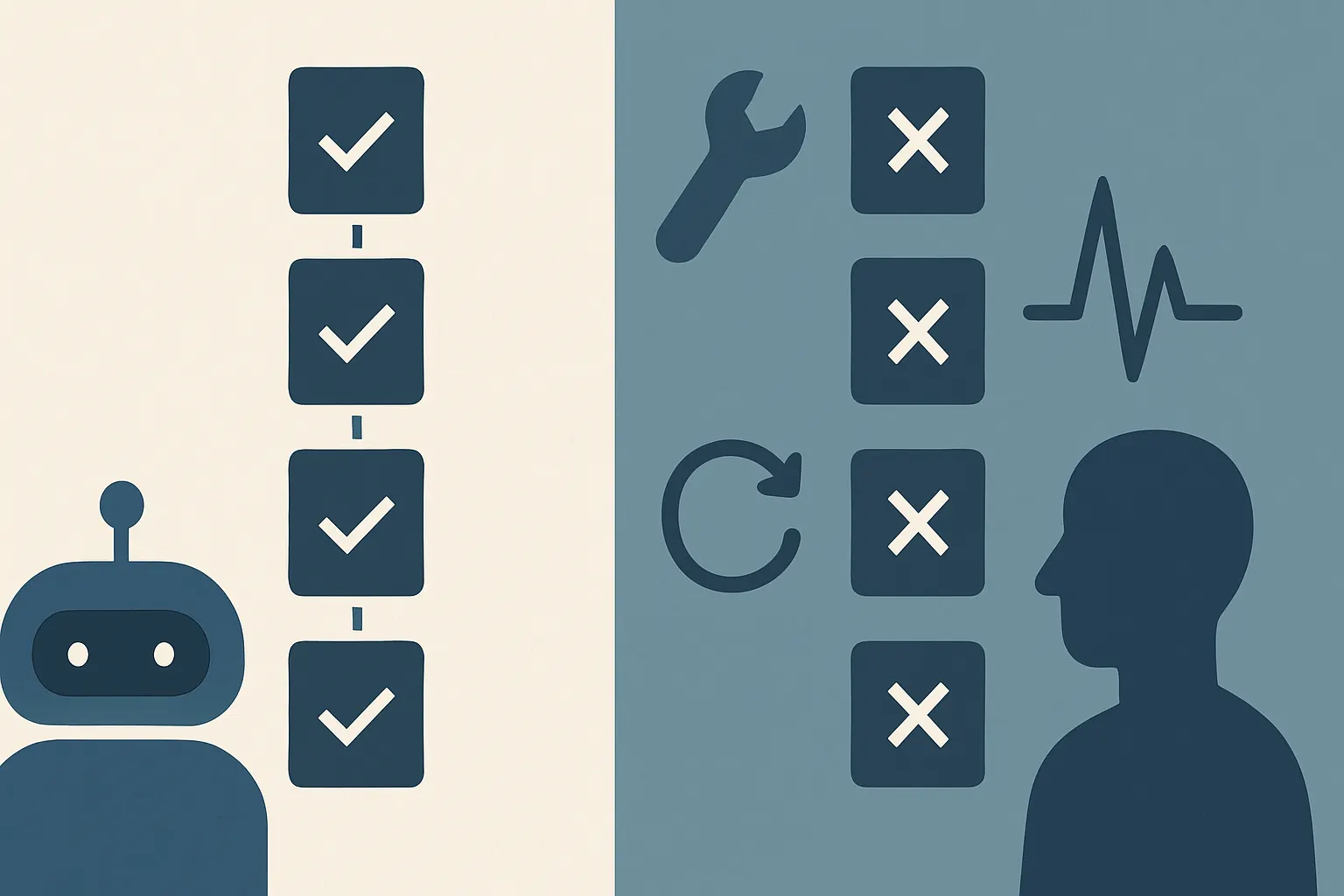
Why production is where agents tell the truth
Benchmarks are staged interviews. Production is moving in together.
That’s when you learn the habits.
An enterprise agent isn’t just reasoning over text. It’s juggling state, tool calls, guardrails, user ambiguity, business rules, and non-negotiable latency budgets. If any one of those cracks, the user doesn’t care that your benchmark score was pretty.
We’ve found production failures usually cluster into five ugly buckets:
State drift
The agent thinks step 4 happened. The backend says it didn’t. Now it’s making decisions on imaginary history.
This is common in multi-step workflows like approvals, booking changes, claims handling, or support escalations. Once state drifts, every next action is built on sand.
Tool misuse
The agent picks the wrong tool, passes the wrong arguments, or uses the right tool in the wrong order. Benchmarks often underweight this because they care about final output, not the path taken.
That’s a mistake.
For enterprise teams exploring /services/ai-agents, this is one of the first things to pressure-test. A polished demo can hide terrible tool discipline.
Recovery failure
A strong agent doesn’t just succeed. It fails well.
When a tool returns garbage or a dependency times out, does the agent retry intelligently? Ask for clarification? Fall back to a safer path? Or does it hallucinate confidence and keep marching like a lost tourist with a map from 1997?
Cost blowups
We’ve seen flows that “worked” but made five unnecessary model calls, repeated retrieval, and used a bigger model than the task deserved. That’s fine in a benchmark run. It’s a budget fire in production.
If you haven’t modeled cost per successful task, you’re guessing. We built tools like our /tools/ai-cost-estimator for exactly this reason.
Human unpredictability
Users do bizarre things. They paste half an email thread. They contradict themselves. They omit the one field you needed. They answer a clarifying question with “same as before,” even though there is no “before.”
Benchmarks rarely capture that chaos.
What production-grade testing should actually look like
If benchmark-first evaluation is a school exam, production-grade testing is more like a fire drill in a building with one blocked exit and a guy microwaving fish in the break room.
You need realism. You need friction. You need failure on purpose.
Here’s how we think about it.
Stop asking “Did it solve the task?” and start asking “How did it behave under stress?”
This is the big shift.
A useful agent eval suite should score not just task completion, but operational behavior. That means measuring things like:
- success rate under noisy inputs
- recovery rate after tool failure
- average and p95 latency
- token and dollar cost per successful run
- number of tool calls per task
- policy violation rate
- consistency across repeated runs
- degradation when context is incomplete or contradictory
That last one matters more than people admit.
An agent that performs well only when the prompt is clean and complete is like a chef who can cook only if every ingredient is pre-measured in tiny glass bowls. Nice on YouTube. Useless in a busy kitchen.
Here’s a simple testing loop we recommend:
flowchart TD
  A[Real enterprise tasks] --> B[Add noise and ambiguity]
  B --> C[Run agent with tools]
  C --> D[Score outcome and path]
  D --> E[Inject failures and retries]
  E --> F[Track latency cost safety]
  F --> G[Update prompts tools or model]
That loop is boring compared to posting benchmark screenshots on LinkedIn.
It’s also how you avoid embarrassment.
Build evals from production traces, not your imagination
This is one of our strongest opinions: synthetic evals are overrated unless they’re anchored to real failure data.
If your benchmark tasks were written in a calm afternoon by your own team, they’ll reflect your assumptions, your wording, and your internal sense of what “reasonable” looks like. Your users will immediately do something unreasonable.
So start with production traces.
Take real conversations, real support tickets, real workflow logs, real failed tool calls, and real escalation cases. Anonymize them properly. Then build eval scenarios from those patterns. That’s where you’ll find the edge cases that matter.
For teams working on voice systems through /services/voice-ai or on-device experiences via /services/on-device-ai, this gets even more brutal. Speech recognition errors, interruptions, accents, background noise, and device constraints will humble a “top” agent fast. We learned versions of this while building /products/runhotel, where voice UX had to survive actual hotel conditions, not lab conditions.
Hotel lobbies are not benchmark-friendly environments.
Test the system, not just the model
Another common mistake: teams evaluate the LLM and ignore everything around it.
But production agents are systems. The model is just one organ. The rest of the body matters: orchestration, retrieval, memory, tool wrappers, fallbacks, caching, observability, and guardrails.
We’ve seen mediocre models outperform stronger ones because the surrounding system was disciplined. We’ve also seen excellent models look dumb because the tool schema was a mess and the retries were naïve.
This is why how we broke top benchmark thinking internally came down to architecture, not just model choice. We stopped asking, “Which model wins the eval?” and started asking, “Which stack survives contact with reality?”
That’s a much better question.
If you’re building enterprise workflows, /services/custom-models can help when domain behavior really matters. But custom models won’t save a sloppy evaluation strategy. Bad tests produce false confidence at any parameter count.
The metrics that actually matter when money is on the line
If your agent touches operations, support, finance, healthcare, logistics, or anything else with consequences, these metrics deserve a seat at the table:
Task success rate under perturbation
Run the same task with missing fields, reordered instructions, irrelevant context, and mild contradictions. If performance collapses, your agent is fragile.
Path correctness
Did it use the right tools in the right sequence with valid arguments? Final answers can hide dangerous process errors.
Time to recovery
When a tool fails, how many steps does it take to recover? Fast recovery is often more valuable than perfect first-pass success.
Cost per successful completion
This is the metric that turns “cool demo” into “viable product.” We care about this a lot because enterprise adoption dies quickly when every workflow feels like hiring a consultant to open a spreadsheet.
Safety and policy adherence
Did the agent stay within allowed actions, data boundaries, and approval rules? If not, the benchmark score is decoration.
Variance across runs
A good agent shouldn’t feel like a slot machine. If the same task succeeds 9 times and fails the 10th for no obvious reason, users will lose trust long before your team finishes root-cause analysis.
Why leaderboards keep winning anyway
Because they’re simple.
A single score is easy to market, easy to compare, and easy for executives to repeat in meetings. “We’re top-three on benchmark X” sounds better than “our recovery behavior under partial tool degradation improved 18% on a custom eval set built from anonymized production traces.”
One of those is useful. The other fits on a slide.
We get the temptation. But if you’re serious about enterprise deployment, especially if you’re talking to a partner like /services/ai-consulting, ask harder questions than benchmark rank. Ask what happens when the tool lies. Ask what happens when the user is unclear. Ask what happens when latency spikes, memory pollutes context, or approvals arrive out of order.
That’s where the real product lives.
So what should you do next?
If you already have an AI agent in pilot, pull 50 failed or escalated sessions and categorize them. Don’t start with the wins. The losses are the map.
Then build an eval suite from those failures and run every model, prompt, tool wrapper, and orchestration change against it. Track success, path correctness, latency, and cost together. If you need help designing that stack, that’s exactly the kind of work we do in /services/ai-agents — and if you want to talk through your current setup, /contact is a good place to start.
One more hot take before we wrap this up: the best agent team often isn’t the one with the smartest model. It’s the one with the least self-deception.
That’s really the story behind how we broke top benchmark worship. We didn’t find a magical eval. We just got tired of being lied to by clean numbers and started testing like production was out to get us.
Because it is.
FAQ
Why do AI agent benchmarks fail in production?
Because they usually test clean, narrow, repeatable tasks, while production is noisy, stateful, and full of tool failures, ambiguity, and human weirdness.
Are public benchmarks useless?
No, but they’re incomplete. They’re useful for rough comparison, not for proving enterprise readiness.
What should we measure instead of just benchmark score?
Measure task success under noisy conditions, tool-path correctness, recovery behavior, latency, cost per successful task, and policy adherence.
Can better models solve the benchmark-to-production gap?
Sometimes they help, but they don’t fix bad orchestration, weak tools, poor memory handling, or unrealistic eval design.
When should we consider custom models or on-device agents?
Consider them when domain specificity, privacy, latency, or offline behavior really matters. That often comes up in /services/custom-models and /services/on-device-ai engagements.
Sources
- OpenAI, “GPT-4.1” evaluation and benchmark discussion: https://openai.com/index/gpt-4-1/
- Anthropic, “Building effective agents”: https://www.anthropic.com/engineering/building-effective-agents
- Stanford HAI, “HELM: Holistic Evaluation of Language Models”: https://crfm.stanford.edu/helm/latest/
- GAIA benchmark paper/site for real-world agent evaluation context: https://gaia-benchmark.github.io/
- SWE-bench benchmark for software engineering agents: https://www.swebench.com/