

When Five Frontier LLMs Disagree, Your AI Stack Needs Guardrails
Hitesh Sondhi · July 22, 2026 · 11 min read
We’ve seen teams ship an AI feature after testing it on one model, one prompt, and one happy-path dataset. Then production shows up like a brick through a window.
One week it’s “works great in staging.” The next week support is forwarding screenshots where Model A says a claim is supported, Model B says it’s false, and Model C writes a very confident paragraph that sounds smart and is completely useless. That’s not an edge case anymore. That’s the job.
A new analysis from Lenz found that five frontier LLMs disagree on 67% of 1,000 real-world fact-check claims Lenz Research. If you build AI systems and that number doesn’t change your architecture, your architecture is lying to you.
Key Takeaways
- Single-model evals are too weak for production decisions when five frontier llms disagree this often.
- Disagreement is a signal. Use it to trigger routing, fallback logic, and human review.
- Your eval set should measure variance across models, not just average accuracy.
- High-confidence answers from one model are not enough for risky workflows like compliance, finance, or support.
- If you can’t afford multi-model checks everywhere, add them only where the cost of being wrong is ugly.
The uncomfortable part: disagreement isn’t noise
The lazy read of the Lenz result is “LLMs still hallucinate.” Sure. We knew that.
The more useful read is this: model disagreement is operational data. It tells you where your system is brittle, where your prompt is underspecified, and where your product needs a brake pedal. If five frontier models diverge on the same claim, the problem isn’t just model quality. It’s uncertainty management.
That’s the part a lot of teams skip because uncertainty is annoying. It doesn’t fit nicely in a launch deck.
Here’s the mental model we use: building with LLMs is less like writing deterministic software and more like running a kitchen with five talented chefs who all improvise. If they all plate roughly the same dish, great. If one sends out ramen, one sends out risotto, and one sets the pan on fire, you don’t need “better branding.” You need kitchen rules.
Here’s what that looks like in practice.
Why your evals are probably flattering you
Most AI evals are built to answer the wrong question.
They ask: “Which model scores highest on our benchmark?” That’s fine for a bake-off. It’s bad for system design. The real question is: where do strong models diverge, and what happens when they do?
The Lenz piece looked at 1,000 real-world fact-check claims and found 67% disagreement among five frontier models Lenz Research. Even if you argue about methodology, the takeaway stands: agreement is not guaranteed even among top-tier systems on factual judgment tasks.
Hot take: if your eval spreadsheet has one accuracy column per model and nothing about inter-model variance, it’s not an eval. It’s a leaderboard with delusions of grandeur.
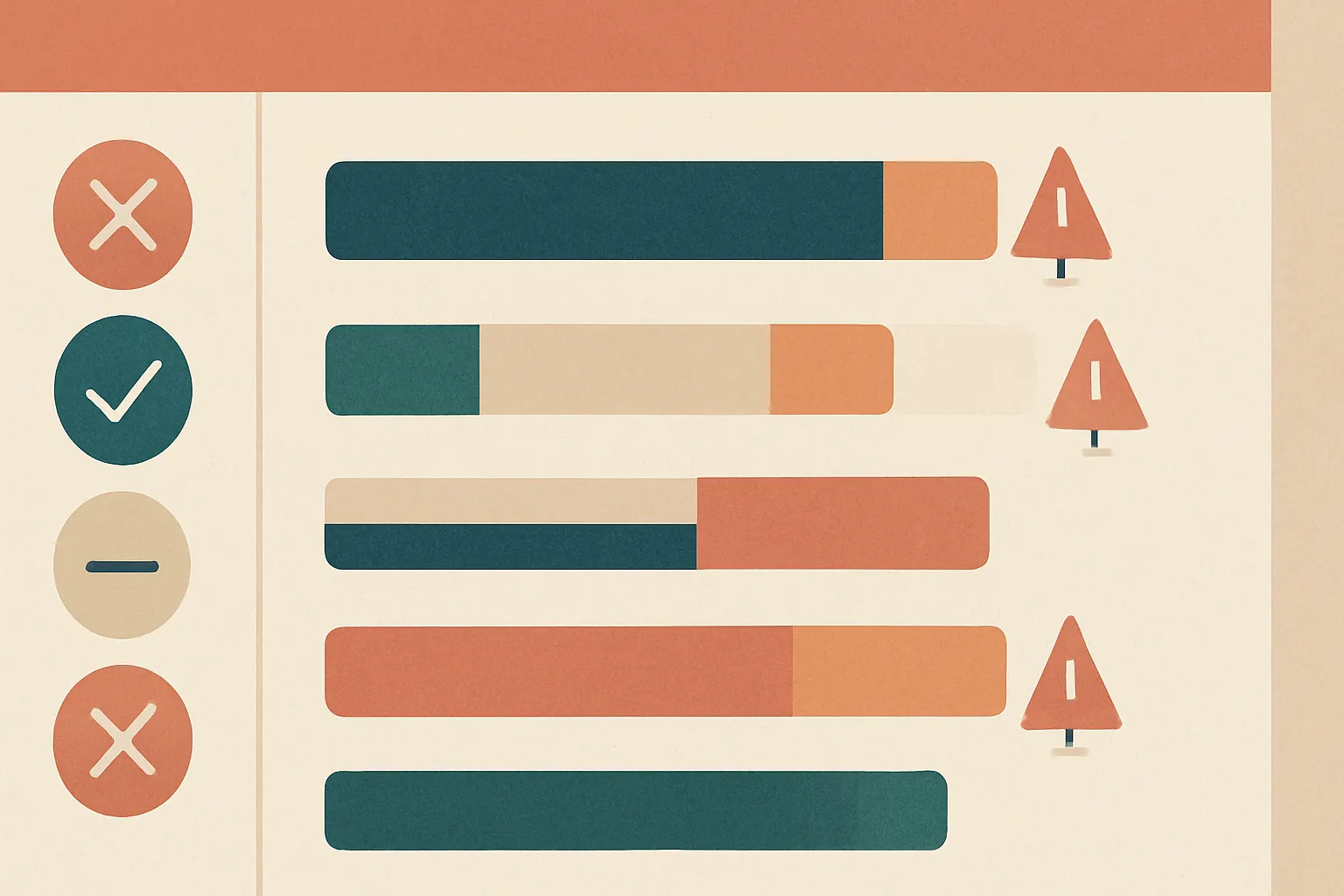
We’ve found four additions make evals much more honest:
1. Track consensus rate, not just correctness
You still need correctness labels. Obviously.
But also track:
- full agreement across models
- split decisions
- one-model outliers
- “confident but isolated” answers
A claim where 4 of 5 models agree and 1 goes rogue is a different operational problem than a 2-2-1 split. Treating both as “some models got it right” is how bad systems sneak into production.
2. Label by business risk
A wrong answer in a brainstorming tool is annoying. A wrong answer in claims processing, legal triage, or medical support is a grenade with the pin half out.
So don’t run one global threshold. Tag eval items by impact:
- low-risk: drafting, summarization, internal search
- medium-risk: support suggestions, workflow automation
- high-risk: policy interpretation, financial recommendations, compliance claims
Same model. Same prompt. Different tolerance.
3. Measure disagreement after retrieval
This is where it gets weird.
A lot of teams assume retrieval fixes factual inconsistency. Sometimes it does. Sometimes it just gives five models the same pile of documents and they still interpret them differently. We’ve seen RAG pipelines act like five lawyers reading the same contract and finding five different loopholes.
If you only evaluate the base model, you miss the system behavior that matters. Test the full chain: retrieval, ranking, context packing, generation, and post-processing.
4. Force binary decisions when the workflow needs them
If your product needs a yes/no decision, don’t accept a paragraph and manually interpret it later. That’s how ambiguity gets smuggled into production wearing a tie.
Ask for:
- verdict
- evidence span
- uncertainty score
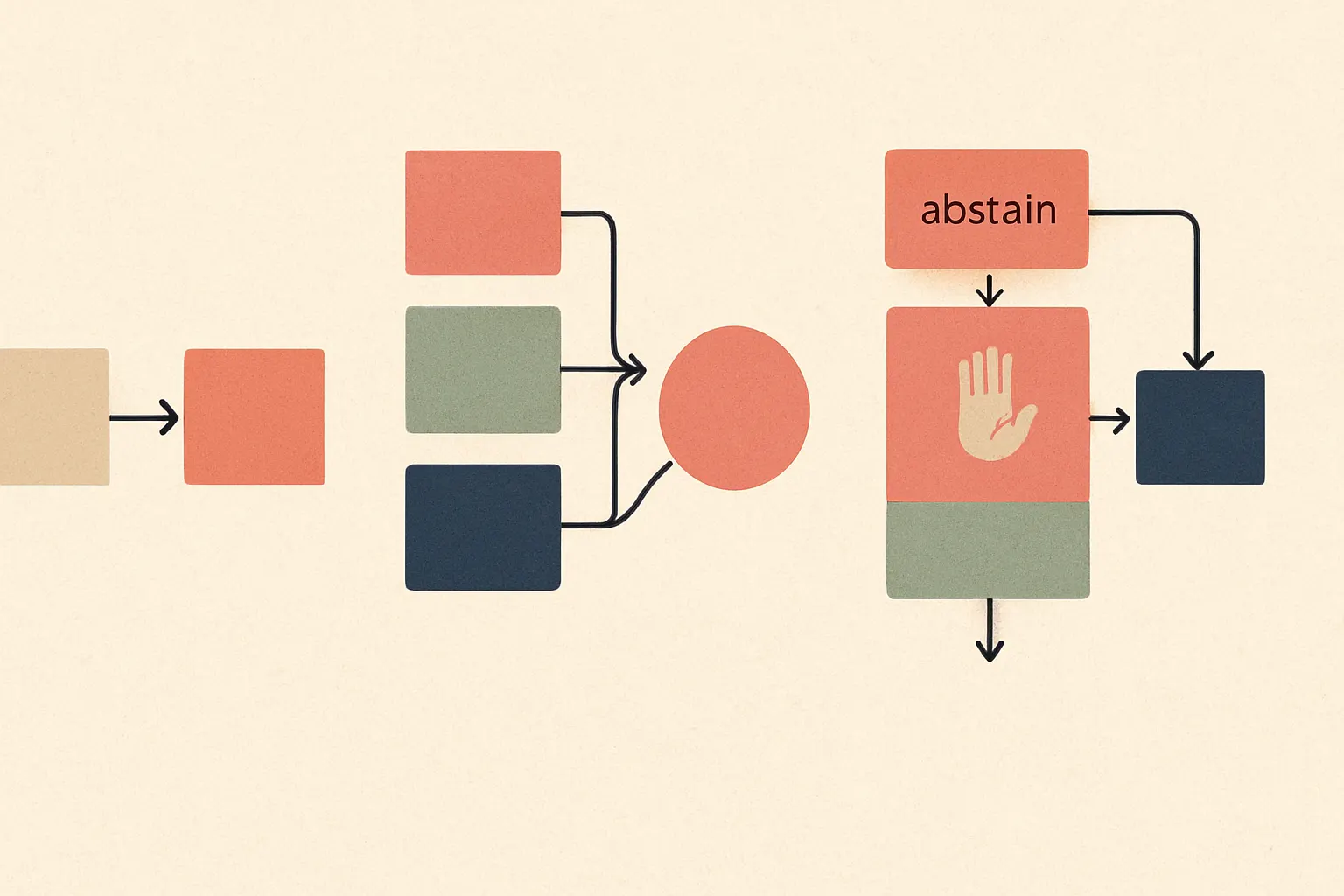
- abstain option
If the model can’t abstain, it will cosplay certainty.
Build the stack like disagreement is inevitable
A lot of teams still build AI systems as if one model call should settle the matter. That’s optimistic in the same way that deploying on Friday is optimistic.
When five frontier llms disagree, your stack needs explicit guardrails in four places: routing, fallback, escalation, and observability.
Here’s a simple version of the flow:
flowchart TD
  A[User request] --> B[Risk classifier]
  B -->|Low risk| C[Primary LLM]
  B -->|Medium/High risk| D[Primary LLM + verifier model]
  C --> E[Confidence and policy checks]
  D --> F[Agreement check]
  F -->|Agree| E
  F -->|Disagree| G[Fallback or human review]
  E -->|Pass| H[Return answer]
  E -->|Fail| G
That diagram is boring on purpose. Production systems should be boring.
Routing: stop sending every task to one giant model
Not every request deserves your most expensive, slowest model.
We usually split traffic by task type and risk. Straightforward extraction or classification can go to a smaller or cheaper model. Ambiguous, high-stakes, or policy-sensitive tasks get a stronger model plus a verifier. If you’re building private or latency-sensitive apps, some of that can run through on-device AI services or a tailored custom model stack.
The trick isn’t “use more models.” The trick is “use extra scrutiny where disagreement hurts.”
That’s cheaper.
And usually better.
Fallback logic: don’t just retry louder
One of the worst anti-patterns we see is fallback logic that does this:
- call model
- get weird answer
- resend same prompt to same model
- hope the vibes improve
This is bad.
A real fallback should change something meaningful:
- switch to a different model family
- tighten the output schema
- reduce context to the most relevant evidence
- ask for citation extraction before final judgment
- downgrade to a safer partial answer
- abstain and escalate
If your fallback is just “again, but with confidence,” you built a slot machine.
Human-in-the-loop: use disagreement as the trigger
Human review is expensive, so teams either overuse it and kill throughput or avoid it and ship nonsense. The middle path is to escalate based on signals that actually correlate with uncertainty.
Disagreement is one of the best ones.
A practical escalation policy might look like this:
- single model only for low-risk tasks
- add a verifier for medium-risk tasks
- escalate if models disagree on verdict
- escalate if evidence spans don’t overlap
- escalate if output violates policy or schema
- escalate if confidence is high but unsupported by retrieved context
That last one matters. Confident nonsense is more dangerous than hesitant nonsense because users trust it faster.
We’ve used similar patterns in AI agent and voice workflows, where a bad answer doesn’t just sit on a screen — it speaks out loud and becomes instantly more believable. That’s one reason we’re opinionated about guardrails in AI agents and voice AI systems. Spoken errors feel authoritative in a way text errors sometimes don’t.
Don’t confuse majority vote with truth
This is where people get seduced by a nice-looking architecture diagram.
If five models disagree, the obvious move is majority voting. Sometimes that helps. Sometimes it’s just five interns copying each other’s homework with different handwriting. Shared training data, similar web evidence, and common prompt biases can produce correlated mistakes.
So no, “4 out of 5 models said it” is not the same thing as “it’s true.”
Use ensembles carefully:
- good for catching isolated failures
- useful when models are genuinely diverse
- weak when all models share the same blind spot
- dangerous when you don’t inspect evidence quality
Our rule of thumb: for factual or policy-sensitive tasks, vote on verdicts only if you can also inspect evidence. Otherwise you’re counting opinions, not validating claims.
Here’s a better pattern:
- independent answer generation
- evidence extraction for each answer
- compare verdicts
- compare evidence overlap
- abstain if verdicts or evidence diverge too far
That’s slower than one-shot generation.
It’s also less embarrassing.
The cost argument is real, but people use it as an excuse
Yes, multi-model checks cost more.
No, that doesn’t mean you should ignore disagreement.
The grown-up approach is selective redundancy. Put extra verification only where failure is expensive. A support chatbot answering “where do I reset my password” doesn’t need a tribunal of frontier models. A claims decision assistant probably does.
If you want to sanity-check the economics before you build, run rough numbers with an AI cost estimator. We do this early because “we’ll optimize cost later” is how teams accidentally design themselves into a corner.
And if latency matters, don’t forget architecture options beyond cloud-only inference. We’ve seen strong results from hybrid designs: lightweight local triage, cloud verification only on risky turns, and hard handoff when uncertainty spikes. That kind of pattern is especially useful in products like RunHotel, where voice interactions need to feel instant but still need boundaries.
Cheap and wrong is expensive in disguise.
What to change this quarter, not someday
If you’re leading an AI product team, here’s the practical checklist.
Redesign your eval suite
Add inter-model agreement metrics. Slice by task type and business risk. Review the disagreement set manually every week.
That disagreement set is gold. It tells you where prompts are vague, retrieval is weak, or policy is underspecified.
Add an abstain path
Force the system to say “I’m not sure” in a structured way. Then wire that to fallback or human review.
Most teams avoid abstention because they think it hurts UX. Wrong. Silent uncertainty hurts UX more once users catch you bluffing.
Introduce verifier models selectively
Don’t verify every answer. Verify high-risk ones, low-consensus ones, and outputs with weak evidence support.
A verifier can be a second frontier model, a smaller specialized classifier, or a rules engine. The point is not prestige. The point is friction in the right places.
Instrument disagreement in production
Log:
- request type
- retrieved sources
- primary answer
- verifier answer
- agreement status
- escalation reason
- final resolution
If you can’t see where your models disagree, you can’t improve routing or thresholds. You’re flying IFR with the cockpit lights off.
Set human review thresholds like a product decision
This isn’t just ML tuning. It’s product policy.
Choose thresholds based on user harm, not just model confidence. Then revisit them monthly with actual production examples.
Our blunt recommendation
If your system makes decisions that affect money, compliance, trust, or customer communication, design for disagreement from day one.
Not after the first incident.
Not after the CEO forwards a hallucinated answer.
Day one.
That means multi-model evals, abstain behavior, evidence-aware verification, and human escalation thresholds that are based on risk instead of hope. If you need help designing that architecture, this is exactly the kind of work we do in AI consulting and production custom models engagements.
The weirdly good news is that disagreement isn’t just a problem. It’s a map. It shows you where your system is fragile before your users do.
That’s useful.
Painful, but useful.
If you’re building an AI product and want a second set of eyes on eval design, routing, or guardrails, talk to us here. Better to add brakes now than discover at 2 a.m. that your “smart” system needed adult supervision the whole time.