

How to design APIs AI agents can use reliably and safely
Hitesh Sondhi · April 26, 2026 · 12 min read
We learned this the annoying way: a perfectly fine human-facing API turned into a chaos machine the moment an agent started using it.
A support workflow agent was supposed to refund a customer once. Instead, it retried a flaky endpoint, lost track of state, and attempted the same action again. Nobody got rich, but everybody got a headache. That's the thing about APIs for AI agents: what works for a patient human clicking buttons often falls apart when a probabilistic system is calling your endpoints at machine speed.
And yes, this is fixable.
Most teams make the same mistake. They think "agent-ready API" means "add OpenAPI spec, ship, pray." That's bad. Specs help, but reliability and safety come from constraints, idempotency, permissions, observability, and responses that don't read like they were written by a committee of databases.
Key Takeaways
- Human-friendly APIs aren't automatically agent-friendly. Agents need stricter contracts, clearer errors, and safer defaults.
- Idempotency keys, [narrow permissions](/blog/does-gas-town-steal), and explicit state transitions do more for safety than clever prompting ever will.
- [OpenAPI is useful, but it's not enough](/blog/how-we-broke-top). Discovery without guardrails is just giving a toddler your car keys.
- The best APIs for AI agents reduce ambiguity: predictable schemas, bounded actions, and machine-readable failure reasons.
- If you can't trace what the agent saw, decided, and executed, you don't have reliability — you have vibes.
Why your existing API probably breaks agents
A human sees a vague error like Something went wrong and adapts. They refresh, call support, or use common sense.
An agent sees that same error and starts improvising.
That's where it gets weird.
Agents don't just consume APIs. They plan around them. They infer. They retry. They chain one call into five more. If your API is inconsistent — customerId in one endpoint, customer_id in another, timestamps in three formats because apparently time is a social construct — the model will eventually make the wrong move.
We've found that reliability problems usually come from four boring things, not exotic model failures:
- Ambiguous action semantics
- Weak authentication and overbroad permissions
- Non-idempotent write operations
- Garbage error design
Boring wins again.
To make this concrete, here's the shape of a safe agent interaction loop:
flowchart TD
  A[Agent receives task] --> B[Discover allowed tools/endpoints]
  B --> C[Validate intent and parameters]
  C --> D[Call API with scoped auth + idempotency key]
  D --> E[API returns structured result or structured error]
  E --> F[Agent decides next step]
  F --> G[Audit log + human escalation if needed]
If your loop skips validation, scope, or audit, you're not building a system. You're hosting a casino.
What makes APIs for AI agents different from normal APIs?
Here's the hot take: most "API best practices" articles undersell how different agent traffic is.
Humans are sparse, forgiving, and contextual. Agents are fast, literal, and weirdly creative in the worst possible moments. They don't just need access to functionality; they need APIs designed for machine decision-making under uncertainty.
That means your API has to do three jobs well:
1. Tell the agent what it can do
This is the discovery layer: OpenAPI, tool schemas, MCP-style tool exposure, or a curated action registry. Anthropic's Model Context Protocol exists for a reason — static integrations don't scale well when agents need dynamic tool discovery across systems Anthropic MCP Docs.
But discovery is only half the story.
If you expose 40 actions with vague names like processTask, updateRecord, and executeOperation, the model will absolutely choose violence. Action names should be painfully clear: create_refund_request, cancel_reservation, send_invoice_pdf.
2. Tell the agent how to do it
This is where schemas matter. OpenAPI has become the default contract format because it gives machines a standardized way to understand operations and parameters OpenAPI Initiative.
Still, a valid schema can be a terrible agent interface.
Enums beat free text. Required fields beat implied ones. Explicit units beat "you know what we meant." If the amount is in cents, say cents. If the date must be ISO 8601, reject everything else.
Fine-tuning your model to work around a sloppy API is like seasoning burnt food. You're not fixing dinner.
3. Tell the agent what went wrong
Most APIs treat errors as an afterthought. For agents, errors are part of the control plane.
Bad:
{ "error": "Request failed" }Better:
{
  "error_code": "INSUFFICIENT_SCOPE",
  "message": "Token cannot issue refunds above 5000 cents",
  "retryable": false,
  "suggested_next_action": "request_human_approval"
}
That one change prevents a lot of dumb retries.
The five integration patterns we actually see in production
Search results are full of fluffy "integration patterns" that sound nice in slides. In practice, we keep seeing five patterns for APIs for AI agents, and each has tradeoffs.
1. Read-only retrieval APIs
These let agents fetch CRM records, order status, inventory, knowledge base content, or analytics.
They're the safest place to start because the blast radius is low. But teams still mess this up by returning giant, noisy payloads. If your getCustomer endpoint returns 180 fields and the agent only needs name, status, and last invoice, you're making the model sift through a junk drawer.
Use filtered responses and task-specific endpoints.
2. Action APIs with strict side effects
This is where money moves, reservations change, tickets close, and emails send.
This pattern needs the strongest controls: idempotency keys, approval thresholds, role-scoped tokens, and explicit confirmation states. Stripe has long documented idempotent request handling for safely retrying writes, and that principle matters even more with agents Stripe Docs.
If an agent can trigger a payment, cancellation, or account change without guardrails, that's not automation. That's negligence.
3. Multi-step workflow APIs
Sometimes one endpoint isn't enough. The agent has to gather data, validate constraints, reserve resources, then commit.
This is where transactional design matters. Don't make the model guess whether step two can safely run before step one is finalized. Give it stateful workflows: draft -> pending_approval -> committed -> rolled_back.
We've done similar thinking in voice and on-device systems where partial failure is normal, especially when connectivity is messy. If you're building agent workflows that need to survive real-world conditions, our work in on-device AI and voice AI runs into the same ugly truth: state management is the whole game.
4. Event-driven callback APIs
The agent kicks off a long-running task — document generation, search indexing, background reconciliation — and gets the result later via webhook or polling.
This is cleaner than forcing the model to sit around waiting. It also reduces timeout chaos. But your callback events need signatures, replay protection, and correlation IDs, or debugging turns into forensic archaeology.
5. Human-in-the-loop approval APIs
This one is underrated.
For high-risk actions, the agent should prepare a proposed action, not execute it directly. Think propose_refund, draft_contract_change, or prepare_vendor_payment. A human approves, then a separate endpoint commits.
We like this pattern because it's honest. Not every decision should be fully autonomous, and pretending otherwise is how teams end up on apology calls.
The safety layer nobody wants to build
Everybody wants the cool demo. Nobody wants to spend a week on permission scopes and audit logs.
That's a mistake.
Here's how the API safety stack should look:
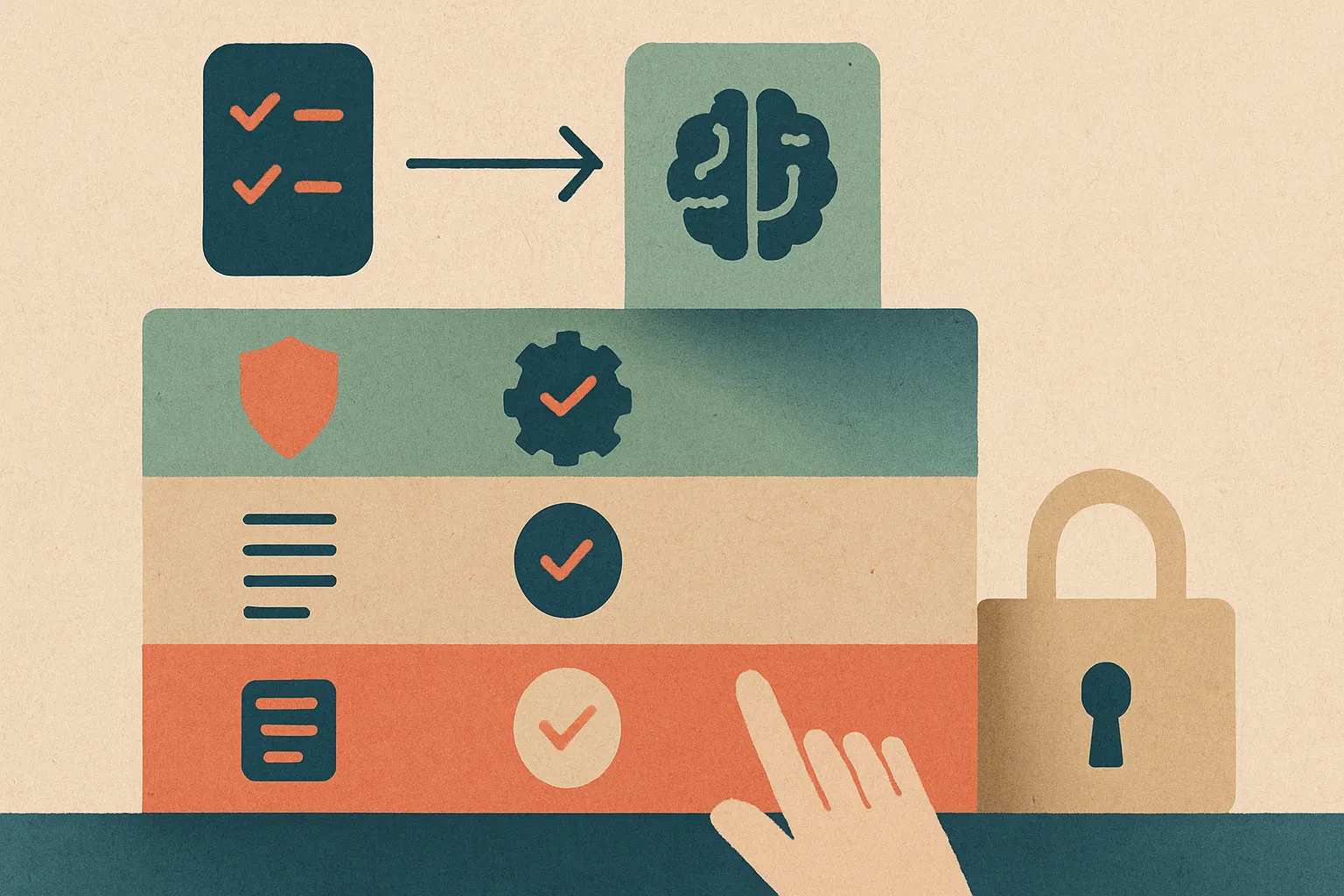
Start with least-privilege access. OAuth 2.0 remains the standard for delegated authorization, and scoped access tokens are table stakes for limiting what a client can do IETF OAuth 2.0. An agent handling booking lookups shouldn't also have permission to issue refunds or export customer data.
Then add a policy layer outside the model.
This part matters more than prompt engineering. The model can suggest an action, but a deterministic policy engine should decide whether it's allowed. For example:
- Refunds over a threshold require approval
- Deleting records is blocked for autonomous agents
- PII export is allowed only for specific roles and regions
- Nighttime bulk actions are rate-limited or disabled
Models are squishy. Policies shouldn't be.
And please log everything: tool selected, arguments passed, response received, user identity, approval state, and final outcome. If a customer asks, "Why did the agent do that?" you need a better answer than "the model thought it was reasonable."
Reliability starts with boring API design
If you want reliable APIs for AI agents, make them boring in the best possible way.
Use explicit, task-shaped endpoints
Don't expose your internal object model and call it a day. Create endpoints around actual jobs:
search_available_roomscreate_booking_holdconfirm_bookingissue_partial_refund
This is one reason vertical products do better than generic toolboxes. In our own product work with RunHotel, the useful actions aren't abstract. They're hotel-shaped. "Late checkout availability" is a real task. "Mutate reservation entity" is how you end up debugging at 2 a.m.
Make write operations idempotent
Agents retry. Networks fail. Timeouts happen. If repeating the same request can create duplicate bookings, duplicate charges, or duplicate tickets, you've built a trap.
Use idempotency keys for all meaningful writes. Return the same result for the same key. Simple. Not glamorous. Extremely effective.
Return machine-readable errors
We said it before because it matters. Error payloads should tell the agent:
- what failed
- whether retrying makes sense
- whether human approval is needed
- what parameter was invalid
- what state the resource is now in
If your API only talks to humans, agents will hallucinate the missing structure.
Bound every field you can
Free-form text is where reliability goes to die.
Use enums, min/max values, regex patterns, allowed transitions, and typed arrays. The more room you leave for interpretation, the more interpretation you'll get. And models are very enthusiastic interpreters.
Why MCP and tool discovery are useful — and still not enough
A lot of people are treating MCP as the answer to everything. It isn't.
It's useful. Dynamic discovery is better than hardcoding every integration forever, and standardized tool exposure reduces glue code Anthropic MCP Docs. But if the underlying tools are unsafe, inconsistent, or wildly over-permissioned, MCP just helps the agent find bad tools faster.
That's the real surprise.
Protocol standardization solves interoperability. It doesn't solve operational safety. You still need good API design, good auth, good policy controls, and good observability. We wouldn't trust a beautifully documented chainsaw to a confused intern, and we shouldn't trust a beautifully exposed destructive endpoint to an unsupervised agent.
A practical checklist before you let agents touch production
Before an agent gets production credentials, we recommend this checklist:
Contract
- OpenAPI or equivalent tool schema is complete and current
- Names are action-oriented and unambiguous
- Required fields, enums, and units are explicit
Safety
- Tokens are narrowly scoped
- High-risk actions require approval
- Sensitive data access is role- and region-aware
- Rate limits exist per tool and per tenant
Reliability
- All writes support idempotency
- Long-running tasks are async with correlation IDs
- Errors are structured and machine-readable
- State transitions are explicit
Operations
- Every tool call is logged
- You can replay and audit decisions
- Alerts exist for repeated failures or unusual action patterns
- Human takeover is easy
If you don't have these, don't hand the agent the keys yet.
If you're figuring out what this should cost before you build it, our AI cost estimator can help you sanity-check the architecture. And if you need a team that's already made these mistakes in safer environments than your production stack, that's exactly what our AI agents, custom models, and AI consulting work is for.
FAQ
What are APIs for AI agents?
They're APIs designed so agents can safely read data and take actions in external systems. The difference from normal APIs is that agents need clearer contracts, tighter permissions, and more structured error handling because they operate autonomously and at speed.
Can I just expose my existing REST API to an AI agent?
Usually not without changes. Most existing REST APIs assume a human developer or frontend sits in the middle, cleaning up ambiguity and handling edge cases the agent will trip over.
Is OpenAPI enough for agent reliability?
No. OpenAPI helps the model understand available operations, but it doesn't guarantee safe permissions, idempotent writes, clear state transitions, or good error semantics.
Should every agent action require human approval?
No, but high-risk actions should. Read operations and low-risk reversible actions can often be automated, while payments, deletions, contract changes, and sensitive data exports usually need an approval gate.
Is MCP better than traditional API integrations?
It's better for discovery and interoperability, not a replacement for sound API design. Think of it as a cleaner toolbox label, not a guarantee that the tools inside are safe.
The part most teams skip
Testing.
Not unit tests. Adversarial agent tests.
Give the agent incomplete inputs, conflicting state, expired tokens, duplicate retries, malformed parameters, and ambiguous user requests. See what it does. We’ve found this is where "works in staging" goes to die.
A decent API for agents should fail like a good pilot: calm, procedural, and hard to trick into doing something stupid.
If your current stack isn't there yet, don't panic. Start with one narrow workflow, add explicit actions, lock down scopes, and instrument everything. Then expand.
If you want help designing APIs for AI agents that won't torch your ops team, talk to us at Cropsly.
Build the guardrails first. The fancy demo can wait.