
Why KANs on FPGAs Could Cut Edge AI Latency in Half
Hitesh Sondhi · June 10, 2026 · 11 min read
We’ve all seen this movie before.
A new model architecture shows up, somebody slaps it onto specialized hardware, and suddenly LinkedIn is full of “this changes edge AI forever” posts written by people who have never debugged a DMA bottleneck at 2 a.m. Then you actually try to ship it, and the “breakthrough” turns out to be a pile of timing violations, ugly toolchains, and latency gains that disappear the second real-world preprocessing enters the chat.
KANs on FPGAs might still be worth the pain.
But only in a narrow band of edge workloads, and pretending otherwise is how teams waste six months building a science fair project instead of a product.
Key Takeaways
- KANs on FPGAs are promising for tiny, latency-sensitive inference paths where memory access dominates and interpretability matters.
- They are not a universal replacement for compact CNNs, MLPs, or transformer-lite models on edge devices.
- The biggest upside comes from turning nonlinear activations into cheap spline-style function evaluation that maps well to FPGA pipelines.
- The biggest downside is engineering complexity: toolchains, quantization, routing pressure, and deployment friction are all worse than most teams expect.
- If you need ultrafast machine learning on-device with hard real-time constraints, KAN+FPGA is worth a prototype. If you just need “fast enough,” it’s probably overkill.
First, what’s the actual claim here?
The core argument behind KANs on FPGAs is pretty simple: Kolmogorov-Arnold Networks replace the usual fixed scalar activations with learnable univariate functions on edges, often represented with splines. That changes the compute pattern in a way that can be friendlier to hardware pipelines than the matrix-heavy “just use another tiny MLP” approach.
Aarush Gupta’s write-up on KANs for FPGA acceleration makes this case directly, focusing on how KAN computation can be structured for efficient hardware realization, especially when the learned functions are approximated in a way that reduces expensive operations and supports parallel evaluation Aarush Gupta.
That’s the appealing part.
The annoying part is that “hardware-friendly” in a blog post and “actually viable in a shipped edge product” are two very different things.
Why this idea is getting attention
Most edge AI teams are fighting the same three enemies:
- Latency
- Power
- Memory bandwidth
Not model size in some abstract benchmark sense. Not leaderboard elegance. Actual end-to-end response time on ugly hardware.
We’ve seen this in on-device AI and voice AI work: your model can look efficient on paper and still feel sluggish because the memory movement, feature extraction, and runtime overhead eat your budget alive. A 20 ms kernel doesn’t matter if the whole path takes 140 ms.
That’s where KANs get interesting. Their learned edge functions can, in principle, be implemented as lookup-table or spline-evaluation blocks with predictable latency. FPGAs love predictable latency the way a pit crew loves standardized tires.
Not because it’s glamorous. Because it wins races.
Why Your “Compact Model” Still Feels Slow
A lot of standard compact neural architectures are optimized for parameter count, not for deterministic low-latency edge inference.
That distinction matters.
A tiny MLP or lightweight CNN on a CPU, NPU, or GPU can still suffer from:
- irregular memory access
- framework overhead
- operator launch overhead
- poor small-batch utilization
- quantization mismatches
- preprocessing dominating compute
We’ve made this mistake ourselves in prototype planning. You benchmark the model core, feel great, then add audio framing, normalization, postprocessing, and I/O. Congratulations, your “real-time” system now responds like it’s thinking through a breakup.
KANs offer a different shape of computation. If the nonlinear pieces are represented compactly and pipelined well, you can sometimes squeeze inference into a tighter deterministic loop than a more conventional architecture.
Sometimes.
That word is doing a lot of work.
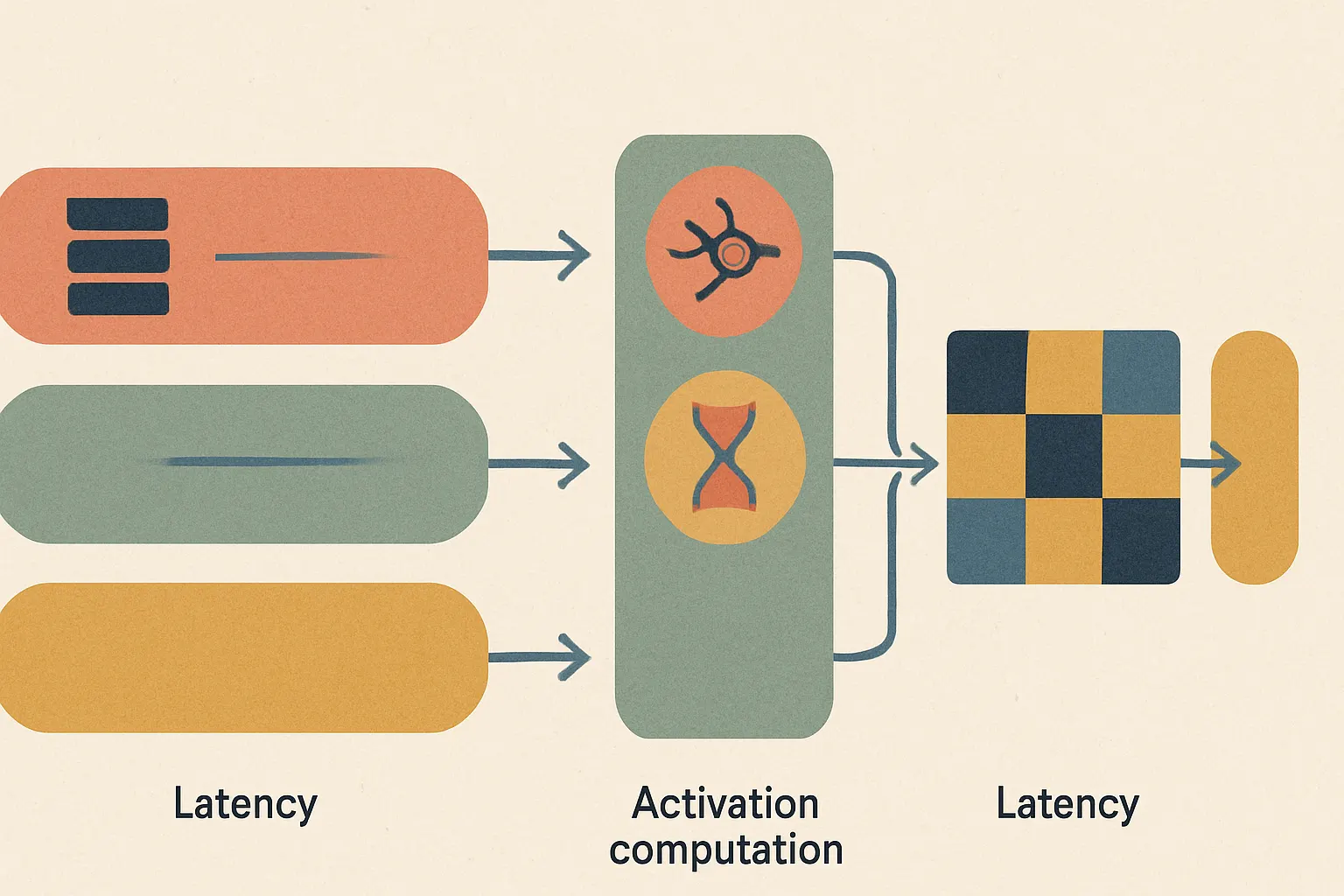
Here’s the basic comparison:
What makes KANs hardware-friendly on FPGAs
The short version: KANs move some expressive power into learnable one-dimensional functions. On hardware, one-dimensional function evaluation is often easier to pipeline and optimize than larger, denser nonlinear compute graphs.
According to Aarush Gupta’s analysis, KAN implementations on FPGAs can benefit from:
- parallel edge-function evaluation
- reduced dependence on expensive general-purpose nonlinear ops
- efficient fixed-point approximations
- opportunities for lookup-table and spline-based implementations Aarush Gupta
That matters because FPGA design rewards regularity. If you can turn inference into a conveyor belt of fixed-point arithmetic and table lookups, you’re in business.
If you need dynamic control flow, giant intermediate tensors, or runtime flexibility, you’re in pain.
Here’s how the pipeline usually looks in practice:
flowchart LR
  A[Sensor/Input] --> B[Preprocessing]
  B --> C[Feature Vector]
  C --> D[KAN Edge Function Blocks]
  D --> E[Aggregation Layer]
  E --> F[Postprocessing]
  F --> G[Output/Action]
That diagram looks neat.
The implementation rarely is.
The hot take: most teams should not start here
Here’s the opinionated part: KANs on FPGAs are not the next mainstream edge AI stack.
They’re the next niche weapon.
That’s still valuable. Sniper rifles are useful. You just don’t issue one to everybody in the army and call it platform strategy.
If you’re shipping an edge product with moderate latency tolerance, a decent NPU, and a standard model family your team already understands, you’ll probably move faster with a compact transformer, CNN, or MLP plus aggressive quantization. The software tooling is better, the hiring market is better, and the deployment path is less cursed.
FPGAs are amazing when you need hard guarantees.
They’re also amazing at punishing vague requirements.
Where KANs on FPGAs could genuinely shine
There are a few cases where this combo starts to look less like a research toy and more like a serious engineering decision.
1. Hard real-time systems
If you have strict tail-latency requirements, deterministic pipelines matter more than average throughput. FPGA implementations can give you predictable execution in a way software stacks often can’t.
Think industrial control, sensor fusion triggers, or embedded decision loops where missing the deadline is worse than being slightly less accurate.
2. Tiny models with ugly latency budgets
If your entire inference budget is brutally small, shaving a few milliseconds off the model path can actually matter. We care about this a lot in products like RunHotel, where user-perceived responsiveness is everything. In voice systems, even small delays feel broken because humans are absurdly sensitive to turn-taking lag.
That doesn’t mean RunHotel uses KANs on FPGAs today. It means we’ve learned the hard way that “pretty fast” and “feels instant” are not the same thing.
3. Interpretable function structure
KANs have an interpretability story that’s more concrete than the usual hand-wavy “we can inspect attention maps” nonsense. The learned univariate functions can sometimes be examined directly, which can help in regulated or physics-informed domains.
This overlaps with the broader appetite for ultrafast machine learning on structured scientific problems, where compact, interpretable approximations are often more useful than giant black boxes. The SERP around “ultrafast machine learning on” is full of scientific and physics-heavy examples for a reason: people care about speed when every extra compute step multiplies across massive simulations.
4. Power-constrained deployments
FPGAs can be extremely efficient when the workload is stable enough to justify hand-tuned dataflow. If you’re deploying at volume and every watt matters, custom hardware mapping starts to make more sense.
But that’s only half the problem.
Why this goes sideways in real projects
The first trap is assuming model-level efficiency equals system-level efficiency.
It doesn’t.
You still have to deal with:
- feature extraction
- memory interfaces
- host coordination
- quantization error
- FPGA resource limits
- retraining when approximation choices hurt accuracy
- deployment and update workflows
We’ve seen teams obsess over the inference block and ignore the rest of the pipeline, which is like spending all your money on a race car engine and then towing a refrigerator behind it.
Toolchains are still rough
This is the part enthusiasts skip over because it ruins the vibe.
FPGA development is better than it used to be, but compared to standard ML deployment stacks, it’s still a tax. HLS can help, but “can help” is not the same as “pleasant.” You’ll fight synthesis times, timing closure, resource mapping, fixed-point tuning, and hardware/software integration.
If your team hasn’t done this before, budget more time than you think.
Then add another 30%.
Quantization can bite harder than expected
KANs often rely on learned function representations. Once you start approximating those functions with fixed-point arithmetic, lookup tables, or low-resolution splines, accuracy can degrade in weird local ways.
A standard small neural net can also suffer under quantization, obviously. But KANs add another axis of fragility because the shape of the learned functions matters directly. If your spline approximation gets crude, the model can go from elegant to drunk.
Model updates are less forgiving
A software-deployed compact model is easy to iterate. Recompile, redeploy, done.
An FPGA-targeted KAN path is more like changing the engine parts in a moving car. Possible, yes. Fun, no.
If your product needs frequent model refreshes, rapid A/B testing, or customer-specific adaptation, the operational overhead may erase the latency win.
So can KANs actually cut latency in half?
Maybe.
But you should treat “cut latency in half” as a workload-specific outcome, not a law of nature.
The source we were given explains the architectural reasons KANs can map efficiently to FPGA execution, but it doesn’t magically guarantee a 2x win for every edge system Aarush Gupta. Real gains depend on:
- input dimensionality
- function representation
- precision format
- memory architecture
- preprocessing overhead
- baseline hardware and model choice
If your baseline is a sloppy Python runtime on an underused CPU, sure, you might get dramatic gains.
If your baseline is a well-quantized compact model on a modern edge accelerator, the improvement may be modest or not worth the pain.
That’s the part people hate hearing.
A practical decision framework
If you’re deciding whether to explore KANs on FPGAs for ultrafast machine learning on edge devices, use this filter.
Consider KAN+FPGA if:
- you have hard p99 latency targets
- your model is relatively stable
- deterministic execution matters
- your team can handle FPGA engineering
- your deployment volume justifies hardware optimization
- interpretability of learned functions is useful
Stick with standard compact architectures if:
- you need fast iteration
- your latency target is already achievable on an NPU or CPU
- your team is mostly software-focused
- your workload changes often
- your preprocessing dominates total latency anyway
That last one is a killer.
We’ve seen projects where the model got all the attention, but the real latency villain was audio cleanup, image resizing, or retrieval overhead. In those cases, custom models won’t save you unless the rest of the pipeline is fixed too.
What we’d do at Cropsly
We wouldn’t bet the roadmap on KANs-on-FPGAs as a first move.
We’d prototype it as a targeted latency weapon.
That means:
- Profile the full pipeline first.
- Find the true p99 bottleneck.
- Build a minimal KAN baseline.
- Quantize early, not at the end.
- Compare against a brutally optimized compact MLP/CNN/transformer-lite baseline.
- Only move to FPGA if the software baseline still misses the requirement.
This sounds boring because it is boring.
Boring is how production systems survive.
If you’re exploring AI agents, on-device AI, or AI consulting for edge products, this is exactly the kind of decision that benefits from a small feasibility sprint before anyone starts making architecture religion out of a benchmark chart. If you want a rough sense of economics before building, our AI cost estimator is a decent place to start. And if you want to talk through tradeoffs with people who’ve shipped real systems, contact us.
The verdict
KANs on FPGAs are real.
They’re also easy to oversell.
For the right workload, they could absolutely be the difference between “edge AI demo” and “edge AI product,” especially when deterministic low latency matters more than flexibility. The architecture has legitimate hardware appeal, and the FPGA mapping story is not fantasy Aarush Gupta.
But if someone tells you KANs are about to replace standard compact neural architectures across edge inference, that’s hype talking.
Our view is simpler: KANs on FPGAs are a specialized tool for teams chasing ultrafast machine learning on-device under tight latency and power constraints. If that’s your problem, prototype aggressively. If it’s not, don’t cosplay as a hardware startup.
The fastest model is the one you can actually ship.