
Choose a small language model or an edge AI pipeline
Hitesh Sondhi · May 11, 2026 · 12 min read
We’ve seen teams burn three months arguing about model size when the real problem was architecture. They kept asking “should we use a small model on-device?” when the actual answer was “your app needs an edge AI pipeline, not a single heroic model doing everything.”
That’s the trap in the small language model vs edge AI debate.
It sounds like a fair comparison. It isn’t. It’s like asking whether you should buy a good chef’s knife or build a restaurant kitchen. One is a component. The other is a system. If you mix those up, you’ll ship something slow, expensive, and weirdly fragile.
Key Takeaways
- A small language model (SLM) is a model choice. Edge AI is a deployment and systems strategy.
- If your problem is latency, privacy, or unreliable connectivity, edge AI usually matters more than model branding.
- SLMs shine when the task is narrow, prompts are structured, and failure is cheap.
- Edge AI pipelines win when you need orchestration: wake-word detection, ASR, routing, local rules, fallback logic, and selective cloud escalation.
- The best production systems often use both: a small language model inside an edge AI pipeline.
Stop Comparing Apples to Forklifts
Here’s the blunt version: small language model vs edge AI is the wrong framing.
A small language model is exactly what it sounds like — a smaller parameter-count language model, usually optimized for lower memory use, faster inference, and narrower tasks. Think Phi-family models, compact Qwen variants, distilled instruction models, or domain-tuned mini-models.
Edge AI means computation happens near where the data is created: on a phone, kiosk, gateway, camera box, Jetson, industrial PC, or some underappreciated little ARM board zip-tied into a cabinet. The “AI” part might include a language model, but it can also include speech recognition, computer vision, ranking, rules engines, anomaly detection, and plain old deterministic logic.
That distinction matters.
Because if you treat edge AI like “just run a small model locally,” you’ll miss the ugly parts: model loading, thermal throttling, intermittent networks, device fleet updates, observability, fallback paths, and what happens when the mic picks up a blender instead of a human.
We’ve built enough production AI to know this one hurts.
What a Small Language Model Actually Buys You
Small language models are having a moment because giant models are often overkill. Not “slightly inefficient.” Overkill.
If your app needs short-form classification, extraction, command interpretation, or tightly scoped dialogue, a smaller model can be the adult in the room. Lower memory footprint. Faster first token. Cheaper inference. Easier fine-tuning. Fewer moving parts. Less drama.
Researchers and vendors keep pushing in this direction for a reason. Microsoft’s Phi-3 family was explicitly positioned around high capability at small size, including edge-friendly variants Microsoft. Qualcomm has also been leaning hard into on-device generative AI and SLM deployment on mobile and edge hardware Qualcomm. And Gartner projected that by 2027, 75% of enterprise-managed data will be created and processed outside traditional centralized data centers or cloud Gartner.
That last stat gets quoted a lot. Sometimes sloppily. But the direction is real.
Here’s where it gets weird.
A lot of teams hear “small model” and assume “problem solved.” Then they discover their 3.8B model still blows up memory on a mid-range Android device, or their quantized build is fast in a benchmark but sluggish in the actual app because tokenization, I/O, and prompt assembly are eating the budget.
Model size isn’t the whole bill.
Why Edge AI Is Bigger Than the Model
Edge AI is a systems decision. It’s about where inference happens, what stays local, what gets escalated, and how the whole thing behaves when reality shows up with bad Wi‑Fi and noisy inputs.
That’s why the small language model vs edge AI comparison falls apart under pressure. A small model might be part of the answer, but the pipeline is what determines whether the product feels magical or broken.
For example, a voice assistant in a hotel room doesn’t need a single general-purpose model doing everything. It needs a wake-word detector, speech-to-text, intent routing, maybe a compact language model for response shaping, local business rules, and a cloud fallback for out-of-scope requests. That’s not a model decision. That’s architecture.
We’ve seen this firsthand in on-device voice systems like RunHotel, where “just use a local LLM” would’ve been a terrible design choice. Hotels don’t care that your benchmark looked pretty. They care that the room assistant responds quickly, works offline when the network is flaky, and doesn’t send every guest utterance to the cloud.
Privacy and latency are where edge AI stops being fashionable and starts being necessary.
According to IBM, edge computing is often adopted to reduce latency and bandwidth demands by processing data closer to the source IBM. NVIDIA makes a similar case for real-time AI at the edge where cloud round trips are too slow or too expensive NVIDIA.
And yes, bandwidth bills have a way of turning “cool architecture” into “who approved this?”
Here’s How the Pipeline Usually Breaks
Most teams start with a model-centric mental model:
- User says something
- Model interprets it
- Model responds
That’s cute. It’s also incomplete.
In production, the flow usually looks more like this:
Here’s a simpler way to think about it:
flowchart TD
  A[User input on device] --> B[Local pre-processing]
  B --> C[Wake word / intent / routing]
  C --> D[Small language model on device]
  C --> E[Deterministic rules]
  D --> F[Local response]
  E --> F
  C --> G[Cloud fallback for hard cases]
  G --> F
That little routing box in the middle is where products live or die.
If every request goes through the model, your costs go up, latency gets noisy, and your failure modes multiply. If you route aggressively, keep obvious tasks deterministic, and only invoke the model when language flexibility actually matters, the system gets cheaper and more reliable.
Hot take: most “AI features” should be 60-80% boring software and 20-40% model.
Not the other way around.
When a Small Language Model Is the Right Call
Use a small language model when the task is narrow, repetitive, and close to the user interaction loop.
Good examples:
- intent classification for support flows
- slot filling for forms
- command parsing for voice interfaces
- summarizing short local documents
- rewriting text to a strict tone or template
- lightweight multilingual assistance where the domain is tightly controlled
This is where a compact model can punch above its weight. Especially if you constrain the prompt and validate outputs. Fine-tuning a small model is like seasoning food — too little and it’s bland, too much and you’ve ruined dinner. The trick is knowing the dish.
At Cropsly, when clients ask about custom models, we usually start by narrowing the task before touching weights. Half the time the biggest win isn’t a more powerful model. It’s cutting the problem into something a smaller model can actually do well.
That’s less glamorous than “deploy frontier AI everywhere.”
It’s also how you stay under budget.
If you want to sanity-check what cloud-heavy inference might cost before you commit, use something like an AI cost estimator. People are often shocked by how quickly “just one API call per interaction” turns into a monthly invoice that needs therapy.
When You Need an Edge AI Pipeline Instead
Choose an edge AI pipeline when your constraints are operational, not just algorithmic.
That means:
- sub-second latency really matters
- privacy or data residency matters
- connectivity is unreliable
- device-to-cloud bandwidth is expensive
- the product must degrade gracefully offline
- multiple local models or detectors need orchestration
- you’re shipping to physical environments, not just browsers
Factories. Hotels. Retail kiosks. Vehicles. Medical devices. Field tools. These are edge problems.
In those cases, a small language model might be one piece of the stack, but not the lead actor. The lead actor is the pipeline: what runs locally, how models are updated, how telemetry is captured, how fallback works, and what happens when the device is underpowered or half-disconnected.
Here’s a useful mental model: an SLM is a musician. Edge AI is the band, the sound engineer, the venue, and the backup generator when the power cuts out.
You don’t win the concert by hiring one good guitarist.
The Real Tradeoffs Nobody Likes Talking About
Let’s talk about the part vendors skip in demos.
1. Small models are cheaper, but they’re not automatically good enough
A 1B-4B model can be fantastic for narrow tasks. It can also confidently produce nonsense outside its lane. If your use case needs broad reasoning, deep tool use, or long-context synthesis across messy documents, a tiny model may fail in ways that are subtle and expensive.
This is why we often pair smaller local models with cloud escalation or external tools via AI agents. Not because agents are trendy, but because giving a model the right tools is often better than making the model bigger.
2. Edge AI improves privacy, but operations get harder
Running locally means less sensitive data leaves the device. Great.
It also means you now own packaging, deployment, hardware compatibility, observability, rollback strategy, and performance across a weird zoo of real devices. Edge fleets are like owning a pack of cats: independent, unpredictable, and somehow all angry for different reasons.
3. Quantization helps, until it doesn’t
4-bit and 8-bit quantization can make on-device deployment practical. Hugging Face documents broad support for quantized inference workflows across many model families Hugging Face.
But quality can degrade, kernel support varies, and actual speedups depend heavily on the hardware and runtime. We’ve seen “faster” quantized builds lose in real-world latency because the surrounding stack was poorly optimized.
Benchmarks lie by omission.
So, Small Language Model vs Edge AI — Which Should You Choose?
If you forced us to answer the exact question — small language model vs edge AI — we’d say this:
Choose a small language model when your main problem is model efficiency.
Choose an edge AI pipeline when your main problem is system behavior in the real world.
And if you’re building anything serious on devices, you’ll probably need both.
That’s the honest answer. Not sexy, but honest.
For many teams, the better sequence is:
- define the user interaction and failure tolerance
- decide what must happen locally
- route deterministic tasks away from the model
- pick the smallest model that meets quality
- add cloud fallback only where it earns its keep
That order saves pain.
The reverse order — “pick a model first and build around it” — is how you end up with a demo that impresses your boss and a product that annoys your users.
A Practical Decision Framework
If you’re stuck, use this checklist.
Pick a small language model first if:
- your task is narrow and language-centric
- the output format can be constrained
- you can tolerate occasional fallback
- you want lower inference cost
- you don’t need a full local orchestration stack
Pick an edge AI pipeline first if:
- you’re deploying to physical devices
- latency must be predictable
- privacy is a business requirement
- offline mode matters
- your workload includes speech, sensors, or multimodal routing
- you need selective cloud usage rather than constant cloud dependence
Here’s what that decision often looks like in practice:
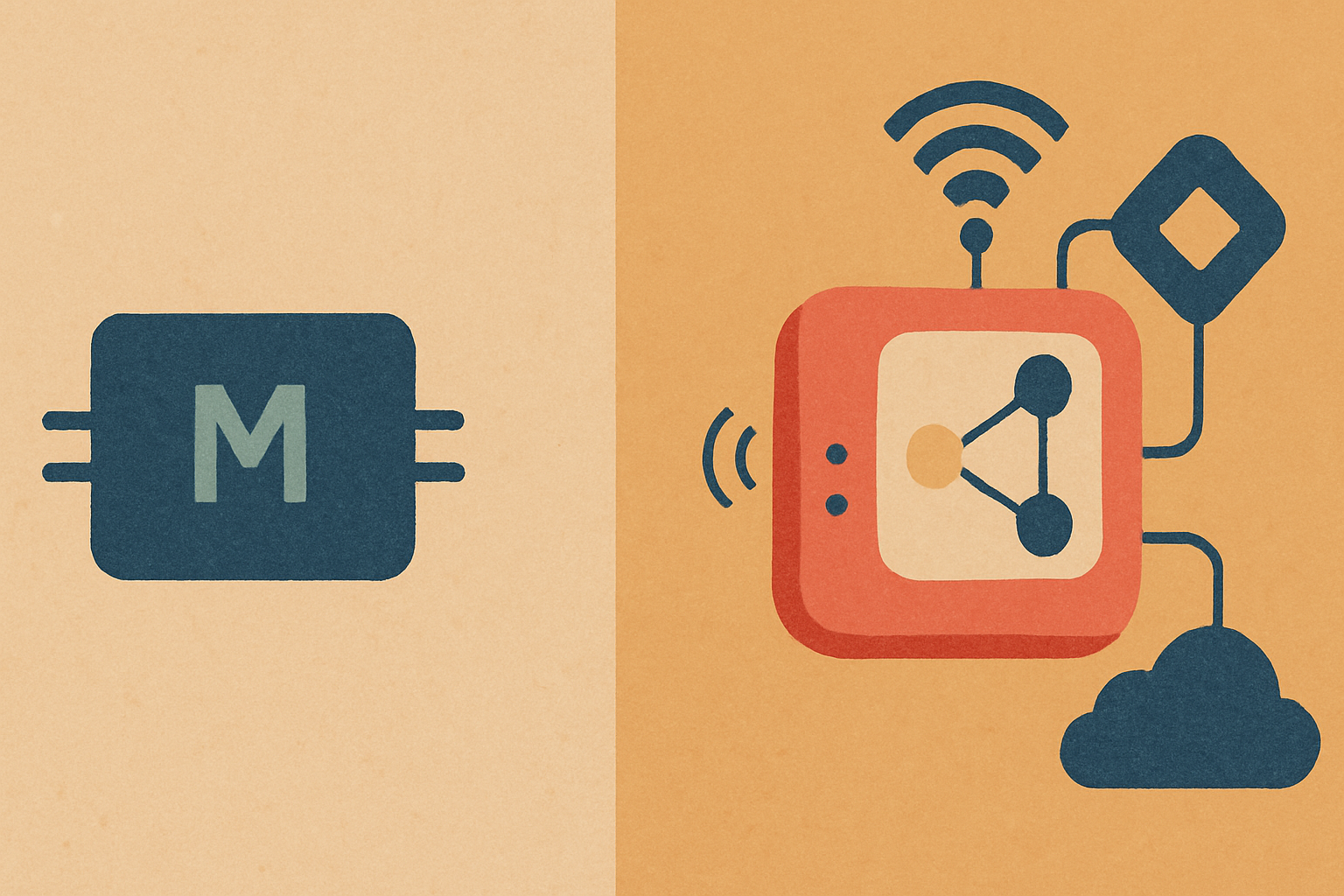
And here’s the part people underestimate: integration is where the real work is. A decent model glued into the right product flow will beat a smarter model stuffed into a bad architecture.
That’s why our on-device AI, voice AI, and AI consulting work usually starts with system boundaries, not model shopping.
Because model shopping is the fun part. Production is the bill.
FAQ
Is edge AI the same thing as using a small language model locally?
No. Edge AI is the broader system strategy of running AI near the data source, while a small language model is just one possible component in that system.
Are small language models good enough for production?
Yes, often. They’re good enough when the task is narrow, prompts are structured, and outputs are validated, but they’re a bad fit for broad open-ended reasoning without guardrails.
Does edge AI always cost less than cloud AI?
No. It can reduce bandwidth and cloud inference costs, but device management, optimization, and deployment complexity can raise engineering costs.
Should we avoid cloud models entirely?
No. Use cloud models where they add clear value, especially for hard cases, long-context tasks, or advanced reasoning. The trick is not paying cloud prices for tasks a local rule or small model could handle.
What’s the best approach for voice products?
Usually a hybrid one. Keep wake-word detection, ASR shortcuts, routing, and common intents local when possible, then escalate selectively for harder language tasks.
What To Do Next
Map your user flow and circle every step that must work with low latency, weak connectivity, or strict privacy. That’s your edge boundary. Then pick the smallest model that survives inside it.
If you want help sorting that out before your team spends six weeks benchmarking the wrong thing, talk to us through Cropsly’s contact page.
Because the worst architecture decision in AI isn’t choosing the wrong model.
It’s solving the wrong problem beautifully.
Sources
- Microsoft: Introducing Phi-3: Redefining what's possible with SLMs
- Qualcomm: The rise of small language models for on-device generative AI
- Gartner Press Release: 75% of enterprise-managed data will be created and processed outside traditional data center or cloud
- IBM: What is edge computing?
- NVIDIA: What is Edge AI?
- Hugging Face Transformers Documentation: Quantization Overview