


Where Microsoft VibeVoice Breaks Down in Real Deployments
Hitesh Sondhi · April 29, 2026 · 12 min read
We’ve seen this movie before: a shiny open model drops, Twitter declares the incumbents dead, someone demos a buttery-smooth podcast voice, and then a real production team tries to run it under latency budgets, memory limits, and compliance rules.
That’s where the hangover starts.
Microsoft VibeVoice is interesting. Genuinely. But if you’re evaluating microsoft vibevoice: open-source frontier voice AI for production, you need more than a demo clip and a Hugging Face page. You need to know where it sings, where it lies to you, and where it falls apart the second actual users show up.
Our hot take: VibeVoice looks better in benchmark-friendly, long-form generation demos than it does in messy, interrupt-heavy, cost-constrained products.
That doesn’t make it bad. It makes it real.
Key Takeaways
- VibeVoice is compelling for expressive, long-form, multi-speaker generation, especially in content workflows, but it’s not automatically the right pick for live product surfaces.
- The biggest production pain points are usually latency, memory footprint, noisy training artifacts, and control over speaker consistency.
- If you need real-time voice UX, turn-taking, barge-in, or on-device inference, you should test brutally before committing.
- Open voice models are most useful when you pair them with strong orchestration, guardrails, and task-specific tuning—not when you drop them in raw.
- For many teams, the smarter path is hybrid: use frontier open models where they shine, and smaller or custom systems where the product can’t tolerate drift.
Why VibeVoice gets people excited in the first place
The appeal is obvious. Microsoft positions VibeVoice as an open-source frontier voice AI effort spanning speech tasks, and public materials around the project emphasize expressive long-form synthesis and multi-speaker conversational audio generation, especially podcast-like outputs (Microsoft Research / VibeVoice GitHub).
That matters because most older TTS stacks sound like a GPS unit trying to read a breakup text.
VibeVoice aims higher. The promise is not just “convert text to audio,” but “generate speech that sounds like people with intent, pacing, and personality.” That’s a different category of product.
Here’s where teams get seduced: if your use case is narrated content, synthetic hosts, training material, story-driven audio, or multi-character dialogue, VibeVoice is much closer to what users actually want than flat, robotic TTS.
And yes, that’s a big deal.
Before we get into the ugly parts, here’s the broad production picture:
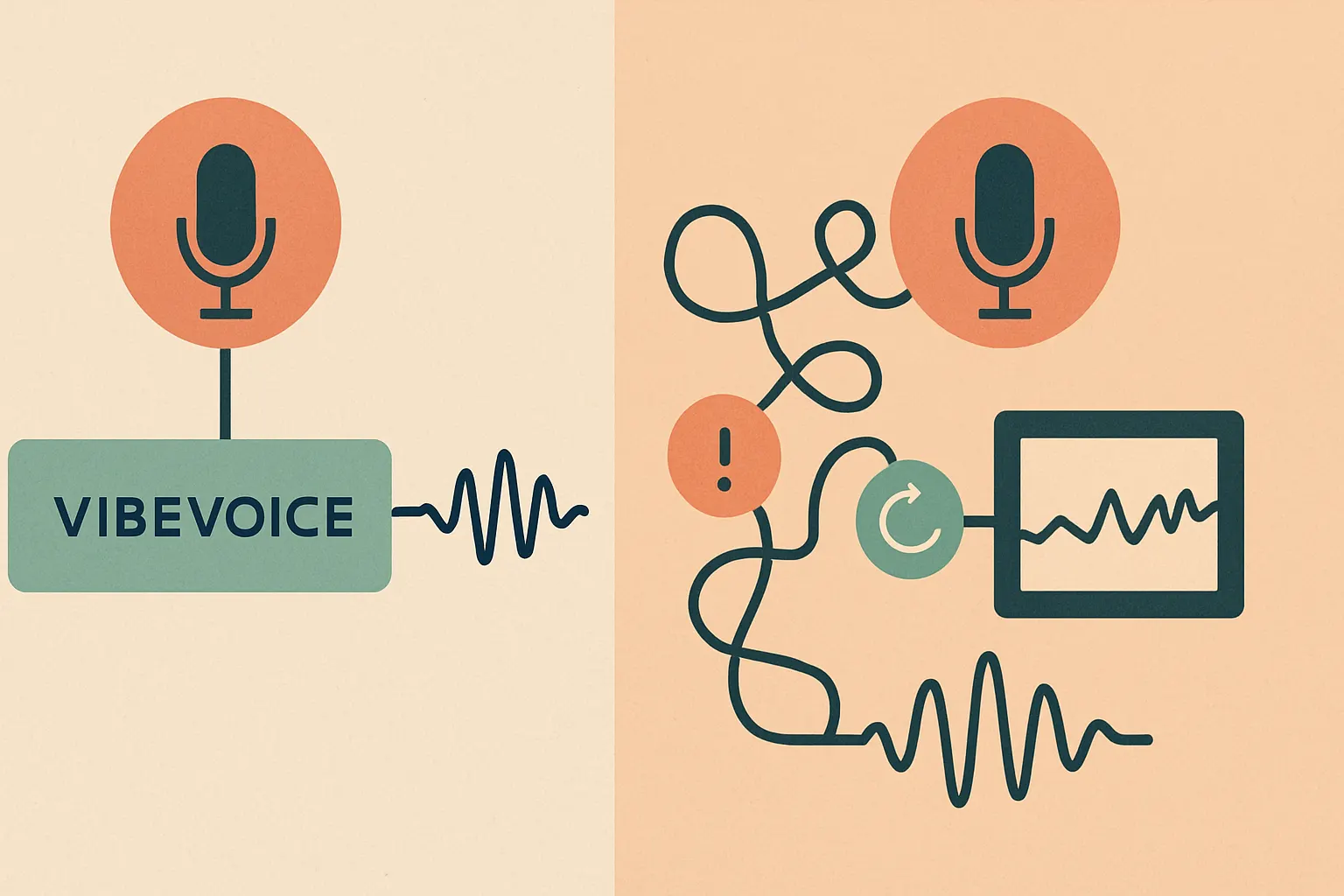
A lot of articles about microsoft vibevoice: open-source frontier models stop at “it can do expressive speech.” Cool. A sports car can also go 200 mph. Try parallel parking it in old-city traffic.
Where Microsoft VibeVoice breaks in the real world
The first problem is that demo quality and deployment quality are cousins, not twins.
Long-form generation is one thing. Interactive voice systems are another. If you’re building a voice assistant, hotel concierge, call workflow, or in-app conversational agent, the user doesn’t care that your model can narrate a fictional podcast with emotional nuance. They care whether it responds fast, handles interruptions, keeps speaker identity stable, and doesn’t randomly sound like it learned intonation from low-quality internet audio.
That last part matters more than people admit.
Some early commentary around VibeVoice has praised its expressiveness while also noting tradeoffs in speed, memory use, and noisy training characteristics (Hugging Face model/community pages for VibeVoice variants). We’ve seen this pattern across open voice models repeatedly: richer output often comes with heavier inference and less predictable behavior under pressure.
And production is pressure.
Latency is where the romance dies
If your product is asynchronous, you can get away with a lot. Generate a clip in a few seconds, cache it, move on.
If your product is conversational, every extra few hundred milliseconds feels like the assistant forgot your name.
Microsoft’s own Azure Speech documentation has long emphasized low-latency streaming architectures for interactive speech applications because user experience degrades fast when responses lag (Microsoft Learn: Speech service documentation).
That’s not a VibeVoice-specific knock. It’s just physics and product reality.
We learned this the hard way on voice systems: users forgive occasional wording mistakes faster than they forgive awkward silence. Silence feels broken. A weird synonym feels human.
That’s why teams often over-index on “voice quality” and under-index on “time to first audio.”
Bad trade.
The model can be expressive. Your infrastructure still has to survive it.
The second issue is memory and deployment shape.
Frontier open voice models are fun on a workstation with a beefy GPU. They get less fun when you need autoscaling, concurrency isolation, and predictable cloud cost. If you’re serving multiple sessions, streaming partials, and keeping fallback models warm, your infra bill starts eating like it’s on an expense account.
This is where a lot of “open-source is cheaper” takes become fantasy.
Open weights can absolutely reduce licensing dependence. But total cost includes GPU reservation, batching inefficiency, observability, retries, audio preprocessing, postprocessing, and the engineering time needed to stop the system from doing weird stuff at 2 a.m. If you want a rough sense of how quickly AI serving costs can drift, we built an AI cost estimator because too many teams were budgeting off vibes instead of math.
Yes, that pun was cheap. Unlike GPU time.
Why your voice stack needs more than one model
This is the part people skip because it’s less sexy than “one model to rule them all.”
In production, the best voice systems are often ensembles. You might use one model for ASR, another for TTS, a smaller model for interruption handling, a VAD layer for turn detection, and a policy layer to decide when to stream, when to cache, and when to fall back. The all-in-one dream is appealing, but it’s often the voice AI version of trying to cook a wedding dinner with one frying pan.
Here’s what that usually looks like:
flowchart TD
  A[User speaks] --> B[VAD + turn detection]
  B --> C[ASR / diarization]
  C --> D[Agent orchestration]
  D --> E[LLM response]
  E --> F[TTS generation]
  F --> G[Streaming audio output]
  D --> H[Fallback rules]
  H --> G
If you’re exploring AI agents, voice AI, or custom models, this architecture question matters more than model hype. The model is one ingredient. The meal is the system.
But that’s only half the problem.
Multi-speaker generation is cool until consistency matters
VibeVoice gets attention for multi-speaker conversational output. Fair enough. That’s one of the strongest reasons to evaluate it.
But once you move from “generate a cool clip” to “ship a branded product voice,” consistency becomes brutal. You need stable speaker identity across sessions, controlled emotional range, pronunciation control, and predictable handling of names, acronyms, room numbers, addresses, and domain-specific terms.
That’s where many expressive models start acting like talented improvisers who refuse to hit their marks.
We’ve found that branded voice experiences usually need tighter control than frontier open models give you out of the box. If your assistant says “Wi-Fi” three different ways in one session, users notice. If your hospitality assistant pronounces a guest’s surname differently every time, support notices.
And support always notices.
For products like RunHotel, where voice interaction has to feel reliable in a real environment, “pretty good most of the time” isn’t enough. Hotels don’t care that the model can narrate a fake podcast beautifully if it stumbles on “late checkout” in a noisy room.
That’s the real production filter.
The dirty secret: noisy training data leaks into the product
Here’s a hot take: a lot of open voice model quality discourse is grading on demo vibes, not operational reliability.
Expressiveness is easy to celebrate. Cleanliness is harder. When a model is trained on noisy or highly variable data, the artifacts don’t always show up in the first 20 seconds of a cherry-picked sample. They show up in edge cases: unstable pacing, odd prosody swings, speaker bleed, brittle pronunciation, or weird tonal jumps after long passages.
It’s like hiring a brilliant actor who occasionally forgets what movie they’re in.
Some public discussion around VibeVoice has already pointed at this tradeoff—more expressive in some scenarios, but heavier and sometimes rougher around the edges than the polished demos imply (community discussion on Hugging Face and GitHub). That doesn’t mean the model is flawed beyond use. It means you should test the failure modes, not just the highlights.
We’d run at least these before you commit:
- Long-form generation over 10+ minutes
- Speaker consistency across separate sessions
- Domain-specific pronunciation lists
- Noisy-input and accented-input ASR cases
- Time-to-first-audio under realistic concurrency
- Recovery after interruption or partial transcript errors
If you don’t test those, you’re not evaluating a product candidate. You’re auditioning a demo reel.
Where open voice AI actually fits
Now for the fair part: there are places where microsoft vibevoice: open-source frontier models make a lot of sense.
Content generation is the obvious one. Podcast-style narration, training content, explainer audio, multi-character stories, synthetic hosts, and internal media pipelines are all strong candidates. In those workflows, you can tolerate a bit more generation time, you can review outputs, and you can cache aggressively.
That changes the economics and the quality bar.
Open models also fit teams that need ownership. If you care about model transparency, custom deployment, data residency, or avoiding API dependency, open voice stacks are attractive. That’s especially true for organizations with specific compliance or localization constraints. Microsoft’s repository licensing and open release posture are a big part of why VibeVoice is getting traction in the first place (GitHub: microsoft/VibeVoice).
For some teams, that alone is enough reason to test it.
If your roadmap includes on-device AI or highly customized speech behavior, open models are often the only serious path. Not because they’re magically better, but because closed APIs rarely let you tune the parts that actually matter.
Still, don’t confuse “open” with “ready.”
Where we wouldn’t bet the product on it
We’d be cautious using VibeVoice as the primary layer for:
Real-time conversational assistants
Especially if you need interruption handling, low-latency turn-taking, or telephony-grade responsiveness.
Strict brand voice systems
If the business needs highly repeatable pronunciation, emotional control, and voice identity consistency across thousands of interactions.
Resource-constrained deployments
If you need to run lean, edge-adjacent, or on-device setups with hard memory ceilings.
High-stakes transactional flows
Banking, healthcare, emergency support, or anything where a small speech error can become a very expensive human problem.
That doesn’t mean “never.” It means “not without a lot of engineering around it.”
And that engineering is the whole game.
The better strategy: hybrid beats ideological
We’re opinionated here: model tribalism is dumb.
The smartest production teams don’t marry one model family and tattoo the repo URL on their chest. They mix tools. They use expressive open TTS where it helps, smaller fast models where latency matters, domain tuning where consistency matters, and fallback logic everywhere.
That’s how adults build systems.
If you’re serious about shipping voice, start with the user experience contract:
- How fast does the first audio need to arrive?
- How much variation is acceptable?
- What happens when ASR is wrong?
- Can you cache responses?
- Do you need on-device privacy or cloud flexibility?
- What’s the cost ceiling per 1,000 sessions?
Then choose the model.
Not the other way around.
If you need help sorting that stack, that’s usually where AI consulting earns its keep. A week of honest architecture work is cheaper than three months of “maybe we can optimize it later.”
Spoiler: later is where projects go to die.
So, is Microsoft VibeVoice worth using?
Yes—for the right shape of problem.
No—if you think it’s a plug-and-play answer for every production voice system.
That’s the honest read on microsoft vibevoice: open-source frontier voice AI right now. It’s promising, flexible, and genuinely useful in content-heavy or customization-heavy workflows. It’s also heavier, trickier, and less magically production-ready than the hype suggests.
That’s normal for frontier open models. The first release is the beginning of the engineering conversation, not the end of it.
If you’re evaluating voice architecture right now, don’t just ask “How good does the sample sound?” Ask “What breaks at scale, under noise, with cost limits, and when the user interrupts mid-sentence?”
That’s the question that saves you.
FAQ
Is Microsoft VibeVoice good for production use?
Yes, in some cases. It looks strongest for long-form expressive audio generation and customizable pipelines, but interactive real-time products need careful testing around latency, memory, and consistency.
Is VibeVoice an ASR model, a TTS model, or both?
Public descriptions around the VibeVoice family and repository indicate coverage across speech directions, with much of the current attention focused on expressive TTS and conversational audio generation (GitHub: microsoft/VibeVoice).
Does open-source mean it’s cheaper than commercial voice APIs?
Not automatically. Open weights can reduce vendor lock-in, but infrastructure, GPU time, engineering complexity, and monitoring can erase the savings fast.
Where does microsoft vibevoice: open-source frontier fit best?
Best fit: content generation, synthetic narration, multi-speaker audio workflows, and products that need customization or deployment control. Worst fit: ultra-low-latency voice UX without significant optimization.
Should you use VibeVoice for on-device voice assistants?
Usually not as a first choice unless you’ve validated the footprint and performance thoroughly. For constrained environments, smaller specialized models often win.
What to do next
If you’re considering VibeVoice, run a brutal bake-off. Compare it against your current stack on latency, consistency, interruption recovery, and real infrastructure cost—not just audio charm.
If you want a second set of eyes on that evaluation, talk to us through Cropsly’s contact page. We build production AI systems, and we’ve learned the boring truth the hard way: the model demo gets the applause, but the plumbing gets the renewal.
And in voice AI, renewals beat applause every time.