


Why Most Enterprise AI Agents Fail on Data Governance
Hitesh Sondhi · July 31, 2026 · 11 min read
The fastest way to make an enterprise AI agent useless is to give it “access to the data.”
That sounds backwards, but we’ve seen this movie too many times. A team wires an LLM into Slack, points it at a warehouse, sprinkles on retrieval, and calls it internal AI. Two weeks later, the bot is confidently answering from stale dashboards, leaking metrics across teams, and inventing numbers because somebody thought “read-only” meant “safe.”
That’s not an AI problem. That’s a governance problem wearing an AI costume.
Cloudflare’s write-up on its unified data platform is interesting for exactly this reason: the valuable lesson isn’t “wow, big company has lots of data.” The real lesson is that internal AI only works when the data platform already behaves like a disciplined system, not a junk drawer. If you’re trying to understand how we built cloudflare's style of internal data access into something your own teams can trust, the answer is much less about prompts and much more about permissions, metadata, and boring architecture choices that save your skin later Cloudflare.
Key Takeaways
- Most enterprise AI agents fail because they sit on top of chaotic data estates and inherit every bad habit.
- Cloudflare’s big idea isn’t “agent magic.” It’s unified, governed access across analytics systems Cloudflare.
- The right architecture treats the AI agent as a policy-constrained interface, not a free-range employee with SQL.
- If your semantic layer, lineage, and access controls are weak, your agent will become a very polite data breach.
- Start with governed analytics workflows first. Fancy autonomy can wait.
The part everybody wants to skip: your data platform is the product
A lot of teams want the sexy diagram first.
Sorry. The unsexy part matters more.
Cloudflare describes building a unified data platform to make data easier to discover, query, and use across the company, while handling the reality of large-scale internal analytics needs Cloudflare. That sounds mundane until you realize this is exactly the foundation an internal AI agent needs.
Because an agent is just a new interface on top of old truth.
If the truth is fragmented across warehouses, dashboards, logs, ad hoc scripts, and “that one CSV in someone’s home directory,” the agent won’t fix it. It’ll amplify it. Like giving a megaphone to the most confused person in the room.
Here’s the architecture pattern we’d recommend for governed internal agents:
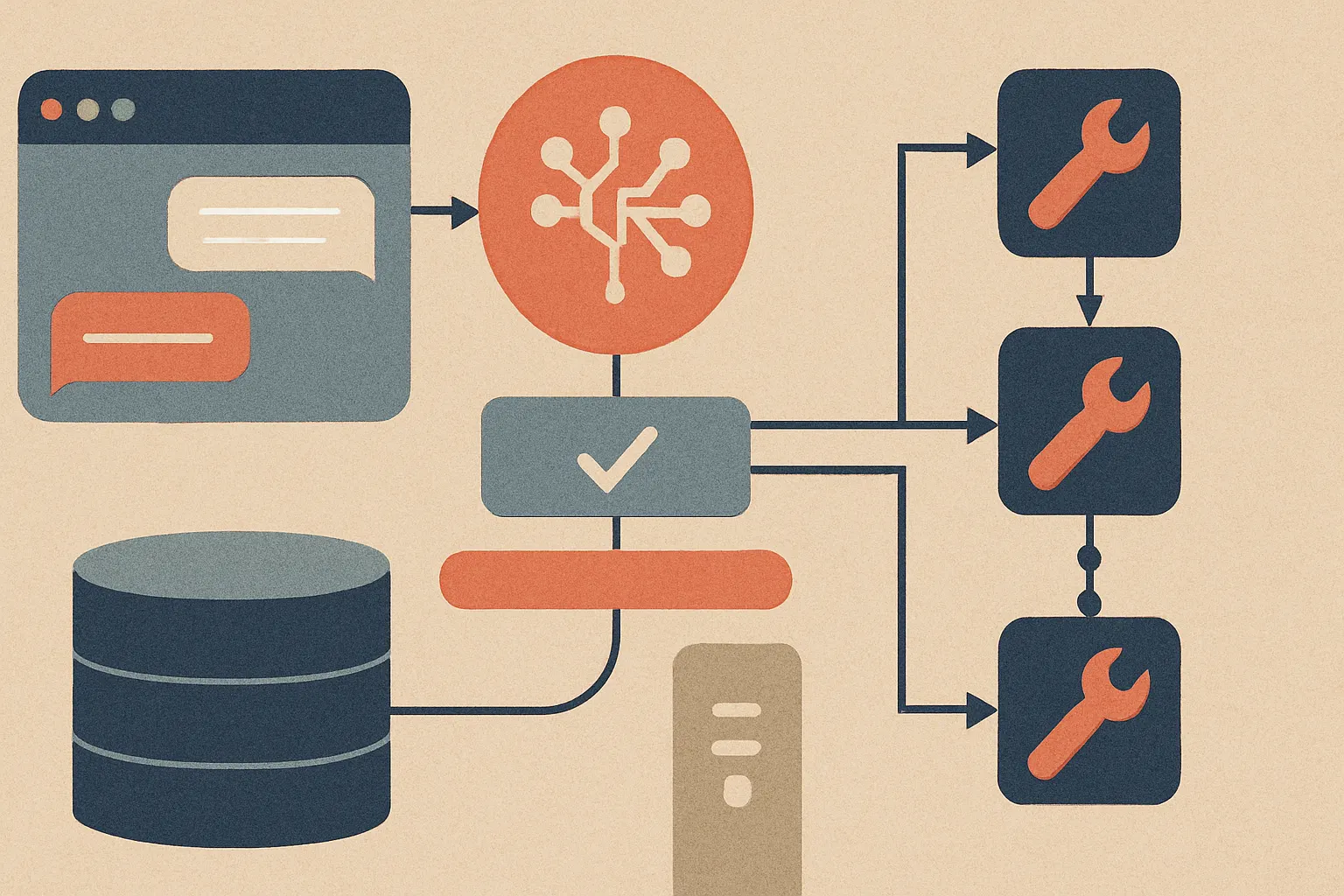
The important bit is not the chat box. It’s the policy and semantic layers between the model and the data.
Why your AI agent shouldn’t query raw enterprise data directly
Hot take: direct warehouse access for LLM agents is usually a bad idea.
Yes, even if it’s read-only.
Read-only access still lets the model retrieve the wrong thing, combine restricted datasets in ways your governance team never intended, or expose sensitive information in summaries. “But it can’t write to production” is not much comfort when it can still tell the sales org about finance data they shouldn’t see.
We’ve found that the safest pattern is to let the agent operate through approved tools and curated views, not arbitrary SQL generation against the whole estate. Think of it like a hotel master key. You don’t hand it to every staff member because “they promise to be careful.” You issue access by role, area, and time window.
That’s where Cloudflare’s unified-platform lesson matters. They didn’t frame the problem as “how do we bolt AI onto random datasets.” They framed it as building a coherent internal data access layer first Cloudflare.
That’s the grown-up move.
The real architecture lesson from Cloudflare: unify metadata before you unify answers
Most internal agents fail long before inference.
They fail at discovery.
If the system doesn’t know which dataset is canonical, who owns it, how fresh it is, what business definition it uses, and who’s allowed to see it, the model is basically doing office gossip at machine speed. The answer may sound polished. It may even be right once. That’s not the same as being trustworthy.
Cloudflare’s platform story points toward a central truth: unified analytics access depends on shared structure around the data, not just storage of the data itself Cloudflare.
Here’s how that flow should work in practice:
flowchart TD
  A[User asks question] --> B[Identity and role check]
  B --> C[Policy engine]
  C --> D[Semantic layer maps business terms]
  D --> E[Approved query tools hit governed datasets]
  E --> F[Results filtered and redacted]
  F --> G[LLM generates answer with citations]
  G --> H[Audit log and feedback capture]
If you skip the semantic layer, the model has to guess what “revenue,” “active customer,” or “incident rate” means. That’s how you end up with three executives quoting three different numbers from the same bot.
We’ve watched this happen. It’s not charming.
“But we have RAG” is not a governance strategy
This is where it gets weird.
A lot of teams think retrieval-augmented generation solves internal knowledge access because it can pull documents at answer time. RAG is useful. We build with it. We also think it’s wildly overrated for governed analytics unless paired with strict tool access and metadata discipline.
Why? Because documents are not the same thing as governed facts.
A wiki page can explain a KPI. It cannot guarantee the KPI was computed from the right tables, under the right permissions, with the right freshness constraints. That’s the difference between asking a bartender for a recipe and asking the kitchen to cook the dish. One gives you a story. The other gives you dinner.
For internal analytics agents, we prefer a split-brain pattern:
- RAG for policy docs, definitions, runbooks, and human context
- Structured tools for metrics, reports, and governed data retrieval
- A policy engine in the middle deciding what the user can actually get
If you’re building AI agents, that separation will save you from a lot of pain.
The permission model is the product, not a feature
Here’s the mistake that causes the most enterprise drama: teams inherit app-level permissions but ignore data-level permissions.
Those are not the same thing.
Just because a user can chat with the assistant doesn’t mean they should see every answer the assistant can potentially assemble. Internal agents need identity-aware retrieval. Not just “is this employee logged in?” but “what can this person see, at this moment, from this source, in this form?”
That means:
- row-level and column-level controls where relevant
- source-aware policies
- redaction before generation, not after
- audit logs on every retrieval step
- answer citations so users can inspect provenance
Cloudflare’s unified data platform story matters because it’s fundamentally about enabling broad internal use of data without turning that use into chaos Cloudflare. That same principle should govern your agent.
An internal AI assistant without auditable permissions is just shadow IT with better grammar.
Why “one big internal copilot” is usually a bad idea
We’re opinionated on this one: the giant all-knowing enterprise copilot is mostly a demo fantasy.
It looks great on stage. It’s a maintenance nightmare in real life.
Different teams need different tools, policies, vocabularies, and latency expectations. Finance wants reconciled numbers and zero improvisation. Support wants fast retrieval over runbooks and ticket patterns. Ops wants log correlation and incident context. Legal wants the model to be boring enough to induce sleep.
One agent can front these experiences, sure. But underneath, you still need domain-specific tools and guardrails. Otherwise the system becomes a Swiss Army knife where every blade is slightly dull and one of them is somehow on fire.
If you’re exploring custom models or AI consulting, this is usually where architecture decisions matter more than model selection. Teams obsess over whether to use one frontier model or another. Meanwhile the real failure is that nobody defined the approved query surface.
What we’d build instead
If we were designing an enterprise internal agent based on the lessons behind Cloudflare’s platform approach, we’d keep it boring on purpose.
That’s a compliment.
1. Put a semantic contract between the model and the warehouse
No raw table spelunking unless you enjoy postmortems.
Define curated metrics, approved dimensions, canonical joins, freshness expectations, and ownership. The agent should ask for “monthly retained customers” and receive a governed query plan, not invent SQL from vibes.
2. Treat tools as the only path to sensitive data
The model can suggest. Tools decide.
Every retrieval action should go through controlled functions with explicit schemas, role checks, and output filters. This is the same reason we like constrained execution in voice AI and on-device AI: freedom is great until it starts breaking things.
3. Make provenance visible in the answer
If the bot says “churn rose 2.1%,” the user should see where that came from, when it was refreshed, and what definition was used. If you can’t show that, don’t show the number.
Brutal? Maybe.
Necessary? Absolutely.
4. Log every step like you’re going to need it in a board meeting
Because you might.
Capture user identity, selected tools, datasets touched, policy decisions, redactions applied, and final answer artifacts. When trust breaks, auditability is the only thing that turns panic into diagnosis.
5. Start with narrow workflows that already hurt
Don’t launch with “ask anything about the company.”
Launch with:
- sales pipeline QA for approved roles
- support ops summaries from sanctioned sources
- incident review assistant over governed telemetry
- finance metric lookup with strict definitions
That’s how trust compounds.
Where smaller models actually help
This article isn’t about model size, but there’s a useful side note here.
For internal agents, smaller or specialized models can be a feature, not a compromise, especially when paired with strong tools and a governed backend. We’ve seen cases where the right constrained system beats a larger model simply because it has fewer opportunities to hallucinate and fewer ways to go off-script.
That’s also why products like RunHotel exist in a different but related world: when reliability, privacy, and bounded behavior matter, architecture choices beat raw model bravado. Bigger isn’t automatically smarter. Sometimes it’s just more expensive and more confidently wrong.
If you want a rough sanity check before building, use an AI cost estimator. The sticker shock alone has saved some teams from building a very expensive mistake.
The phrase nobody likes hearing: you probably need less agent, more platform
We’ve had clients come in asking for an internal AI assistant, and what they actually needed was a cleanup crew for their data contracts.
That’s not a glamorous answer. It is, however, the answer that works.
The lesson we’d take from Cloudflare’s unified data platform is simple: internal AI succeeds when the organization has already done the hard work of making data discoverable, governable, and usable across boundaries Cloudflare. The agent is the interface. The platform is the system.
And systems beat demos.
If you’re building this now, here’s the order we’d follow
First, identify the highest-value internal questions that already have clear ownership and governance.
Second, map the approved datasets and business definitions behind those questions.
Third, expose those through tools, not open-ended data access.
Fourth, put policy enforcement and audit logging in the middle.
Then add the LLM.
Not before.
If your team is stuck between “we want an internal copilot” and “security is about to tackle us in the hallway,” we can help design the boring parts that make the exciting part actually work. That’s our job at Cropsly, whether it’s AI agents, governed model workflows, or the ugly integration work nobody brags about but everybody needs. If that’s where you are, contact us.
Because the real trick isn’t building a smart agent.
It’s building one that knows when to shut up.