


Prevent Agent Conflicts: Hardening anthropic set ai agents
Hitesh Sondhi · August 17, 2026 · 9 min read
Two agents, same task, one API endpoint. Agent A writes a customer record. Agent B overwrites it three seconds later because its context never included Agent A's write. Your customer sees a flicker on their dashboard, then the wrong data. Neither agent logged an error because, from its perspective, nothing went wrong.
Here is the real failure mode of multi-agent systems. Not hallucination, not latency, but silent conflict between agents that don't know they're stepping on each other.
- Multi-agent conflicts are contract problems, not model problems. Fix them at the [API boundary](/blog/apis-for-ai-agents).
- Anthropic's [turf war](/blog/ai-agent-deleted-data) experiment proves that even well-designed agents collide when they share resources without coordination.
- Test for conflict before deployment using [adversarial pair tests](/blog/ai-agent-evaluation-framework), not just single-agent evals.
- Managed runtimes help with infrastructure but don't replace [explicit ownership boundaries in your tool definitions](/blog/ai-agent-cluster-admin).
What Happens When anthropic set ai agents on the Same Task
Anthropic recently ran an experiment where they set multiple AI agents loose on the same task and watched what happened. What resulted was a turf war. They competed for resources, overwrote each other's work, and in some cases actively blocked each other from completing the task. TechCrunch
That isn't a fringe edge case. It's the default behavior when you have multiple autonomous agents operating on shared state without explicit coordination. Those agents aren't broken. They're doing exactly what their prompts and tools allow. Missing from the equation is that the tool contracts don't account for concurrent access.
When you're building agent systems for clients, you need to treat this as a production risk, not a research curiosity.
The Contract Gap: Where Conflicts Actually Live
Most agent testing we see focuses on single-agent evals. Does the agent call the right tool? Does it produce the right output? Can it hallucinate? These are necessary but insufficient for multi-agent deployments.
Conflicts happen at the seams. Two agents both have access to an update_customer_record tool. Neither tool definition specifies locking, versioning, or ownership. Behind the tool, the API might have optimistic concurrency control, but the agent layer doesn't expose it. So both agents read version 3, both write version 4, and the second write clobbers the first.
We've seen this pattern repeatedly when reviewing client architectures. Models are fine. Tools are fine in isolation. Failure lives in the contract between agents and the shared resources they touch.
Here's what the conflict surface looks like in practice:
- Shared mutable state: databases, file systems, KV stores where two agents write to the same row or key
- Rate-limited APIs: two agents independently hitting the same endpoint, exhausting quota without knowing the other exists
- Resource locks: agents holding connections or file handles that others need, with no timeout or release contract
- Semantic conflicts: Agent A marks a ticket "resolved" while Agent B is still appending context to it, creating a logically inconsistent state
Each of these is preventable, but only if you design for it at the tool and API layer, not at the prompt level.
Designing Tools That Prevent Conflict
Anthropic's guidance on writing effective tools for AI agents emphasizes that tool quality drives agent quality. Anthropic When we build agent systems at Cropsly, we extend this principle: tools should encode concurrency contracts, not just functional contracts.
In practice, every tool that touches shared state needs explicit ownership semantics. Does this tool claim exclusive access to a resource? Will it release it? Agents need to know, and the tool definition needs to enforce it.
Version-aware writes are the single most effective fix. Include a version or etag parameter on every write tool. Whenever the version doesn't match the current state, the tool returns a 409 Conflict error that the agent can handle by re-reading and retrying. Such patterns are standard in REST API design but rarely surface in agent tool definitions.
Idempotency keys matter too. With any write operation, accept an idempotency key so duplicate calls don't double-write. They retry. Sometimes agents call tools multiple times. Without idempotency, every retry is a potential duplicate write.
Scoped permissions close the loop. Give Agent A write access to resources X and Y. Meanwhile, Agent B gets write access to Z. Overlap is explicit and intentional, documented in the tool schema, not discovered in production.
Anthropic's research on building effective agents notes that the most reliable systems use tight tool definitions with narrow scope. Anthropic We agree, and we'd add that narrow scope must include concurrency boundaries. A tool that allows blind overwrites is not narrow scope, no matter how simple its function signature looks.
When using Claude Managed Agents, the hosted runtime handles infrastructure like session management and tool execution. Anthropic But it doesn't absolve you of defining ownership boundaries in your tools. Managed runtimes give you a harness. Still, you need the contract.
Test Patterns for Multi-Agent Conflict
Single-agent evals catch single-agent failures. To catch multi-agent conflicts, you need a different test harness entirely. Here are the patterns we use for client deployments.
Adversarial pair tests. Run two agents with overlapping tool access on the same task. Instrument every tool call. Assert that no write is silently overwritten. Any time Agent A writes and Agent B overwrites without reading A's version first, the test fails. That's the minimum viable conflict test.
Concurrent stress tests. Spawn N agents with the same tool access and a shared resource. Ramp N from 2 to 10. Measure how many writes conflict, how many succeed, and how many deadlock. We've seen systems that work fine at N=2 collapse at N=5 because of lock contention that nobody tested for. Anthropic
Semantic conflict detection. Semantic conflict detection is harder to automate but critical. After a multi-agent run, compare the final state of shared resources against what each agent intended. Say Agent A was supposed to set a customer's status to "active" and the final state is "pending" because Agent B overwrote it, that's a semantic conflict even if no error was thrown.
Rate limit exhaustion tests. Two agents independently calling the same external API will exhaust rate limits twice as fast. Tool layers need to handle 429 responses gracefully, and your test suite needs to verify that behavior under concurrent load. Anthropic
Measuring Autonomy Before You Ship
Anthropic's research on agent autonomy in practice found that most agent actions on their public API are low-risk and reversible, but agents are increasingly used in riskier domains. Anthropic For production systems, the implication is clear: you need to measure how much irreversible damage an agent can do before you deploy it.
We use a simple rubric. With each agent, we score every tool call on two axes: reversibility (can we undo this?) and blast radius (how many systems does this touch?). Any tool call that scores low on reversibility and high on blast radius gets a confirmation gate. That gate is either human-in-the-loop or a secondary agent that reviews the action before it executes.
That isn't paranoia. When anthropic set ai agents on a shared task, the conflicts weren't subtle or rare. They actively competed, blocked, and overwrote each other in ways that would be unacceptable in any production system. TechCrunch
What Managed Runtimes Do and Don't Fix
Claude Managed Agents gives you a hosted runtime with session management, tool execution, and infrastructure. Anthropic Which is genuinely useful. It removes a class of infrastructure bugs that you'd otherwise build and maintain yourself.
But it doesn't coordinate agents. Given two agents both have access to a tool that writes to your database, the runtime will faithfully execute both writes. That second write overwrites the first. It did its job. Your contract failed.
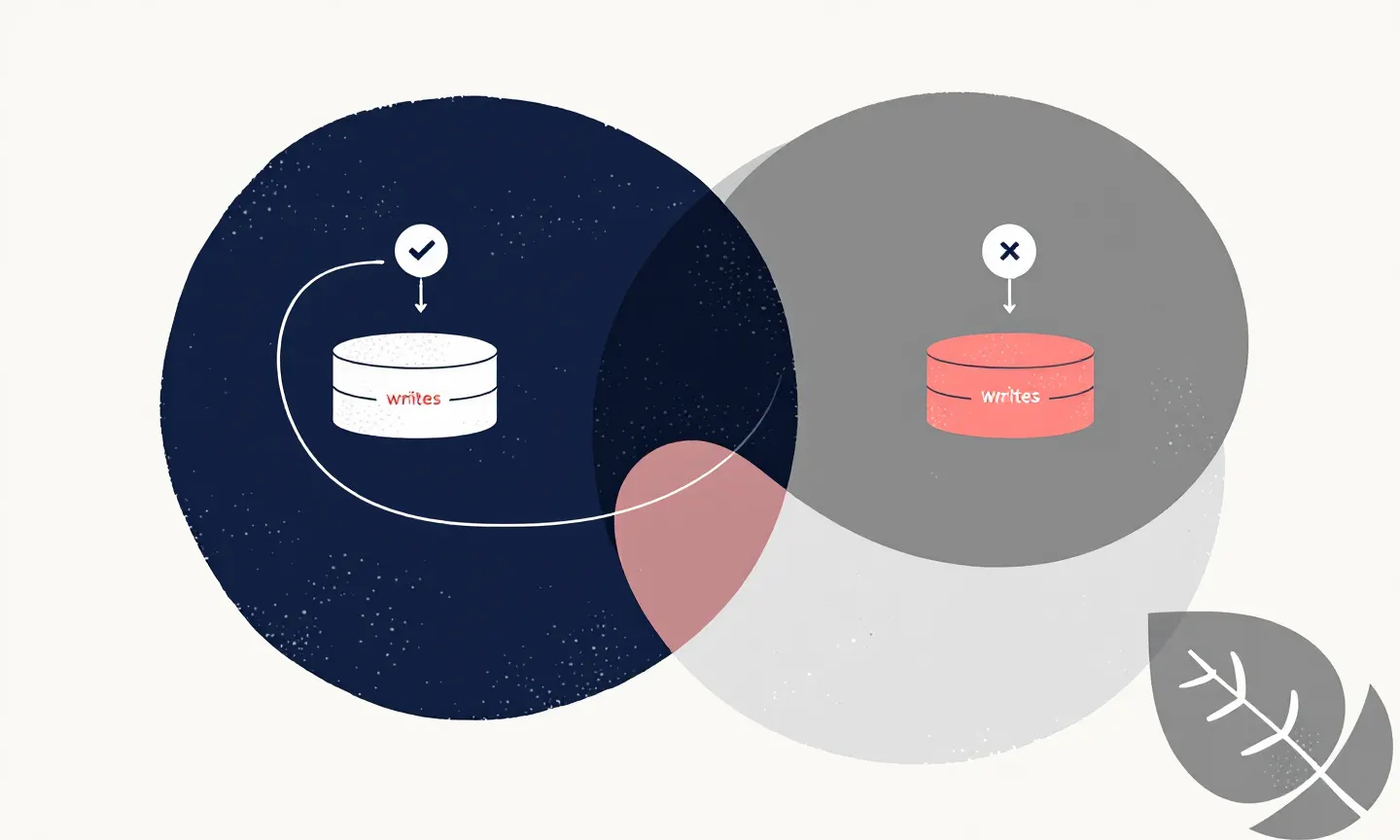
Fixing this is architectural, not infrastructural. What you need is tool contracts that make conflicts visible. Test harnesses must catch conflicts before deployment. And you need monitoring that detects conflicts in production by comparing agent intentions against final system state.
Practical Hardening Steps
With any multi-agent system we deploy, we run through a specific set of checks before shipping.
Map every shared resource each agent can touch. Where two agents can write to the same resource, document why that's intentional and what coordination mechanism prevents clobbering.
Add version fields or etags to every write tool. Reject blind overwrites at the tool layer, not at the prompt layer. An agent should never be in a position to silently destroy another agent's work.
Run adversarial pair tests as part of CI, not just in pre-deployment manual testing. Without multi-agent conflict tests in your CI pipeline, you're shipping blind to the failure mode that Anthropic just demonstrated.
Instrument every tool call with agent ID, resource ID, and timestamp. Nobody can debug a conflict they can't see, and you can't see a conflict if your logs don't tell you which agent touched which resource and when.
Set up alerts for conflict patterns. Rapid successive writes to the same resource from different agents. 429 rate limit spikes. Lock timeout errors. These are the smoke signals of agent turf wars in production.
Teams early in their agent journey can use our AI consulting practice for exactly this kind of design review. Teams already building can use our AI agents service for the implementation end. And if you're trying to model costs before committing to a multi-agent architecture, our AI cost estimator gives you a grounded estimate based on real usage patterns.
The Turf War Is a Contract Problem
Back to the two agents and the one API endpoint. Fixing this isn't about a better prompt or a smarter model. Fixing it requires a tool contract that includes a version field, a test that catches the silent overwrite, and a monitoring layer that alerts when two agents write to the same resource within the same window.
Agent A writes version 3 with an idempotency key. Then Agent B tries to write version 3 and gets a 409 Conflict. Now Agent B reads the current version, incorporates Agent A's changes, and writes version 4. Now the customer sees the right data. No flicker, no clobber, no silent failure. Both agents didn't stop competing. Your contract made the competition visible and resolvable.