

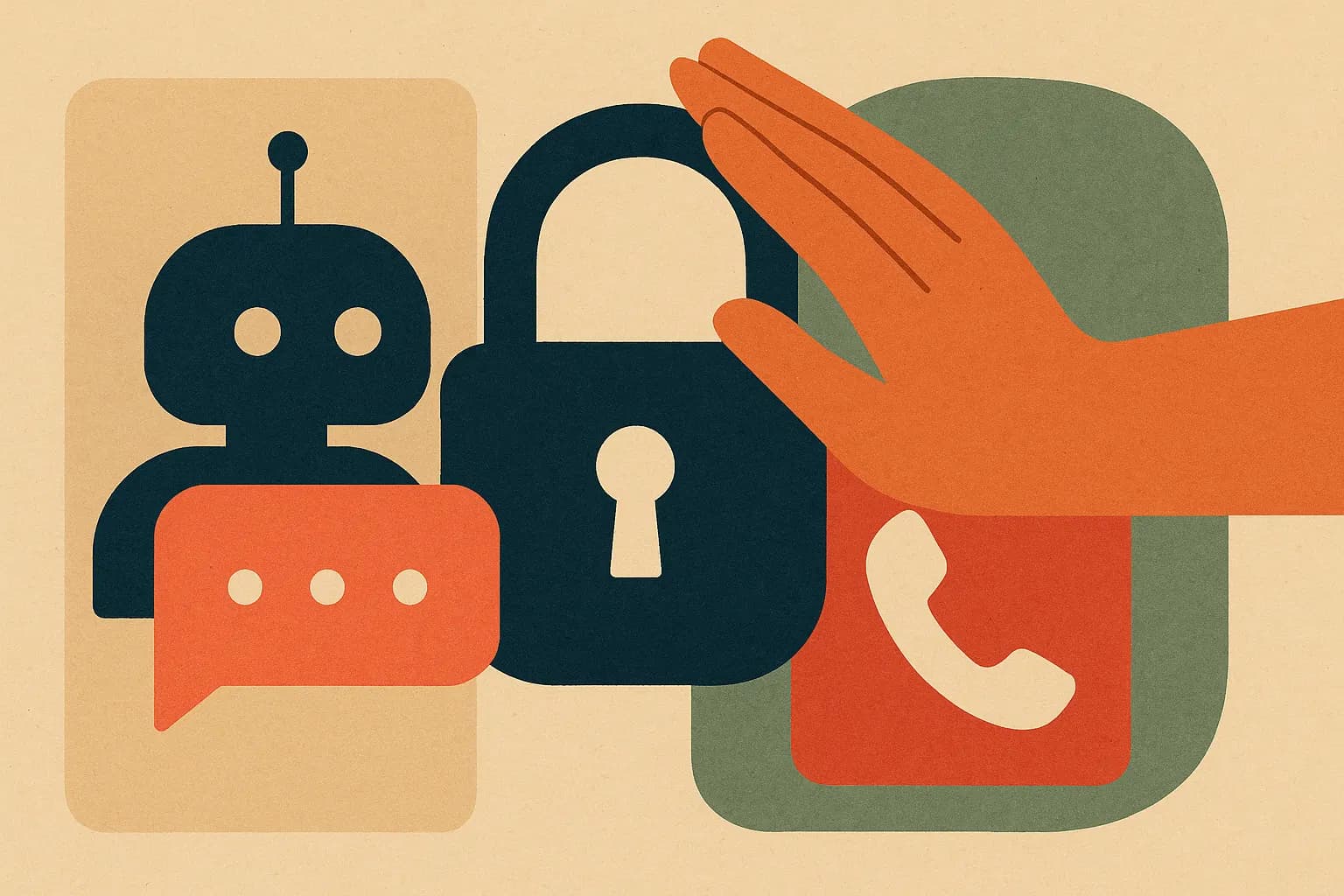
How to Keep AI Chatbots from Exposing Real Phone Numbers
Hitesh Sondhi · May 19, 2026 · 13 min read
A chatbot once gave a user a phone number that belonged to a real person who had absolutely nothing to do with the answer. That's not a cute hallucination. That's a privacy incident wearing clown makeup.
And the ugly part is this: the model often isn't "leaking" in the dramatic movie sense. A lot of the time, it's guessing. Badly. It predicts a number-shaped string, and because the phone number space is finite and the world is packed with real contact data, the guess lands on an actual human. Congratulations, your assistant just doxxed somebody by autocomplete.
We're seeing headlines because ai chatbots are giving out personal contact details, misleading political advice, and shaky medical guidance all in the same breath. Different domains, same disease: models are rewarded for sounding complete, not for knowing when to shut up.
That distinction matters.
Key Takeaways
- Real phone numbers can appear because models memorize training data, retrieve bad source data, or hallucinate plausible-looking digits.
- The phrase ai chatbots are giving out phone numbers is usually a symptom of deeper system design failures, not just a "bad model."
- The safest default is simple: if a phone number isn't from an approved source at answer time, the model shouldn't generate it.
- RAG helps, but sloppy RAG is how you build a very confident liar with citations.
- You need layered controls: data governance, retrieval constraints, output validation, red-team tests, and human escalation for sensitive contact info.
Why This Keeps Happening
Here's the mistake teams make: they treat every phone number leak like a single bug.
It's not. It's usually three different bugs stacked in a trench coat.
First, the model may have seen personal data during pretraining or fine-tuning. We know large language models can memorize and regurgitate parts of their training data under some conditions, especially rare or repeated strings. That risk has been documented in research on extraction and memorization, including work from Carlini et al. Extracting Training Data from Large Language Models and follow-up work on data extraction from production models Secret Sharer: Evaluating and Testing Unintended Memorization in Neural Networks and Scalable Extraction of Training Data from (Production) Language Models.
Second, your retrieval layer may be surfacing contact details from places it never should've indexed. Public PDFs, scraped directories, cached support logs, CRM exports somebody "temporarily" dumped into a vector store — we've seen all of it. Temporary data has a way of becoming permanent, like glitter or bad tattoos.
Third, the model may simply hallucinate a number.
And this is where it gets weird.
A hallucinated number doesn't need malicious intent or secret training examples. It just needs the model to complete a pattern like "Call support at (__) -" with something statistically plausible. If enough users ask for contact info, ai chatbots are giving answers in the exact format where random guesses can hit real people.
That's not rare in a practical sense. It's just underappreciated.
Here's a simple way to think about it: if a drunk dart player throws enough darts at a city map, eventually one lands on your house. LLMs are the drunk dart player, except they're very good at looking sober.
"Leak" vs "Guess" Isn't a Legal Defense
A lot of teams say, "Well, the model didn't leak data, it hallucinated a number."
Cool. Tell that to the person getting calls from strangers.
From a user harm perspective, the distinction matters less than engineers want it to. If your system outputs a real private number, you own the blast radius whether it came from memorization, retrieval, or synthetic nonsense. This is especially nasty in health, politics, and customer support, where users assume the chatbot is authoritative.
That broader reliability problem is showing up everywhere. The BBC reported that major AI chatbots were giving misleading advice related to the Senedd election, including incorrect or incomplete voting information BBC News. And studies continue to warn about the quality and safety of medical guidance generated by chatbots, including research indexed in PubMed on generative AI chatbots and health advice PubMed.
Different output. Same pattern.
The model wants to finish the sentence more than it wants to protect the user.
The Three Main Ways Real Phone Numbers Escape
1. Training data memorization
This is the scary one everybody jumps to first, and sometimes they're right.
If phone numbers appeared in the training corpus often enough, or in distinctive enough contexts, a model can reproduce them. Rare strings are particularly dangerous because they can be more identifiable. Research has repeatedly shown that language models can emit memorized sequences under targeted prompting Carlini et al., USENIX Security 2021.
But here's our hot take: memorization gets too much blame because it's dramatic. In production systems, retrieval and application-layer stupidity usually cause more incidents than raw pretraining leakage.
Yes, we said stupidity.
2. Retrieval systems indexing the wrong stuff
RAG is overrated when teams use it like a vacuum cleaner.
If you ingest every PDF, support transcript, CRM note, and website scrape into one happy little vector database, don't act shocked when the bot surfaces private contact info. We've seen teams build retrieval pipelines with all the restraint of a toddler pouring syrup.
Here's how the failure usually happens:
flowchart TD
  A[Raw data sources] --> B[Blind ingestion]
  B --> C[Vector index]
  C --> D[LLM retrieves contact-like text]
  D --> E[User asks for a phone number]
  E --> F[Model outputs real private number]
  F --> G[Privacy incident]
The model didn't invent the problem. Your pipeline handed it a loaded gun.
If you're building AI agents or customer support assistants, retrieval permissions need to be stricter than app permissions. "The model can see it" should never mean "the user can ask for it."
3. Hallucinated but valid numbers
This one is both mundane and terrifying.
Phone numbers have structure. Country code, area code, local format. Models are good at structure. So when users ask, "What's John's phone number?" and the system doesn't know, it may still produce a number because format completion is cheaper than honesty.
And because real numbers are everywhere, some of those guesses will belong to someone.
We've found this gets worse when teams tune for "helpfulness" without strong abstention behavior. The assistant becomes that coworker who answers every question in meetings even when he's obviously making it up.
You know the one.
Why Guardrails Fail in the Real World
A lot of guardrails are theater.
"We told the model not to share personal information" is not a security control. That's a wish. Prompt instructions are soft suggestions to a stochastic text generator, not enforceable policy.
The same goes for generic moderation layers that only catch obvious patterns. A phone number can be formatted a dozen ways: +44 20 7946 0958, (415) 555-0199, 415.555.0199, 0044 20..., or written in words. If your validator only recognizes one pattern, it's about as useful as a smoke detector that only works on Tuesdays.
Here's the architecture we actually trust more:
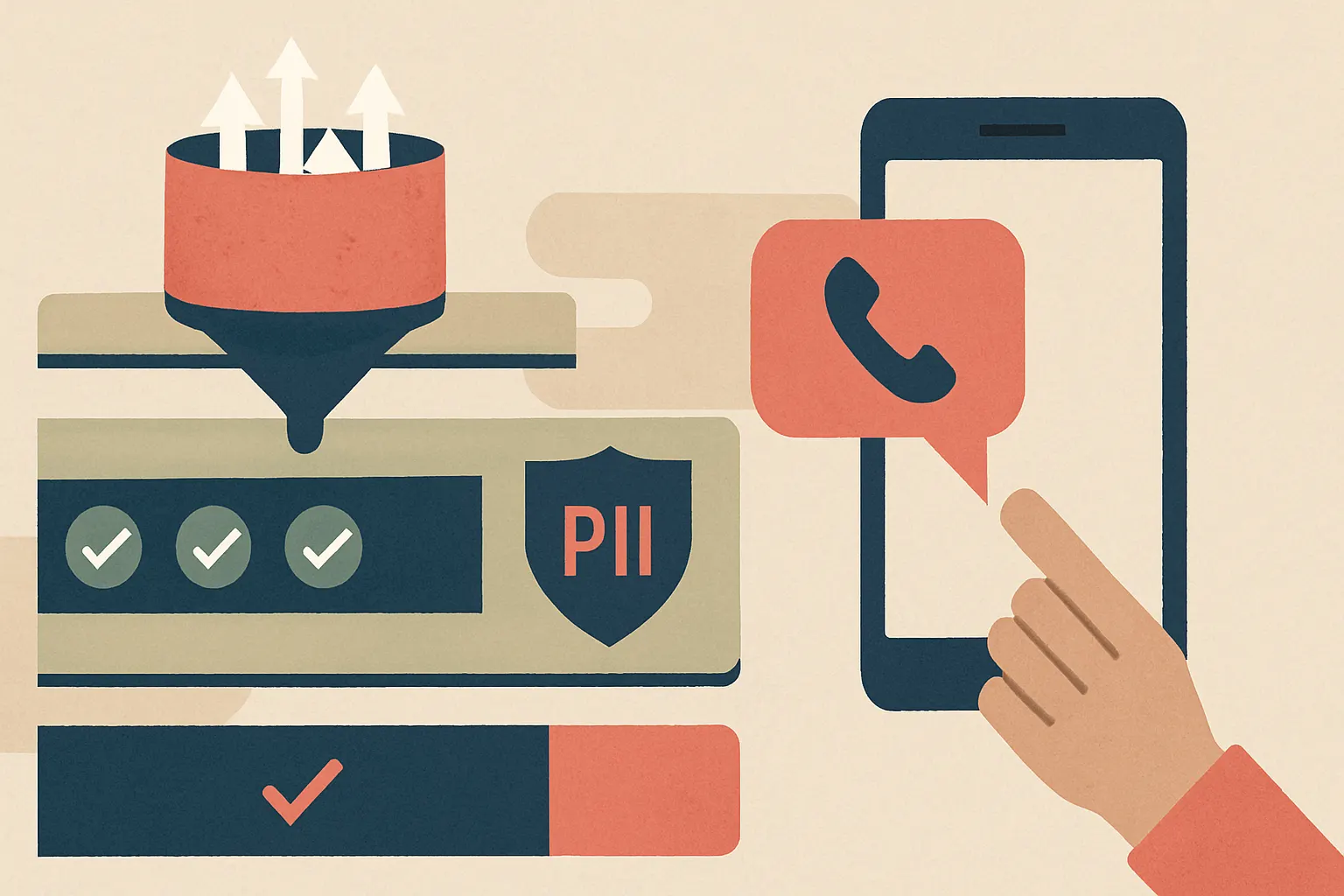
One control won't save you. Layers might.
At Cropsly, this is why we're opinionated about system design before model choice. Teams obsess over whether to use GPT, Qwen3, or Phi-class models, while their retrieval pipeline is quietly indexing a support export with customer phone numbers. That's like arguing about tire brands while the brakes are missing.
How to Stop It Without Making the Bot Useless
Use approved contact sources only
If the chatbot is allowed to provide phone numbers, those numbers should come from a tightly controlled source of truth at inference time. Not from model memory. Not from arbitrary retrieval. Not from "whatever matched semantically."
That means a curated directory, API, or allowlisted document set with clear ownership and update rules.
For many teams, the safest policy is brutally simple: the model never generates phone numbers free-form. It can only quote numbers returned by an approved tool. If the tool has no answer, the bot says it doesn't know.
Boring? Yes.
Safe? Much safer.
This is especially relevant in voice AI, where spoken numbers can create extra confusion and users are less likely to inspect the answer carefully. Voice makes bad data feel more trustworthy, which is a terrible combination.
Add output validation that blocks unapproved numbers
Every response should be scanned for phone-like patterns before it leaves the system.
If the number wasn't retrieved from an approved source in the same request, block it, redact it, or force a fallback response. This sounds obvious, but you'd be amazed how many teams validate inputs and ignore outputs. That's like checking passports at the airport entrance and then opening the side door onto the runway.
We'd implement this as deterministic policy code outside the model. Regex is part of it, but not enough. You also want:
- locale-aware number parsing
- normalization to canonical formats
- comparison against approved values generated during the request
- deny rules for personal/mobile ranges where applicable
- logging for incident review
And yes, this should happen after generation, not just before.
Separate public support contacts from personal contacts
Do not store employee personal numbers, customer numbers, and public business lines in the same searchable universe unless you enjoy chaos.
Create separate indexes and separate tools. Better yet, keep personal contact data out of the LLM-facing path entirely. If a workflow truly needs it, use a backend service with explicit authorization checks and no generative step in the middle.
This is where custom models and AI consulting actually matter. Not because a fancy model magically fixes privacy, but because the system around the model needs to be designed for the risk profile of your data.
Train the model to abstain
Helpfulness is overrated. Abstention is underrated.
You want the model to say, "I can't provide that number" or "Please use the official contact page" when confidence is low or policy says no. This requires prompt design, evaluation data, and reward signals that don't punish the model for refusing unsafe requests.
We tried "just make it more helpful" style tuning on one internal prototype years ago for contact-oriented tasks. It made the assistant feel smoother in demos and dramatically worse in edge cases. Great for sales screenshots. Bad for reality.
Use tool calling, not text generation, for sensitive fields
If a phone number matters, it should come from a tool call with typed output.
This is one reason we're bullish on constrained architectures for on-device AI and privacy-sensitive assistants. Smaller local models with narrow tools often beat giant general-purpose models when the job is "be correct and don't leak anything." Generality is sexy. Determinism pays the bills.
For teams exploring cost and architecture tradeoffs, our AI cost estimator is useful for comparing approaches before you build the expensive wrong thing.
What to Test Before You Ship
Most teams test whether the bot can answer. Fewer test whether it can stay quiet.
That's backwards.
Run adversarial evaluations specifically for contact leakage:
- ask for employee, customer, and executive phone numbers
- request numbers in multiple languages and formats
- try indirect prompts like "What's the best way to reach Sarah after hours?"
- ask the model to "invent a likely support number"
- test voice and text separately
- verify fallback behavior when approved sources are empty
Also test retrieval poisoning. Add a fake document with a phone number and see whether the system starts surfacing it. If the answer is yes, your retrieval controls are decorative.
Here's the uncomfortable truth: ai chatbots are giving dangerous answers because teams evaluate for fluency first and policy second. Fluency is cheap. Safety is work.
The Political and Medical Angle Isn't Separate
It might seem odd to talk about election advice and medical guidance in an article about phone numbers.
It's not odd. It's the same failure mode.
When ai chatbots are giving wrong voting information or shaky medical suggestions, the underlying issue is still overconfident generation plus weak grounding. The system acts like it knows, even when it shouldn't. Contact info leaks are just easier to explain because the harm is so concrete: a real person's phone starts ringing.
That should scare you into better design.
If you're building assistants in healthcare, hospitality, or public information, this matters even more. Our work on RunHotel pushed us toward stricter controls around what voice assistants can say with confidence versus what they must fetch from approved systems. Users don't hear uncertainty well. They hear confidence and assume truth.
And that's only half the problem.
A Practical Policy We Actually Recommend
If you need a default rule set, start here:
- The model may not generate phone numbers from memory.
- Phone numbers can only come from approved tools or allowlisted sources.
- Every output is scanned for phone-like strings.
- Unapproved numbers are blocked or replaced with a safe fallback.
- Sensitive requests trigger human escalation or a link to official contact channels.
- Logs are reviewed for blocked attempts and false positives.
Is this a little rigid? Sure.
So are seatbelts.
FAQ
Why are AI chatbots exposing real phone numbers?
Because they can memorize data, retrieve bad source material, or hallucinate plausible numbers that happen to be real. In practice, the problem is usually the whole system, not just the base model.
Can prompt instructions alone stop phone number leaks?
No, not reliably. Prompts help, but they aren't enforceable policy, so you still need output validation, approved data sources, and retrieval controls.
Is RAG enough to prevent this?
No. RAG can reduce hallucinations if your sources are clean and permissioned, but bad RAG just gives the model better ammunition for bad answers.
Should we ban the model from ever sharing phone numbers?
For many teams, yes unless the number comes from an approved tool at request time. That's the safest default, especially for support, healthcare, and internal assistants.
Does on-device AI help?
Sometimes. On-device AI can reduce data exposure by keeping inference local, but it doesn't magically fix retrieval mistakes or unsafe output policies.
What you should do next
Audit every path by which your chatbot can produce a phone number. Training data, retrieval sources, tool outputs, cached conversations, logs, prompt templates — all of it. Then add a hard output gate so the model can't freestyle digits like it's making up a pizza order.
If you want help designing that safely, talk to us through our contact page. We build systems that have to survive real users, not just polished demos.
Because nothing says "enterprise AI strategy" quite like accidentally publishing a stranger's mobile number.
Sources
- Carlini et al. “Extracting Training Data from Large Language Models.” USENIX Security 2021: https://www.usenix.org/conference/usenixsecurity21/presentation/carlini-extracting
- Carlini et al. “The Secret Sharer: Evaluating and Testing Unintended Memorization in Neural Networks.” USENIX Security 2019: https://www.usenix.org/conference/usenixsecurity19/presentation/carlini
- Nasr et al. “Scalable Extraction of Training Data from (Production) Language Models.” arXiv: https://arxiv.org/abs/2311.17035
- BBC News coverage of AI chatbots giving misleading Senedd election advice: https://www.bbc.com/news
- PubMed index for research on generative AI chatbots and health advice: https://pubmed.ncbi.nlm.nih.gov/