


Vector database vs knowledge graph for enterprise retrieval
Hitesh Sondhi · May 14, 2026 · 13 min read
We watched a retrieval system ace the demo, then embarrass itself in production three days later.
The question was simple: “Which vendors can process EU guest data, support SSO, and are already approved by procurement?” Our vector search returned a beautifully written policy paragraph and a random vendor case study. It sounded smart. It was useless.
That’s the whole problem with enterprise retrieval. Looking relevant and being correct are not the same thing.
If you’re stuck in the vector database vs knowledge graph debate, here’s the blunt version: vector databases are usually faster to ship, cheaper to get working, and great with messy documents. Knowledge graphs are better when relationships, rules, provenance, and explainability actually matter. Most enterprise systems need both. The teams that insist on picking only one are usually optimizing for org charts, not reality.
Key Takeaways
- Vector databases are great at semantic similarity over unstructured text, but they’re weak at explicit reasoning and relationship-heavy queries.
- Knowledge graphs shine when your retrieval depends on entities, permissions, hierarchies, and multi-hop relationships.
- If you need something working next month, vectors usually win. If the answer must be auditable, graphs often win.
- For enterprise RAG, hybrid retrieval is usually the least bad option: vectors for recall, graphs for precision and constraints.
- The real choice isn’t “which is better?” It’s “what kind of mistakes can your business afford?”
Why this argument keeps going in circles
A lot of articles frame vector database vs knowledge graph like it’s SQL vs NoSQL all over again. It’s not. These tools solve different retrieval problems, and pretending otherwise is how teams end up rebuilding their stack six months later.
Vector databases answer, “What content is semantically similar to this query?” That’s incredibly useful when your data is PDFs, emails, call transcripts, support tickets, contracts, and all the other enterprise sludge nobody normalized because everyone was too busy surviving Q4.
Knowledge graphs answer, “How are these entities related, and what rules govern those relationships?” That matters when “approved vendor” depends on geography, legal entity, contract status, department ownership, and policy exceptions approved by exactly one person who’s now on parental leave.
Same company. Very different jobs.
Here’s a simple mental model: vector retrieval is like asking a well-read librarian to find books that feel related. Knowledge graph retrieval is like asking a meticulous investigator to show the chain of evidence.
One is fast and intuitive. The other is annoying in the best possible way.
What vector databases are actually good at
We’ll say it plainly: vector databases are the default starting point for enterprise retrieval because they’re easier to deploy and they tolerate chaos.
That’s not a small advantage.
Modern embeddings can capture semantic similarity across messy text surprisingly well. If your user asks, “What’s our parental leave policy in Germany?” a good vector index can retrieve policy sections even if the document says “family leave benefits for DE employees.” That flexibility is exactly why vector search became the backbone of so many RAG systems.
The retrieval flow usually looks like this:
flowchart TD
  A[User query] --> B[Embedding model]
  B --> C[Vector search]
  C --> D[Top-k chunks]
  D --> E[LLM rerank or answer generation]
  E --> F[Response with citations]
Simple. Effective. Dangerous when overtrusted.
According to the Pinecone Learn center, vector databases are designed to store embeddings and perform similarity search efficiently, which is exactly why they fit semantic retrieval so well. And OpenAI’s embeddings documentation explains why semantically similar text can be mapped near each other in embedding space. That’s the engine under the hood.
But semantic similarity is not understanding.
That’s the part people keep hand-waving away.
A vector index doesn’t inherently know that Vendor A is a subsidiary of Company B, that Company B lost approval last quarter, and that only procurement can override the block for France. It might retrieve documents that mention all of those facts. It won’t reliably enforce them as a connected truth structure unless you bolt on other systems.
And yes, you can patch around this with metadata filters, rerankers, query expansion, and prompt tricks. We’ve done all of that. Some of it works.
Some of it is duct tape wearing a tie.
Here’s what that architecture often looks like in practice:
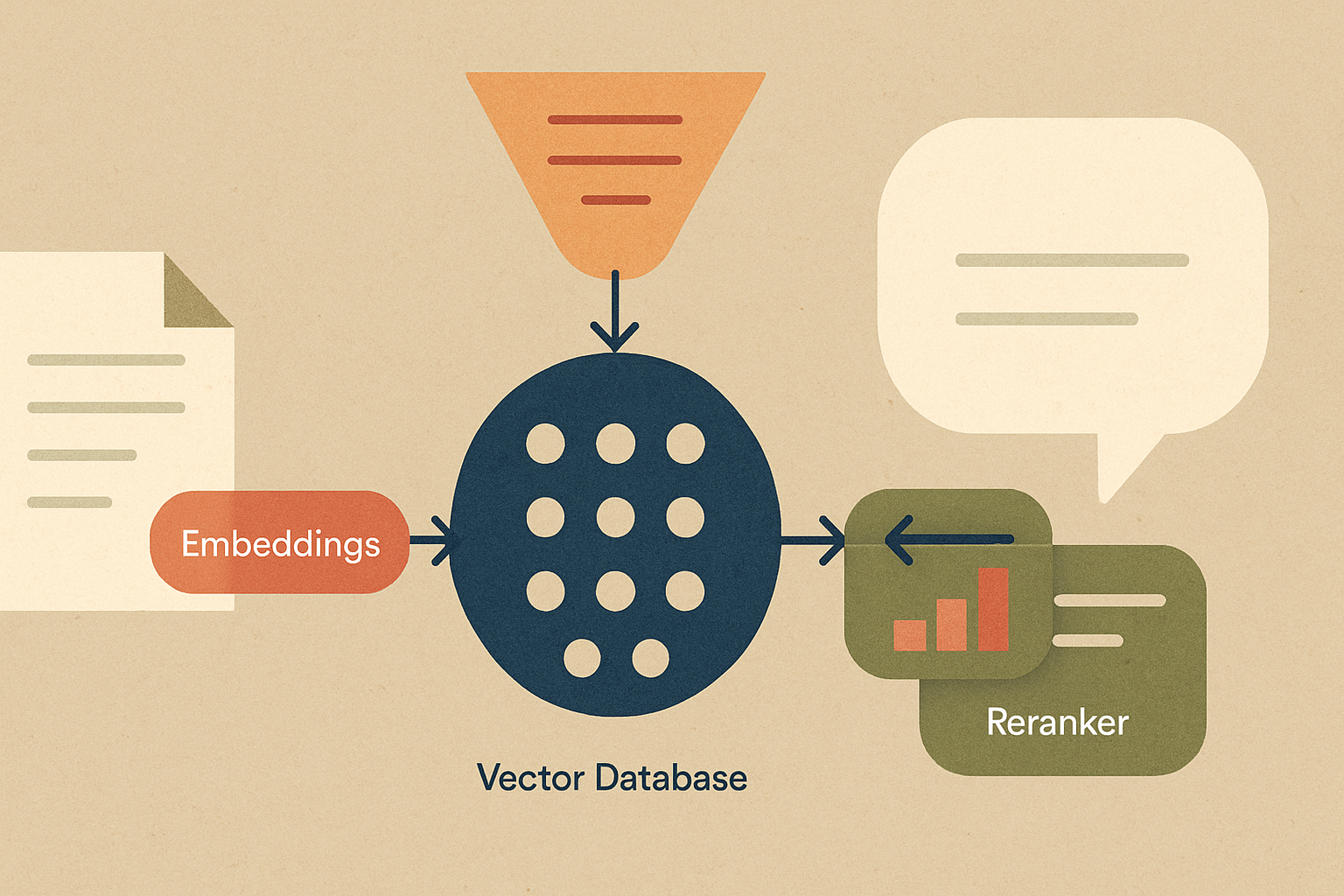
If your enterprise retrieval problem is mostly “find the right passages from a mountain of documents,” vectors are a strong choice. They’re especially useful for internal search, support knowledge bases, policy retrieval, and any workflow where the source of truth already lives in text.
That’s why they often show up first in AI agent systems and custom RAG stacks. They get you from zero to useful quickly.
But that’s only half the problem.
Why knowledge graphs keep making a comeback
Knowledge graphs are having one of those “we ignored this for years and now suddenly it’s cool again” moments.
Fair enough. They earned it.
A knowledge graph represents entities and relationships explicitly: employee -> belongs to department -> reports to region -> governed by policy -> constrained by legal entity. That structure gives you something vectors don’t naturally provide: deterministic traversal over known facts.
If your query is “Which approved vendors can store guest voice recordings for UK hotels but not transfer data outside the EEA?”, a graph can model vendors, regions, data classes, compliance obligations, and approval states as first-class objects. You’re not hoping the right paragraph appears in the top 5 chunks. You’re traversing relationships.
That’s a huge difference.
According to Neo4j, knowledge graphs are useful for modeling connected data and making relationships explicit and queryable. And Google Cloud’s guide to knowledge graphs describes them as a way to represent real-world entities and the relationships between them in a machine-readable form. That machine-readable part matters a lot in enterprise settings.
Because enterprises run on relationships.
Not vibes.
This is where the vector database vs knowledge graph conversation gets interesting. Knowledge graphs are often better when you need:
- multi-hop reasoning
- explainable answers
- entity disambiguation
- policy and permission awareness
- lineage and provenance
- structured grounding across systems
They’re also better when legal, compliance, procurement, finance, or healthcare people are involved. Those teams don’t care that your semantic search was “close enough.” They care whether the answer can be traced, defended, and audited.
And they should.
The part nobody likes: graphs are expensive to do well
Hot take: most enterprise teams should not start with a knowledge graph unless they already know their domain model is the product.
There, we said it.
Graphs are powerful, but they’re not magic. Building one means defining entities, normalizing identifiers, maintaining ontologies, resolving duplicates, handling schema evolution, and keeping the graph fresh when your source systems change for the fifth time this quarter because someone bought another SaaS tool.
We’ve seen teams pitch a graph like it’s a silver bullet, then spend months arguing whether “customer account” and “billing account” are the same node. That’s not retrieval. That’s taxonomy trench warfare.
It’s like deciding to organize your garage by building custom shelving, labeling every screw, and color-coding seasonal equipment. Great if you’ll live there for ten years. Insane if you just need to find the snow shovel tonight.
This is why vector-first systems keep winning early. They’re forgiving. You can ingest documents, chunk them, embed them, add metadata, and get value fast. For many businesses, that’s enough.
Until it isn’t.
So which one should you choose?
Here’s the practical version of vector database vs knowledge graph.
Choose a vector database first if:
- your data is mostly unstructured documents
- you need a working retrieval system quickly
- your questions are mostly “find relevant passages”
- your team doesn’t have graph modeling expertise
- explainability matters, but strict relational correctness doesn’t dominate every answer
Choose a knowledge graph first if:
- your retrieval depends on entities and relationships
- your users ask multi-hop questions across systems
- permissions, approvals, hierarchies, and lineage matter
- you need deterministic, auditable retrieval
- your domain is stable enough to justify formal modeling
That sounds neat on paper. Real life isn’t neat.
Most enterprises have both messy documents and structured business logic. Contracts live in SharePoint. Product hierarchies live in ERP. Exceptions live in email. The actual approval path lives in Karen’s head.
Good luck embedding Karen’s head.
The hybrid model is usually the winner
Our strongest opinion here: hybrid retrieval is underrated, and “just use vectors for everything” is overrated.
A good enterprise system often uses vector search for broad recall and a knowledge graph for constraint checking, relationship traversal, and answer validation. The vector side finds candidate evidence in unstructured text. The graph side answers “does this entity actually relate to that one under these rules?”
That combination is much closer to how enterprises actually work.
Here’s what the hybrid flow looks like:
flowchart LR
  A[User query] --> B[Entity extraction]
  A --> C[Embedding search]
  B --> D[Knowledge graph traversal]
  C --> E[Candidate passages]
  D --> F[Relevant entities and constraints]
  E --> G[Reranker / fusion layer]
  F --> G
  G --> H[LLM answer with citations and rules]
This pattern also helps reduce one of the biggest RAG failure modes: plausible nonsense. Microsoft’s advanced RAG guidance emphasizes that retrieval quality, grounding, and orchestration matter as much as the model itself. We agree, hard.
Because if your retrieval is sloppy, your LLM becomes a very confident intern with a nice vocabulary.
At Cropsly, this hybrid thinking shows up whenever retrieval has to support real operations, not just pretty demos. If you’re building internal copilots, support automation, or domain-specific assistants, this is usually where custom models and AI consulting start paying for themselves: not in model novelty, but in retrieval architecture that matches the messiness of the business.
That’s the unsexy truth.
Enterprise retrieval isn’t just about relevance
A lot of teams compare vector search and graph retrieval as if the only metric is answer quality. That’s too narrow.
Enterprise retrieval also has to deal with access control, freshness, provenance, operational complexity, and cost. A system that retrieves the right answer but leaks the wrong document is not “mostly working.” It’s broken.
This is one place graphs can be especially useful. They can model who can see what, under which conditions, and through which relationships. Vector databases can support metadata filtering, and many do it well, but metadata filters are not the same thing as a rich permission model spread across connected entities.
Different tool. Different job.
And if you’re deploying retrieval into constrained environments, the architecture choices get even sharper. On-device and edge systems often can’t carry your entire enterprise graph around, which means you may need compressed indexes, local subsets, or task-specific retrieval logic. We’ve seen this kind of tradeoff come up in on-device AI and voice AI work, where latency budgets and offline requirements force you to be ruthless about what retrieval logic lives where.
You can’t just throw the whole data warehouse at a hotel front desk device and call it architecture.
That’s how you get paged at 2 a.m.
A brutally honest decision framework
If you want the short version, use this:
Pick vectors when speed matters more than structure
They’re easier to stand up, easier to iterate, and better for large volumes of unstructured content. If your biggest problem is document retrieval, vectors are the obvious first move.
Pick graphs when correctness depends on relationships
If wrong joins, bad entity resolution, or missing constraints can break the business, graphs deserve serious consideration. They’re slower to build, but they fail in more legible ways.
Pick both when the business is messy
Which is most businesses.
That’s why the smartest answer to vector database vs knowledge graph is often “yes.” Not because we’re dodging the question, but because enterprise retrieval usually spans both semantic similarity and explicit relationships.
One finds the hay. The other tells you which needle actually matters.
Where teams usually screw this up
They confuse retrieval quality with model quality.
They ship a slick chatbot before defining source-of-truth systems.
They use vectors to answer relationship-heavy questions and act surprised when the system hallucinates a policy chain that never existed.
Or they over-engineer a graph before proving anyone even needs that level of structure.
We’ve seen all four. None were fun.
If you’re early, start with the smallest architecture that can fail honestly. That usually means vector retrieval with strong metadata, citations, evaluation, and a clear plan for where graph modeling would add value later.
If you already know your domain is all about entities, approvals, and multi-hop logic, skip the cosplay and design the graph properly from day one.
And if you need help estimating what this stack will actually cost before your CFO starts twitching, use our AI cost estimator. It’s a lot better than pretending infra is free.
FAQ
Is a vector database better than a knowledge graph for RAG?
Not universally. Vector databases are usually better for retrieving semantically similar chunks from unstructured text, while knowledge graphs are better for relationship-heavy, explainable retrieval.
Can a knowledge graph replace a vector database?
Sometimes, but usually not completely. A graph can represent structured knowledge beautifully, but it won’t magically become the best tool for semantic search across messy documents, transcripts, and long-form text.
Why do enterprises often need both?
Because enterprise knowledge is split between text and structure. Policies, contracts, and manuals live in documents, while approvals, org hierarchies, and system relationships live in structured data.
Which is easier to implement?
Vector databases are usually easier. You can get useful retrieval running quickly with embeddings and chunking, while graphs require domain modeling, schema decisions, and ongoing data governance.
Are knowledge graphs more explainable?
Yes, generally. Graphs make entities and relationships explicit, which makes it easier to trace why a result was returned and how facts connect.
Final answer: stop treating this like a religion
The vector database vs knowledge graph debate gets weirdly tribal for something that should be a design decision.
Vectors are not dumb. Graphs are not old-fashioned. Both are useful. Both are bad when used for the wrong job.
If you’re building enterprise retrieval, start by mapping the failure modes you can’t tolerate. If “we missed a relevant paragraph” is the main risk, vectors are probably enough. If “we gave a confident answer that violated policy because we ignored relationships” is the risk, bring in a graph.
And if you’re somewhere in the middle — welcome to enterprise software, where the answer is usually hybrid and slightly annoying.
If you want help designing that stack, talk to us through Cropsly’s contact page. We’ve built enough production AI systems to know where the bodies are buried, including a few of our own. For a look at how we think about production-grade AI products, check out RunHotel.
The demo is easy. The retrieval architecture is the part that decides whether Monday morning is calm or catastrophic.