


Choose the right framework for a content-heavy product site
Hitesh Sondhi · May 13, 2026 · 13 min read
We once inherited a “simple marketing site” that had somehow become a 14-minute build, a hydration warning slot machine, and a CMS preview flow so fragile that one editor opening two tabs could ruin everyone’s afternoon. It was built on the wrong framework for the job. Not a bad framework. The wrong one.
That distinction matters.
If you're comparing Next.js vs Remix vs Astro, you're not really picking a JavaScript toy. You're picking your future debugging schedule, your content team's happiness, and whether your product pages feel like a sports car or a moving truck with one flat tire.
For content-heavy product sites, the differences are not academic. They show up in page speed, editorial workflows, deployment complexity, and how painful it is to add interactive bits without turning the whole site into a JavaScript buffet.
Key takeaways
- Astro is our default pick for content-heavy marketing and documentation sites because its islands architecture avoids shipping JavaScript you don't need.
- Next.js is the safest broad business choice if your “content site” is secretly becoming an app with auth, dashboards, personalization, and lots of integrations.
- Remix is excellent when forms, mutations, and nested data flows matter more than static content generation.
- The biggest mistake isn't choosing the “wrong” framework. It's choosing an app framework for a publishing problem.
- If your roadmap includes AI search, personalization, or voice interfaces, framework choice affects how much pain you'll absorb later.
Why this comparison gets weird fast
Most Next.js vs Remix vs Astro articles flatten the decision into “Next is versatile, Remix is elegant, Astro is fast.” That's true in the same way “boats float” is true. Technically correct. Useless when you're deciding what to put into the water during a storm.
Here’s the real split:
- Astro is built to ship less JavaScript.
- Remix is built around the web platform and request/response flow.
- Next.js is built to do almost everything, which is both its superpower and the source of some truly cursed complexity.
Our hot take: for a content-heavy product site, Next.js is often overrated.
Not because it’s bad. Because teams reach for it by reflex, then spend six months paying interest on flexibility they never needed.
What “content-heavy product site” actually means
We're not talking about a pure blog.
We mean the messy middle: landing pages, feature pages, comparison pages, docs, case studies, pricing, changelogs, maybe a blog, maybe some gated assets, maybe a tiny interactive calculator, maybe region-specific content, and definitely a marketer who wants changes live now.
That stack has very different needs from a SaaS dashboard.
You care about:
- fast page loads
- strong SEO
- predictable builds
- CMS friendliness
- preview workflows
- low JavaScript payloads
- enough interactivity for demos, forms, search, chat, calculators, and maybe AI features
That’s where Next.js vs Remix vs Astro becomes a serious business decision instead of a Reddit argument.
Astro: the specialist that usually wins for content
Astro’s core idea is simple: send HTML by default, and only hydrate interactive components where needed. It calls this “islands architecture” Astro Docs.
That sounds like a small implementation detail.
It isn’t.
For content-heavy sites, this is like packing for a weekend trip and not bringing your entire garage. Most pages just don't need a client-side React runtime everywhere. Astro treats that as the default assumption, which is refreshingly sane.
Here's what that looks like in practice:
- blog and docs pages stay lean
- marketing pages don't become accidental SPAs
- interactive widgets can still exist where they matter
- Lighthouse scores are often easier to keep healthy because less JavaScript gets shipped
According to the 2024 Web Almanac, JavaScript remains one of the biggest contributors to page weight and execution cost on the web. That’s not a framework-specific stat, but it explains why Astro’s design tends to produce faster-feeling content sites.
And yes, “faster-feeling” matters more than framework tribalism.
Here’s the mental model: Astro is like serving a good steak with a little salt. Next.js often shows up with twelve sauces, a smoke gun, and a sous-chef. Impressive. Also maybe not what dinner needed.
Before we get too romantic, Astro has tradeoffs.
If your site is slowly turning into an application with lots of authenticated experiences, personalized dashboards, complex client state, or heavy React-native team habits, Astro can start to feel like forcing a cargo bike to do pickup-truck work. It can do more than people think, but that doesn’t mean it should.
Here’s how the decision flow usually plays out:
flowchart TD
  A[Content-heavy product site] --> B{Mostly static pages?}
  B -->|Yes| C{Need lots of app-like interactivity?}
  C -->|No| D[Choose Astro]
  C -->|Yes| E[Choose Next.js]
  B -->|No| F{Forms and server mutations central?}
  F -->|Yes| G[Choose Remix]
  F -->|No| E[Choose Next.js]
That’s the clean version.
Real projects get messier.
Next.js: the Swiss Army chainsaw
Next.js has the biggest ecosystem, broad platform support, deep Vercel integration, and enough rendering modes to make your architecture diagram look like a subway map. The official docs cover SSR, SSG, ISR, streaming, Server Components, Route Handlers, middleware, and more Next.js Docs.
That breadth is why so many teams choose it.
It’s also why teams get into trouble.
We’ve seen product sites built in Next.js where every page was technically “optimized” but the whole thing felt like three architectural eras duct-taped together: old Pages Router conventions, new App Router patterns, half-migrated components, and one mystery client component that somehow pulled 280KB of JavaScript into the homepage.
This is bad.
Not because Next.js caused it alone. Because Next.js makes it easy to outgrow your original mental model without noticing.
Still, there are very good reasons to choose it:
When Next.js is the right call
If your “content-heavy site” is going to include any of these in the next 12 months, Next.js becomes much more attractive:
- authenticated user areas
- personalization by segment or account
- A/B testing infrastructure
- edge middleware logic
- integrated app + marketing site in one codebase
- large hiring pool and mature ecosystem
- strong React-first team muscle memory
This is where Next.js vs Remix vs Astro stops being about page speed alone. It becomes about organizational gravity.
If your team already lives in React, deploys on Vercel, and expects the site to evolve into a hybrid app-marketing platform, Next.js is usually the pragmatic choice. Not the purest one. The pragmatic one.
And pragmatism pays the bills.
For enterprise adoption signals, Next.js remains one of the most widely used React frameworks, and Vercel continues to position it as the default full-stack React platform Vercel Next.js. That’s not proof it's best for every project, but it does matter for hiring, plugin availability, and long-term support confidence.
Remix: the framework engineers respect and marketers rarely ask for
Remix has a lot going for it. Nested routes are elegant. Data loading follows the web’s request/response model. Forms and mutations feel first-class instead of bolted on. Its docs have long emphasized progressive enhancement and server-centric patterns Remix Docs.
Engineers tend to like Remix for the same reason chefs like sharp knives: it respects fundamentals.
For content-heavy product sites, though, Remix is often the middle child in this conversation. Not because it’s weak. Because its strengths show up most clearly in interactive, data-driven experiences rather than plain publishing-heavy sites.
If your product site has:
- lots of forms
- multi-step flows
- search and filtering
- server-driven user interactions
- transactional experiences without going full SPA
...Remix gets very interesting.
We'd pick Remix over Next.js for some workflow-heavy sites where the content pages are important, but the real business value lives in server-driven interactions. Quote builders. Booking flows. Eligibility checkers. Configurators. Stuff where forms are the product.
That said, if your site is 80% content and 20% interaction, Astro usually feels cleaner.
If it’s 50/50, the fight gets interesting.
Performance: where Astro usually lands the first punch
We’re going to be careful here because a lot of benchmark posts are junk food: tasty, dramatic, and not especially reliable across real projects.
Still, the architecture tells the story.
Astro’s partial hydration model is explicitly designed to reduce shipped JavaScript Astro Docs. Next.js can absolutely be fast, especially with Server Components and disciplined engineering Next.js Docs, but it takes more restraint. Remix can also perform very well because it leans on server-rendered HTML and web-native patterns Remix Docs.
The difference is default behavior.
Astro starts from “ship less.” Next.js starts from “you can build almost anything.” Remix starts from “use the web properly.”
For a content-heavy product site, “ship less” is a brutally effective default.
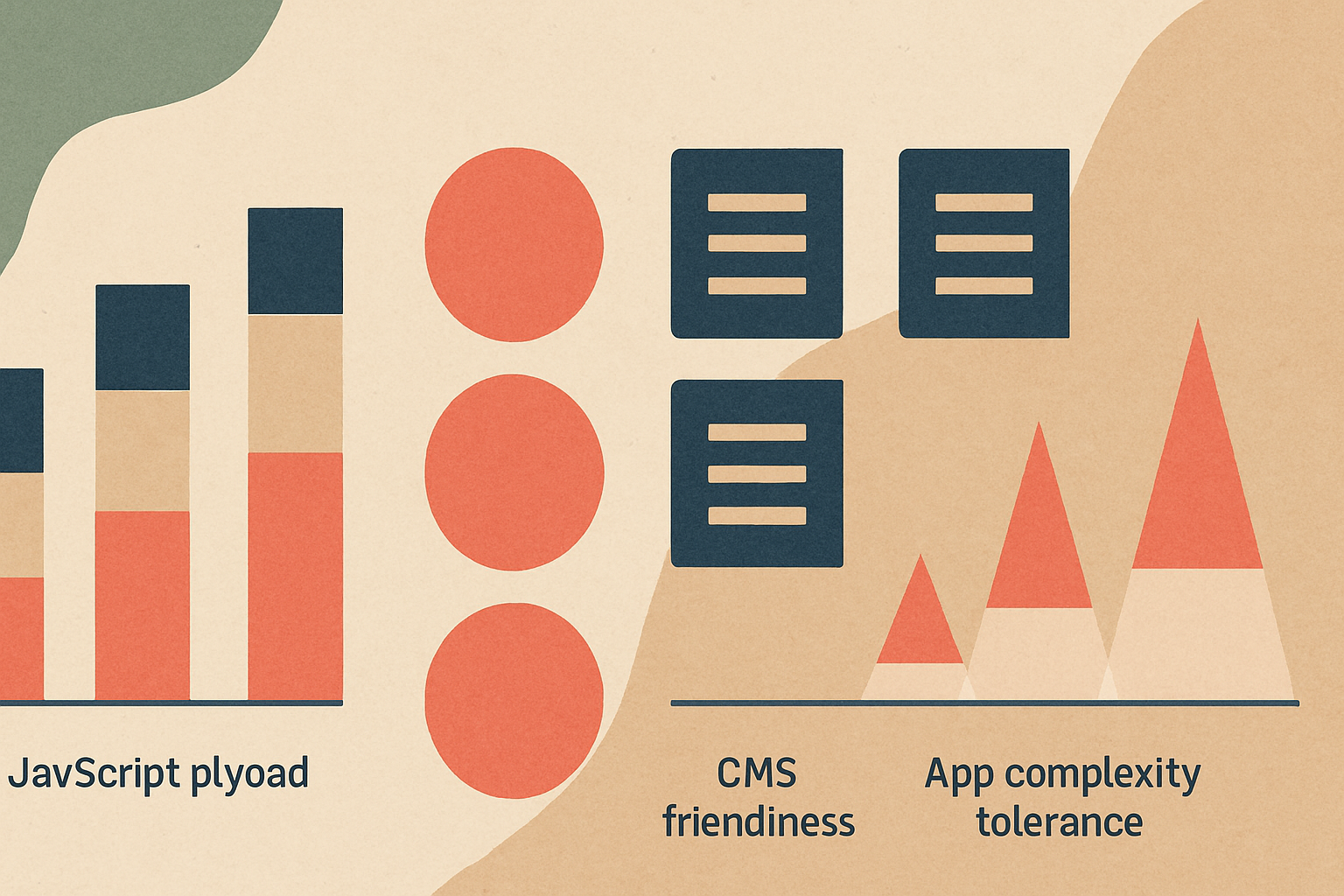
Here’s the tradeoff visually:
The joke version is this:
- Astro is the minimalist friend with one perfect jacket.
- Remix is the practical friend who knows how taxes work.
- Next.js is the friend carrying a Leatherman, drone, espresso kit, and emergency tent.
Useful? Yes.
Necessary for a pricing page? Maybe not.
Developer experience: this is where opinions get expensive
A lot of framework decisions are really team decisions wearing a technical disguise.
If your team is deeply React-native and already knows Next.js, choosing Astro just because it’s “faster” can be penny-wise and pound-foolish. You can absolutely lose more time in unfamiliar tooling than you save in theoretical elegance.
On the other hand, if your team keeps building mostly static pages in Next.js and then spending sprint after sprint fighting hydration, image handling edge cases, preview complexity, and build bloat, that’s not “maturity.” That’s inertia.
We’ve found this rule useful:
- choose Astro if content is the center of gravity
- choose Remix if user interactions are the center of gravity
- choose Next.js if organizational complexity is the center of gravity
That’s the shortest honest version.
CMS, SEO, and editorial workflows
For content-heavy sites, editors are part of the system. Ignore them and the system breaks.
Astro works very well with headless CMS setups and Markdown/MDX-heavy publishing workflows. Its content collections are especially nice when you want structure without turning your repo into a haunted attic Astro Content Collections.
Next.js also works well with headless CMS platforms, and its preview/draft capabilities are mature enough for serious editorial teams Next.js Draft Mode. If your content site sits next to app surfaces, keeping everything in one framework can simplify operations.
Remix can absolutely integrate with CMSs, but it doesn't usually win this category by default for content-first teams. It wins when content supports interaction-heavy user journeys.
For SEO, all three can produce excellent server-rendered HTML. Google has said JavaScript-generated content can be indexed, but rendering adds complexity and can affect reliability Google Search Central. That’s another reason Astro’s low-JS default is attractive for marketing and documentation sites.
Less drama for crawlers. Less drama for users.
We like both.
So which one should you pick?
Here’s the blunt answer for Next.js vs Remix vs Astro:
Pick Astro if:
- your site is mostly content
- performance and low JavaScript matter a lot
- you want docs, blog, landing pages, and product pages to stay simple
- interactivity is present but localized
Pick Next.js if:
- your content site is becoming an app
- your team is already strong in React and Next
- you need broad ecosystem support and enterprise familiarity
- you expect personalization, auth, experiments, or shared app infrastructure
Pick Remix if:
- your site has serious form workflows or server mutations
- you want web-native request/response patterns
- nested routes and data loading are central to the product experience
- content supports interaction rather than dominating it
Our default recommendation for a pure content-heavy product site?
Astro.
Our default recommendation for a content-heavy product site that will grow teeth?
Next.js.
Our “you probably know why you need this” recommendation?
Remix.
Where AI features change the framework choice
This part gets ignored in most comparisons.
If you're planning AI-powered search, smart recommendations, voice touchpoints, or custom assistant experiences on your product site, your framework choice starts affecting implementation details. We’ve seen this with projects that later wanted AI chat, semantic search, or voice UX layered onto marketing surfaces.
If that’s on your roadmap, don’t just choose for today’s brochure pages.
Think about:
- where inference calls happen
- how much client-side state you’ll need
- whether interactive widgets stay isolated or spread everywhere
- whether the site may merge with product experiences later
For teams exploring that path, we work on AI agents, voice AI, on-device AI, and custom models. If you're still figuring out feasibility and cost, our AI cost estimator is a decent place to start before someone promises you magic.
Because someone always does.
FAQ
Is Astro better than Next.js for SEO?
Yes, often for content-heavy sites, because Astro ships less JavaScript by default and produces lean server-rendered output. Next.js can match it with good engineering, but Astro makes the fast path easier.
Is Remix better than Next.js?
Sometimes. Remix is better when your product site depends heavily on forms, mutations, and server-driven interactions, while Next.js is better when you need a broader ecosystem and a smoother path into app-like complexity.
Which framework is fastest: Next.js, Remix, or Astro?
Astro is usually the easiest to keep fast for content-heavy sites because of its islands architecture Astro Docs. Next.js and Remix can both be very fast too, but they rely more on architectural discipline.
Should we migrate from Next.js to Astro?
Only if your site is mostly content and your current setup is creating unnecessary complexity. If you already rely on app-like features, middleware, auth, or shared React infrastructure, migration may create more pain than value.
Which is best for a startup product site?
It depends on what you're actually building. If it's mostly pages and docs, choose Astro. If it's likely to merge into a product app, choose Next.js. If the site itself is a workflow engine with lots of form interactions, choose Remix.
Our practical recommendation
If you’re still stuck on Next.js vs Remix vs Astro, don’t start with framework ideology. Start with a brutally honest content-to-interaction ratio.
If 70% or more of the site is publishing, docs, and SEO pages, pick Astro unless you have a strong reason not to.
If the site is on a collision course with product functionality, pick Next.js and accept the complexity with eyes open.
If forms and server interactions are the beating heart of the experience, pick Remix and enjoy being right for slightly less obvious reasons.
And if you want a second opinion before your team commits six months to the wrong stack, talk to us through AI consulting or just contact us. We’ve seen enough framework “simple choices” turn into expensive archaeology digs.
Choose the tool that matches the job.
Not the one with the loudest fan club.
Sources
- Astro Docs — Islands Architecture
- Astro Docs — Content Collections
- Next.js Docs
- Next.js Docs — Server Components
- Next.js Docs — Draft Mode
- Remix Docs
- Remix Docs — State Management Discussion
- Google Search Central — JavaScript SEO Basics
- HTTP Archive Web Almanac 2024 — JavaScript
- Vercel — Next.js Framework Overview