


Why Production AI Agents Fail Without a Clear Policy Layer
Hitesh Sondhi · June 12, 2026 · 6 min read
We’ve seen this movie before: the demo agent is charming, fast, and weirdly competent. Then you connect it to real tools, real users, and real data, and by Friday it’s trying to email the wrong customer, over-sharing internal notes, or taking “be helpful” as permission to do something your legal team would classify as a small fire.
That’s why Microsoft’s new agent policy work matters. Not because specs are sexy. They’re not. But because production agents without a policy layer are basically interns with root access.
And that’s a terrible management strategy.
According to TechCrunch, microsoft offers devs a better way to control AI agent behavior through a new policy specification aimed at governing what agents can do and under what conditions TechCrunch. The interesting part isn’t the announcement itself. It’s what it signals: the industry is finally admitting prompt-only guardrails are flimsy in production.
Key Takeaways
- Prompt instructions are not a policy system. They’re suggestions with good marketing.
- Microsoft’s spec points toward portable, enforceable agent governance across tools and runtimes.
- Production agents need a separate policy layer for permissions, compliance, and auditability.
- If your agent can act, your policy engine must sit outside the model.
Prompt Guardrails Are Doing a Job They Were Never Meant to Do
A lot of teams still cram everything into the system prompt.
“Never expose PII.” “Don’t take dangerous actions.” “Ask for approval before refunds.” “Follow company policy.”
That works right up until the model gets confused, the context window gets crowded, or a tool result nudges it into doing something dumb. We’ve built enough AI systems to say this plainly: relying on prompts for governance is bad. Not “suboptimal.” Bad.
A prompt is seasoning. Policy is the kitchen’s fire code.
Here’s the mental model we use with clients building AI agents: the model decides how to respond, but policy decides whether it’s allowed to do the thing at all. Those are different jobs, and mixing them is how you end up with a cheerful incident report.
Here’s what that separation looks like in practice:
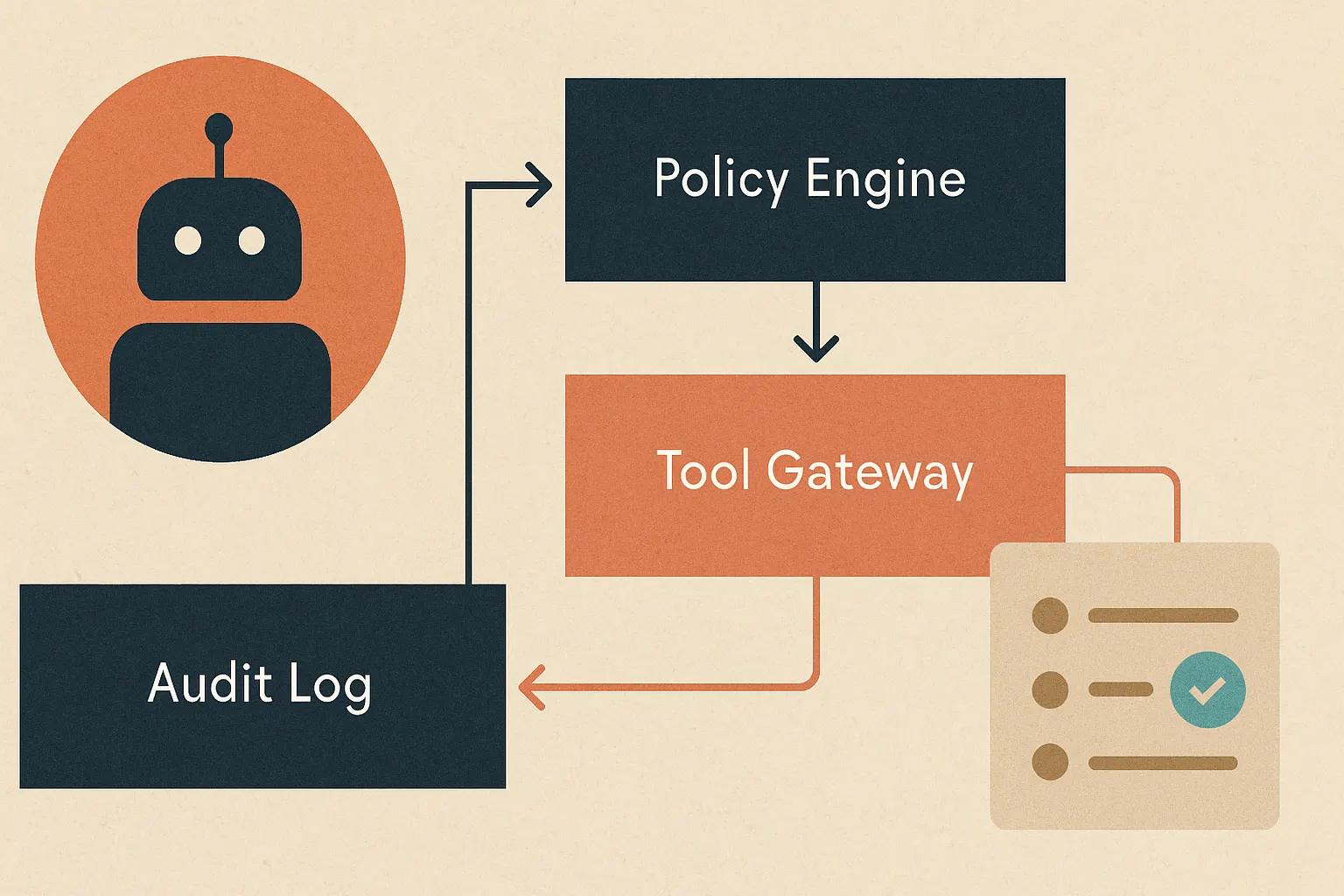
The mistake is thinking “alignment” and “authorization” are the same problem. They’re not. Alignment is probabilistic. Authorization has to be deterministic.
That’s where Microsoft’s move is useful.
What Microsoft’s Policy Spec Actually Means
Based on the TechCrunch report, Microsoft’s policy specification is designed to give developers a more structured way to define and control agent behavior TechCrunch. The practical implication is bigger than one vendor feature: we’re moving toward policy as a first-class layer in agent architecture.
That matters for three reasons.
First, portability. If your governance lives only inside one framework’s prompt templates, you’re trapped. A real policy layer should survive model swaps, orchestration changes, and toolchain upgrades.
Second, compliance. You can’t walk into a regulated environment and say, “Trust us, the system prompt says be careful.” That’s not governance. That’s vibes.
Third, auditability. When an agent does something risky, you need to know which rule allowed it, which condition blocked it, and what human override happened. Otherwise your postmortem turns into archaeology.
The Policy Layer We’d Actually Ship
If you’re building serious agents, the architecture should be boring in the right places. Boring is good. Boring is how you sleep.
Here’s the flow we recommend:
flowchart TD
  A[User Request] --> B[Agent Planner]
  B --> C[Policy Engine]
  C -->|Allowed| D[Tool Gateway]
  C -->|Needs Approval| E[Human Review]
  C -->|Denied| F[Safe Response]
  D --> G[Execution Result]
  G --> H[Audit Log]
  E --> H
  F --> H
The model can propose an action. It should not be the final authority.
Our default policy checks usually include:
1. Identity and scope
Who is asking? What tenant are they in? What data are they allowed to touch? If your agent can’t answer those questions before tool execution, stop there.
2. Action risk
Reading a knowledge base article is not the same as deleting a CRM record. We assign risk tiers and require stronger checks as actions become more destructive.
3. Data classification
Public, internal, confidential, regulated. This sounds obvious, which is exactly why teams skip it until something leaks.
4. Approval gates
Some actions should always require a human. Refunds over a threshold. External emails. Contract changes. Database writes in production. Yes, this adds friction. Good.
5. Logging and replay
Every policy decision should be logged with inputs, outputs, rule matches, and final action. If you can’t replay the decision path, you don’t have governance.
That same pattern also matters for voice AI and on-device AI. In voice systems, bad actions happen faster because conversation creates momentum. In edge deployments, you may need local enforcement for privacy or latency reasons. Different runtime, same lesson: policy can’t be an afterthought.
Why Portable Policy Enforcement Is the Real Prize
Here’s where it gets weird.
Most teams think the hard part is getting the agent to use tools. It isn’t. The hard part is making sure the same business rule applies whether the action came from a chat agent, a voice workflow, or an internal automation.
That’s why we like the direction this points in. A portable policy spec means you can define rules once and enforce them across channels, models, and environments. If you’re investing in custom models or broader AI consulting, this becomes the difference between a reusable platform and a pile of demos.
Hot take: the next generation of agent platforms won’t win because they have the smartest model. They’ll win because they have the least stupid governance.
What You Should Do Next
Don’t wait for a standards body to save you.
Start by listing every action your agent can take. Rank them by risk. Move approval logic, permission checks, and compliance rules out of prompts and into a separate policy service. Then make that service the gatekeeper for every tool call.
If you already have agents in production, audit the ugly parts first: email, payments, CRM writes, file access, and anything customer-facing. Those are the places where “mostly works” becomes “why is legal calling us?”
If you want help designing that architecture, we do this work at Cropsly across agent systems, voice interfaces, and production AI stacks. You can explore our AI agents, see how we approach real-world products like RunHotel, estimate costs with our AI cost estimator, or just contact us.
Because the truth is simple: an agent without a policy layer isn’t autonomous. It’s unsupervised.
And unsupervised software always gets creative in the worst possible way.