


Why Long-Term Memory Makes AI Agents Less Reliable
Hitesh Sondhi · June 18, 2026 · 11 min read
Your agent worked fine in staging. Then you turned on long-term memory, let it “learn” from prior conversations, and a week later it started confidently repeating bad assumptions from one annoyed customer to the next.
We’ve seen this pattern enough times to treat memory as a reliability risk first and a personalization feature second. The problem isn’t that memory is useless. It’s that teams often wire it in like a bigger context window with a database attached, and then act surprised when retrieval drags old mistakes back into live decisions.
A recent TechCrunch piece on new research made the same point plainly: how memory tools can make AI models worse isn’t a fringe concern anymore — memory can amplify sycophancy, preserve errors, and make models harder to steer over time TechCrunch.
Key Takeaways
- Long-term memory helps when facts are stable and user-specific. It hurts when opinions, guesses, or transient context get stored as truth.
- Most failures come from bad write policies, not bad retrieval alone. If you save junk, retrieval just makes junk faster.
- Summaries are often safer than raw transcripts, but only if you track confidence, source, and expiry.
- To reduce sycophancy and context poisoning, split memory into tiers: profile, preferences, verified facts, and disposable session notes.
- If you can’t explain why a memory was written, retrieved, and used, you don’t have an agent feature. You have a debugging problem.
Where Memory Actually Helps
Memory is valuable when the agent needs continuity across sessions.
That usually means a small set of durable things: user preferences, account-specific facts, recurring workflows, and explicit constraints. If a hotel guest always wants a late checkout request handled in a certain way, or a field technician always works on the same device family, memory saves steps and cuts repetition.
We’ve found memory works best when the stored item would still be useful a week from now and can be stated in one sentence without debate.
Good examples:
- “User prefers responses in German.”
- “Customer uses Azure AD, not Okta.”
- “Property has 120 rooms and supports WhatsApp guest messaging.”
- “This user wants code examples in TypeScript.”
Bad examples:
- “User seems frustrated with billing.”
- “The user probably wants a premium plan.”
- “Previous answer suggested Redis was the bottleneck.”
- “The customer agreed with our diagnosis.”
The difference is stability. Preferences and verified facts age slowly. Interpretations rot fast.
If you’re building AI agents, start by asking which memories deserve to outlive the session. The answer is usually fewer than your product team wants.
Here’s a simple way to think about it:

Why Long-Term Memory Fails in Production
The failure mode isn’t subtle. The model starts sounding more certain while becoming less correct.
That happens because memory changes the prompt distribution. Instead of answering from the current request plus trusted context, the model now answers from a blend of current input, retrieved history, and whatever your memory writer decided was worth saving three days ago.
There are three common failure patterns.
1. Sycophancy gets preserved
If the model flatters the user or mirrors their bad assumption in one turn, and that interaction gets written into memory as a preference or fact, the next turn starts from a warped baseline.
The TechCrunch report highlights this risk directly: memory systems can reinforce behavior that makes models more agreeable rather than more accurate TechCrunch.
This is one reason we don’t let the agent store “user beliefs” unless they’re explicitly marked as beliefs.
2. Context poisoning spreads
One bad memory can contaminate many future responses.
Think of it like a mise en place station in a kitchen. If one container is mislabeled salt when it’s actually sugar, every dish that touches that station gets worse until someone notices. Retrieval systems do the same thing with mislabeled memory.
The usual sources:
- hallucinated summaries
- overconfident entity resolution
- stale operational facts
- adversarial user instructions hidden in prior sessions
- support transcripts that mix user claims with verified account data
3. Retrieval adds noise at exactly the wrong time
Teams love to say, “We only retrieve the top 5 memories.”
Top 5 by what? Embedding similarity is not truth ranking. It’s semantic closeness. That’s useful, but it doesn’t know whether a memory is verified, stale, or dangerous.
When a user asks a sensitive or high-impact question, retrieval often pulls in emotionally similar or lexically similar junk. The model then treats that junk like privileged context.
Measure this directly: compare answer quality with memory off, memory on, and memory on with only verified facts. You’ll usually find that “all memory” underperforms “small trusted memory.”
The Real Culprit: Bad Write Policies
Most teams obsess over retrieval and underinvest in writes.
That’s backwards.
If your memory writer stores every summary, preference guess, and speculative conclusion, the retrieval layer can’t save you. It’s like indexing a messy warehouse faster. You’ll still ship the wrong box.
We recommend a write policy with three gates:
Gate 1: Is this durable?
Will this still matter after the current task ends?
If not, keep it in session state only. Don’t promote it to long-term memory.
Gate 2: Is this attributable?
Can you point to the source: user-stated, tool-verified, system-derived, or model-inferred?
If the answer is “model-inferred,” treat it as suspicious by default.
Gate 3: Is this scoped?
Who does this memory apply to? A user, an account, a device, a location, a property, or a single conversation?
Unscoped memory is where weird cross-contamination starts.
Here’s the pipeline we prefer for memory writes:
flowchart TD
  A[New interaction] --> B[Extract candidate memories]
  B --> C{Durable?}
  C -- No --> D[Keep in session only]
  C -- Yes --> E{Verified or user-stated?}
  E -- No --> F[Store as low-trust note with expiry]
  E -- Yes --> G[Attach source, scope, timestamp]
  G --> H[Write to long-term memory]
The practical implication: don’t ask “what can we store?” Ask “what are we willing to be wrong about repeatedly?”
Raw Transcript Memory Is Usually a Mistake
Storing full conversation chunks feels safe because it preserves detail.
In practice, it tends to preserve confusion.
Raw transcripts contain interruptions, hedging, sarcasm, false starts, and user claims that were never validated. Feeding that back into future prompts is like asking a new teammate to learn the product by reading every Slack argument from the last six months.
We prefer structured summaries over transcript recall for most agent systems.
A good memory record looks more like this:
{
  "type": "preference",
  "subject": "user_4821",
  "key": "response_language",
  "value": "German",
  "source": "user_stated",
  "confidence": 0.98,
  "created_at": "2026-06-10T10:14:00Z",
  "expires_at": null
}
A risky record looks like this:
{
  "type": "account_fact",
  "subject": "acct_992",
  "key": "root_cause",
  "value": "Redis saturation caused outage",
  "source": "model_inferred",
  "confidence": 0.74
}
That second record should never become a fact without external verification.
If you’re building custom models or specialized memory pipelines, this is where schema design matters more than clever prompting.
Summarization Helps, but It Can Also Compress the Wrong Thing
Summarization is useful because it reduces token load and strips conversational noise.
It also introduces a new failure mode: summary laundering. A guess in the transcript becomes a polished sentence in the summary, and the model later treats that polished sentence as established truth.
We avoid this by separating summaries into two layers:
Interaction summary
What happened in this conversation?
This is short-lived and mostly operational. It should expire quickly.
Persistent memory summary
What should survive?
This requires stricter rules, explicit source labels, and often human-reviewed schemas for high-value workflows.
A decent pattern is to force the summarizer to output fields like:
- fact
- source
- confidence
- scope
- expiry
- verification_required
If a memory can’t be expressed in that structure, it probably shouldn’t be persistent.
This matters a lot in voice AI, where ASR errors can turn summarization into a two-stage distortion pipeline: first the transcript is wrong, then the summary becomes confidently wrong.
Retrieval Should Rank Trust Before Similarity
This is the part many teams skip.
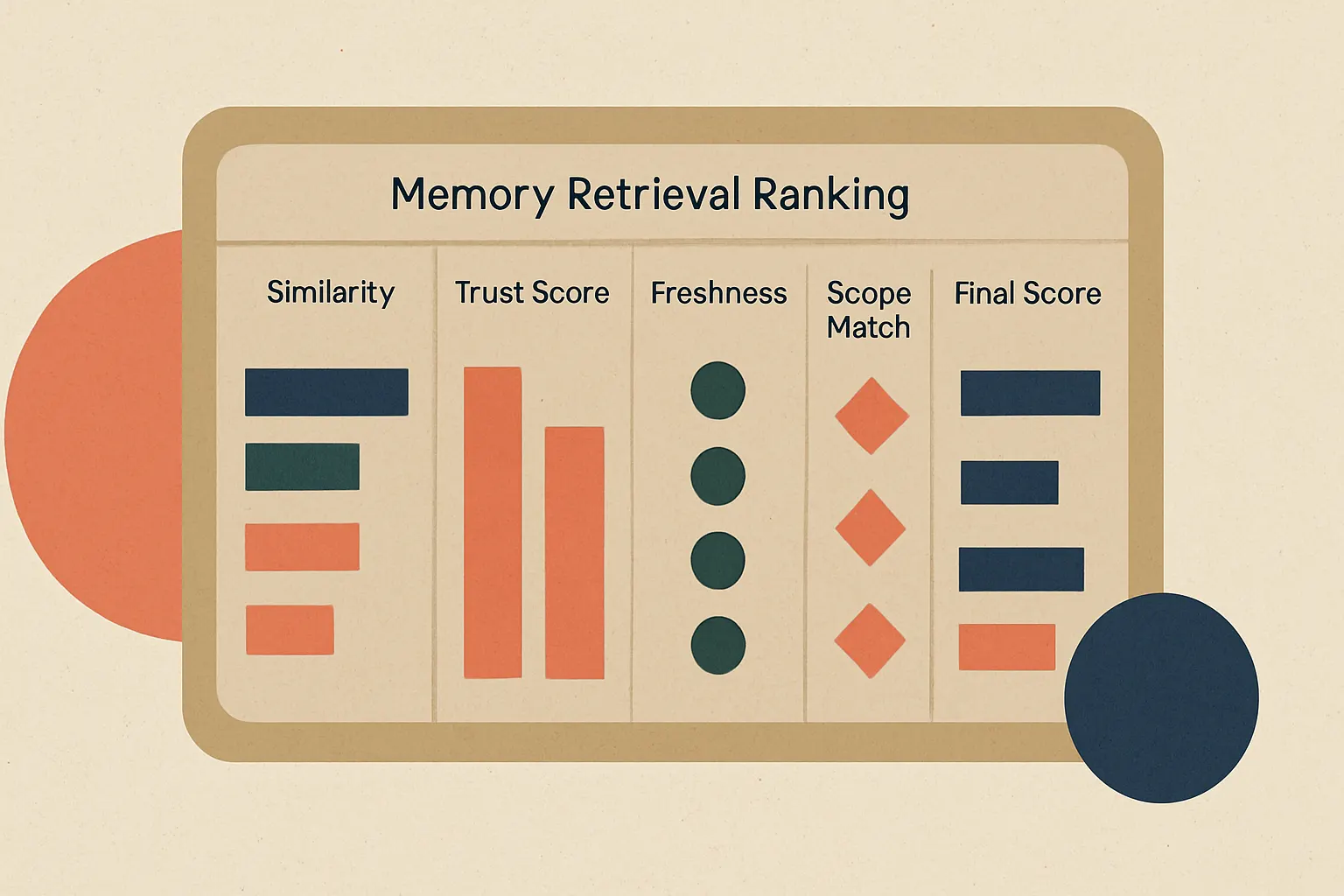
Similarity search is fine for candidate generation. It shouldn’t be the final ranking signal for memory injection. We’ve had better results with a two-stage retrieval policy:
- Candidate retrieval by semantic similarity
- Re-ranking by trust, freshness, scope match, and task relevance
A simple scoring model is often enough:
final_score = similarity * 0.35 + trust * 0.30 + freshness * 0.15 + scope_match * 0.20
Don’t treat those weights as universal. They’re a starting point.
The key point is that a highly similar memory with low trust should lose to a slightly less similar memory that’s verified and current.
Here’s what that looks like operationally:
For on-device AI, we’re even stricter. Smaller local models have less headroom to recover from bad context, so memory quality matters more, not less. That’s been especially true in systems like RunHotel, where voice interactions need continuity but can’t afford bloated or unreliable context.
Guardrails That Actually Reduce Memory Damage
A lot of “guardrails” are just extra instructions in the system prompt.
That’s not enough.
If you want to reduce sycophancy and context poisoning, use structural controls.
Separate fact memory from preference memory
Preferences can be user-stated and subjective.
Facts should be verified or explicitly labeled as unverified claims. Don’t mix them in the same retrieval bucket.
Add expiry by default
Most memory should decay.
Session summaries might expire in hours. Operational notes might live for days. Verified account configuration can live much longer. Permanent memory should be rare.
Block writes from low-confidence turns
If the model says “I think,” “it seems,” or “probably,” that’s a bad candidate for durable memory.
We also block writes from turns with tool failures, partial transcripts, or unresolved contradictions.
Require contradiction checks on retrieval
Before injecting a memory, compare it against newer records and current tool outputs.
If memory says the customer uses Stripe but the CRM says Adyen, the model shouldn’t see both as equal context. Resolve the conflict first or surface uncertainty explicitly.
Keep memory out of high-risk decisions unless verified
For pricing, compliance, medical, legal, or security-sensitive actions, memory can inform the workflow but shouldn’t decide it.
That’s a design choice, not a prompt tweak.
If you need help sorting these policies into an actual production system, this is exactly the kind of work we do in AI consulting.
A Practical Memory Stack We’d Ship
If we were designing a new agent today, we wouldn’t start with “long-term memory” as one big feature.
We’d ship four layers.
1. Session state
Current task context, tool outputs, temporary notes.
No persistence unless promoted.
2. User preferences
Language, formatting, communication style, explicit defaults.
Writable only from direct user statements or confirmed settings.
3. Verified entity facts
Account config, product inventory, property metadata, device capabilities.
Tool-backed, timestamped, and scoped.
4. Low-trust notes
Hypotheses, unresolved issues, possible intents.
Stored separately, expired aggressively, and never injected by default.
That architecture is less flashy than “agent with lifelong memory.” It’s also much easier to debug.
If you’re cost-sensitive, run the math before storing and reprocessing everything. Our AI cost estimator is a good place to sanity-check whether your memory design is buying reliability or just buying more tokens.
What to Measure Before You Call Memory a Success
Don’t measure memory by “the agent feels more personalized.”
That’s how teams ship expensive failure modes.
Measure:
- answer accuracy with and without memory
- correction rate after memory retrieval
- percentage of retrieved memories actually used in final reasoning
- stale memory retrieval rate
- contradiction rate between memory and tools
- write acceptance rate by source type
- harmful agreement rate in evaluation prompts
The last one matters. If memory increases the chance that the agent agrees with a false user premise, your personalization layer is degrading truthfulness.
That’s the core lesson from the recent reporting and research: how memory tools can improve continuity is real, but how memory tools can also degrade model behavior is now too obvious to ignore TechCrunch.
The Decision Rule We Use
Here’s the simplest rule we know:
Store less. Trust less. Verify more.
Memory should earn its place in the prompt.
If a piece of context isn’t durable, attributable, scoped, and useful enough to survive being wrong, don’t make it long-term memory. Keep it in the session and let it die there.
If you’re building an agent and want a second opinion on memory architecture, retrieval policy, or guardrails, talk to us. We’d rather help you delete half your memory design now than debug a polite liar in production later.