

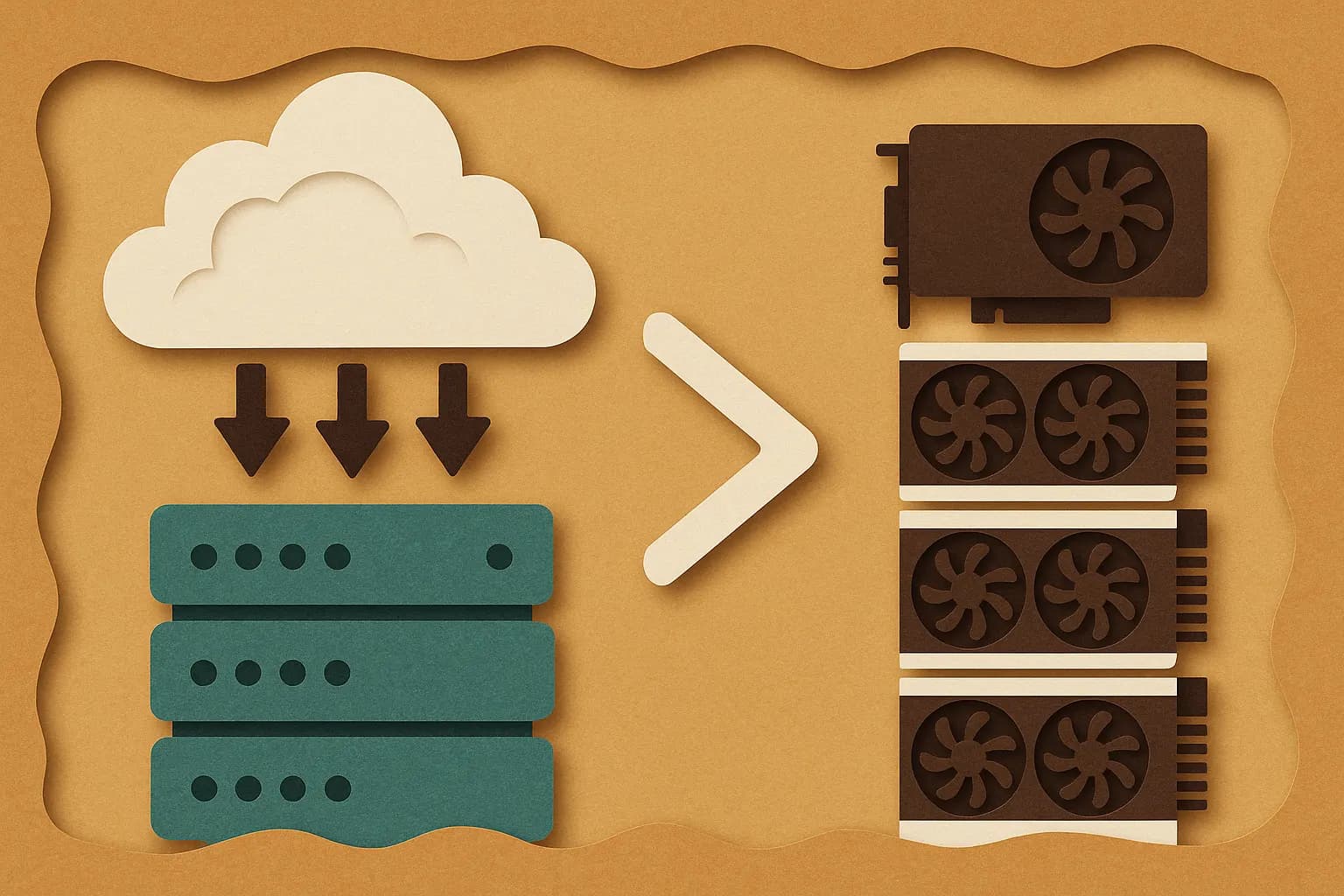
MegaTrain Means You Can Stop Pretending You Need 8 GPUs
Hitesh Sondhi · April 10, 2026 · 12 min read
A lot of teams have been lying to themselves.
Not maliciously. More like the way you tell yourself you need a standing desk, a second monitor, and a $280 mechanical keyboard before you can write one decent paragraph. In LLM training, the lie has been: “serious training starts when you have a multi-GPU cluster.”
MegaTrain just kicked that door open.
The paper behind megatrain: full precision training makes a pretty blunt claim: you can train 100B+ parameter large language models at full precision on a single GPU by treating CPU memory as the real home for parameters and optimizer states, while the GPU becomes a temporary compute engine. If that sounds backwards, good. Most useful systems ideas do at first.
And yes, this matters even if you’re not training a 100B monster.
Key Takeaways
- MegaTrain shifts the bottleneck from GPU memory to host memory, which changes who can realistically experiment with large-model training.
- The big idea isn’t “magic compression.” It’s a memory-centric design that streams what the GPU needs when it needs it.
- Full precision is the provocative part. While the industry has obsessed over lower precision, MegaTrain argues there’s still room for brute-force numerical fidelity when the system design is smart.
- This won’t make single-GPU training fast in every setup. It makes some previously impossible workloads possible.
- For startups and applied AI teams, the real win is architectural freedom, not bragging rights.
What MegaTrain Actually Changes
Most articles on MegaTrain are going to repeat the same line: 100B+ parameters, single GPU, full precision. That’s true, but it’s also lazy.
The real story is that MegaTrain attacks the most annoying constraint in training: GPU memory is tiny compared to what modern models want. An NVIDIA H100 SXM has 80GB of HBM3 memory according to NVIDIA — which sounds huge until you remember that model weights, gradients, optimizer states, activations, and temporary buffers all want a piece of that same pie. Suddenly your “massive accelerator” feels like trying to move apartments using only a backpack.
MegaTrain’s answer is refreshingly unromantic: stop pretending the GPU should hold everything.
Instead, the system keeps parameters and optimizer states in host memory and moves chunks to the GPU for computation. That means the GPU behaves less like a warehouse and more like a workbench. You don’t store the whole hardware store on the bench. You bring over the wrench, use it, and put it back.
That’s the core of megatrain: full precision training in one sentence.
Why This Is a Bigger Deal Than It Sounds
We’ve seen this movie before in infrastructure.
A new paper drops. Everyone tweets the headline. Half the internet acts like distributed training is dead. Then engineers actually try to build with it, and the truth shows up wearing steel-toed boots.
Here’s the truth: MegaTrain doesn’t mean single-GPU training is suddenly cheap, easy, or universally better. It means the memory wall got a crack in it.
That’s different.
For years, if you wanted to train beyond a certain scale, you were shoved toward model parallelism, pipeline parallelism, ZeRO-style sharding, or some cursed combination of all three. Those systems work, but they’re often like organizing a wedding for 400 guests. Every detail depends on every other detail, and one flaky network link can ruin the whole evening.
Single-GPU training avoids a lot of that pain.
No cross-GPU synchronization storms. No NCCL weirdness at 2 a.m. No “works on 4 GPUs, deadlocks on 8” nonsense. If MegaTrain can offload enough memory pressure to CPU RAM while keeping the GPU fed, it changes the engineering tradeoff in a very practical way.
And practical beats elegant in production every time.
Why Full Precision Is the Hot Take
Here’s where we’ll annoy some people: the industry’s obsession with lower precision has become a reflex.
FP16, BF16, quantization, 8-bit optimizers, 4-bit adapters — these are all useful tools. We use them. You probably should too in many cases. But the idea that every training problem should be solved by squeezing precision lower is starting to feel like a chef fixing every bad dish by adding more salt.
Sometimes the problem isn’t arithmetic width. It’s system design.
MegaTrain is interesting precisely because megatrain: full precision training goes against the grain. Instead of saying, “how can we fit the model by reducing numerical fidelity?” it asks, “what if we redesign memory movement so full precision is still viable?” That’s a more ambitious systems question.
Bold move.
According to the paper listings and summaries circulating via Hugging Face Daily Papers and paper aggregators, MegaTrain is explicitly framed as a memory-centric system for full-precision training of 100B+ parameter models on a single GPU (Hugging Face Daily Papers, arXiv). If you can pull that off with acceptable throughput, you’re not just optimizing around hardware limits — you’re changing the shape of the problem.
But that’s only half the problem...
The Catch Nobody Should Ignore
PCIe is not HBM.
That sounds obvious, but people keep talking about CPU offload as if moving data from host RAM to GPU is free. It’s not. Not even close. NVIDIA documents NVLink and HBM bandwidth numbers that are dramatically higher than standard host-device interconnect bandwidth, and that gap is exactly why memory-centric systems live or die by scheduling and overlap, not by wishful thinking (NVIDIA NVLink, NVIDIA H100).
If your system can’t prefetch aggressively, overlap transfers with compute, and avoid thrashing, then offloading turns into a traffic jam.
And traffic jams kill training throughput.
Here’s how the pipeline works at a high level:
flowchart TD
  A[Parameters + optimizer states in CPU RAM] --> B[Prefetch next layer shard]
  B --> C[Transfer active shard to GPU]
  C --> D[Forward/backward compute on GPU]
  D --> E[Write updated states back to CPU RAM]
  E --> F[Prefetch next shard]
That diagram looks neat because diagrams are liars.
In reality, this kind of system is a knife fight over timing. Transfer too late, the GPU idles. Transfer too early, memory pressure spikes. Slice tensors badly, and overhead eats your gains. We’ve built enough performance-sensitive AI systems to know that “should work on paper” and “survives production” are distant cousins, not siblings.
Why Single-GPU Training Is So Appealing Anyway
Because distributed training is expensive in all the ways finance teams don’t measure well.
Yes, there’s cloud cost. You can estimate that pretty quickly, and if you want the rough numbers for a project, our AI cost estimator helps. But the hidden cost is engineering attention: debugging sharding bugs, tuning communication overlap, handling fault tolerance, and explaining to stakeholders why a “simple training run” now needs cluster orchestration and a small prayer circle.
We’ve seen the same pattern in adjacent work.
When we build custom models, AI agents, or on-device AI, the teams that move fastest are usually the ones with the fewest moving parts. That doesn’t mean “small is always better.” It means complexity charges interest.
MegaTrain is attractive because it offers a different debt structure.
Instead of paying in distributed systems complexity, you pay in host-device bandwidth management and memory orchestration. That’s still hard. But for a lot of teams, it’s a better kind of hard.
What This Means for Startups, Researchers, and Applied AI Teams
If you’re a startup, MegaTrain should change how you think about experimentation.
Not because you’re about to train a 100B model next week. You probably aren’t, and honestly, you probably shouldn’t. Most startups would get more value from better data, narrower objectives, and stronger evaluation than from chasing giant base-model training runs.
That’s our hot take: most companies don’t have a model-size problem. They have a problem-definition problem.
Still, megatrain: full precision training matters because it widens the design space. If single-GPU setups can handle larger full-precision workloads than we assumed, then a bunch of previously “cluster-only” experiments become feasible for smaller teams, universities, and applied R&D groups.
That can ripple outward fast.
Think about domains where data is sensitive, deployment is constrained, or iteration speed matters more than leaderboard theater. Voice systems. Embedded assistants. Domain-tuned models for operations. We care about that a lot at Cropsly because products like RunHotel and our voice AI work keep reminding us that practical AI wins usually come from making the system fit the environment, not the other way around.
A single-GPU training path won’t replace every cluster. But for some teams, it could remove the cluster from the critical path entirely.
Why This Could Matter for On-Device AI Too
This is where it gets weird.
MegaTrain is about training, not deployment. But the mindset behind it — treat scarce fast memory as a transient compute surface and put bulk state somewhere else — rhymes with what happens in edge and on-device systems all the time.
When we work on on-device AI, we’re constantly budgeting memory like we’re packing for a budget airline. Every tensor has to justify its existence. Every buffer is guilty until proven innocent. You start thinking less like a researcher with infinite A100s and more like a mechanic trying to fix an engine with three tools and bad lighting.
That discipline tends to produce better systems.
So even if you never use MegaTrain directly, its architecture is a reminder that a lot of “hardware limits” are actually assumptions hiding in plain sight.
Here’s a simple way to think about the old model versus the MegaTrain model:
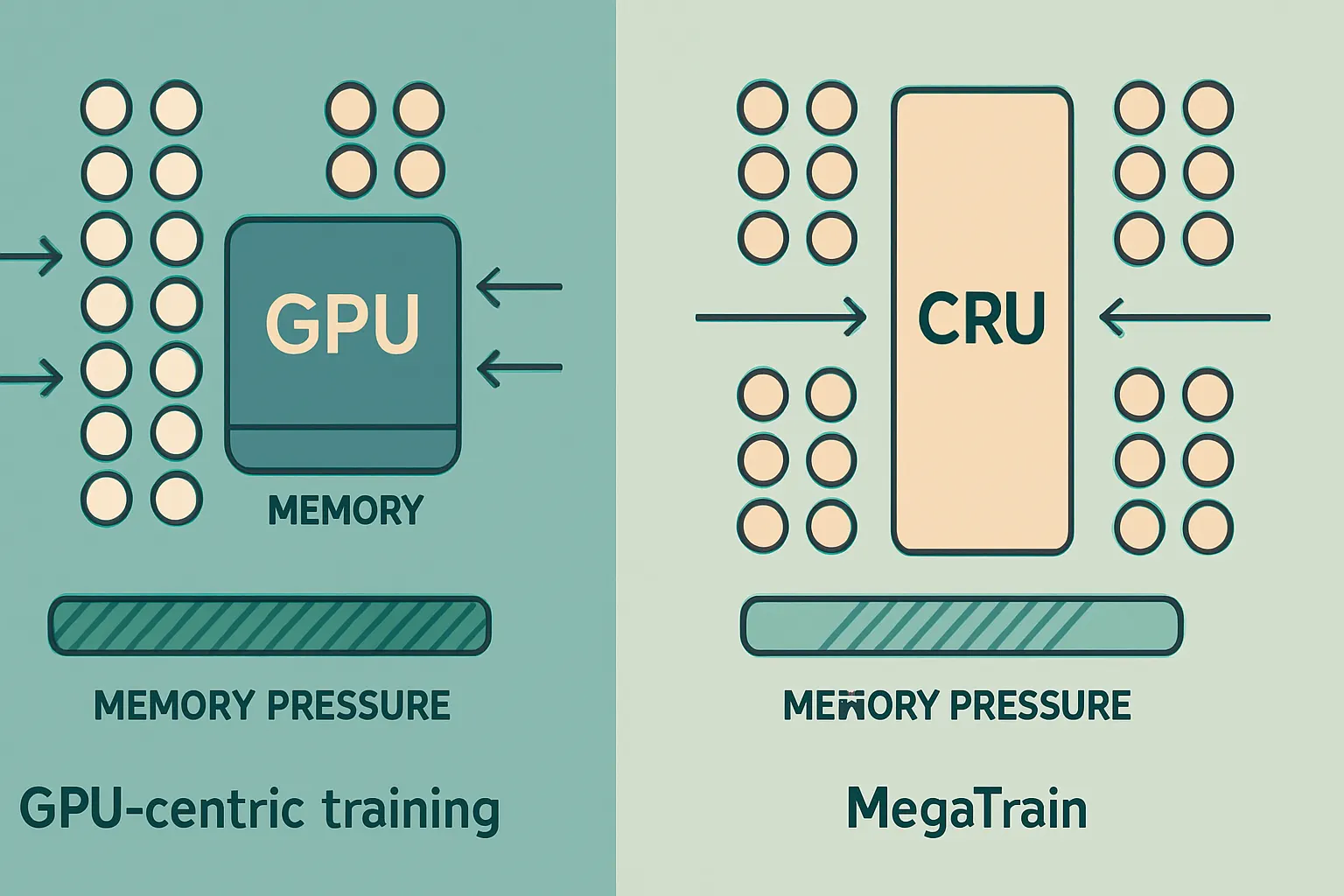
Traditional training says: keep the whole orchestra on stage and hope the stage doesn’t collapse.
MegaTrain says: keep most musicians backstage, bring out the violins when the score calls for them, and stop pretending the stage is a warehouse.
Same symphony. Different logistics.
What MegaTrain Doesn’t Mean
It doesn’t mean full precision is always the best choice.
It doesn’t mean quantization, LoRA, QLoRA, ZeRO, FSDP, or mixed precision are obsolete. That would be ridiculous. Those methods exist because they solve real problems, and many of them are still the right answer for fine-tuning, serving, or cost-sensitive training.
It also doesn’t mean one consumer GPU and a desktop tower are suddenly enough for every ambitious research project. Host memory capacity, bandwidth, CPU behavior, storage throughput, and software stack quality all still matter. A lot.
And please don’t read “single GPU” as “simple.”
We’ve made that mistake before in other contexts. One box can be simpler than eight boxes, but if the software is juggling memory transfers, compute overlap, and fault handling at high utilization, it’s still serious engineering. Fewer machines doesn’t mean fewer dragons.
So, Should You Care?
Yes — if you train models, design AI infrastructure, or make budget decisions around model development.
MegaTrain matters because it attacks the assumption that scaling training always requires scaling GPU count. Even if its exact implementation doesn’t become your stack, the architectural lesson is valuable: memory hierarchy is not a footnote. It’s the battlefield.
And if you’re leading an AI team, this should influence strategy.
Before you commit to a distributed training architecture, ask whether your bottleneck is really compute, or whether it’s memory placement and movement. Before you spend months on cluster complexity, ask whether a memory-centric design could get you 80% of the benefit with 30% of the pain. That’s not universal advice, but it’s a much better question than “how many GPUs can we rent?”
If you need help sorting that out, that’s exactly the kind of mess we handle through AI consulting and hands-on system design. Or just contact us and tell us what you’re trying to train. We like hard problems. We just prefer the kind that end in working software.
FAQ
What is MegaTrain in simple terms?
MegaTrain is a training system that keeps model parameters and optimizer states in CPU memory and uses the GPU mainly for active computation. That makes it possible, at least in the paper’s framing, to train very large models at full precision on a single GPU.
Why is full precision such a big deal?
Because most scaling strategies reduce precision to save memory and speed things up. MegaTrain is notable because it tries to preserve full numerical precision while solving the memory problem through system architecture instead.
Does MegaTrain make distributed training unnecessary?
No. It makes some workloads possible on a single GPU that previously looked unrealistic, but distributed training still matters for throughput, time-to-train, and very large-scale production research.
Is this useful for startups?
Yes, mostly because it expands your options. Even if you never train a 100B model, the ideas behind MegaTrain can help you think more clearly about memory bottlenecks, infrastructure cost, and when cluster complexity is actually worth it.
Is MegaTrain relevant to inference or on-device deployment?
Not directly, since it’s a training system. But the memory-centric design philosophy is very relevant to constrained deployment environments, especially where fast memory is scarce and careful state movement matters.
The Real Takeaway
MegaTrain isn’t exciting because it makes for a flashy headline.
It’s exciting because it reminds us that a lot of AI infrastructure dogma is just yesterday’s workaround wearing a lab coat. The assumption that giant-model training must be spread across many GPUs may still be true for many cases, but it’s no longer safe to treat it as law.
That’s a healthy disruption.
If you’re building serious AI systems, the next step is simple: audit your training stack and identify where memory actually lives, where it moves, and what that movement costs you. Start there. Not with hype. Not with cluster envy.
Because sometimes the breakthrough isn’t a bigger engine.
It’s finally admitting your garage was organized badly.
Sources
- NVIDIA H100 Tensor Core GPU product page: https://www.nvidia.com/en-us/data-center/h100/
- NVIDIA NVLink overview: https://www.nvidia.com/en-us/data-center/nvlink/
- Hugging Face Daily Papers: https://huggingface.co/papers
- arXiv paper index/search for MegaTrain: https://arxiv.org/