

Why ER Diagnosis AI Fails After the Study—and What Makes It Safe
Hitesh Sondhi · May 4, 2026 · 12 min read
A model beats doctors in a study, everyone posts the headline, and by Friday somebody in a boardroom says, “Great, let’s put it in the ER.”
That’s how you get hurt.
We’ve seen this movie in AI over and over: a system crushes a benchmark, looks brilliant in a controlled evaluation, then faceplants the moment real humans, messy inputs, bad integrations, and legal accountability show up. Healthcare just happens to be the version where the stakes aren’t ad clicks or support tickets. They’re people with chest pain at 2:13 a.m.
And yes, the recent headlines matter. In Harvard study, AI reportedly offered more accurate emergency room diagnoses than physicians in a controlled setup, according to coverage from multiple outlets including Harvard Gazette and Futurism summarizing the research context and results Harvard Gazette, Futurism. That’s interesting.
It’s not the same thing as “safe to deploy.”
Key Takeaways
- A study result is not a clinical system. Benchmarks measure capability; hospitals need reliability, [auditability](/blog/implementing-audit-logging-in-a-nestjs-application), and failure containment.
- The dangerous gap isn’t model IQ. It’s [workflow fit](/blog/agent-first-process-redesign): missing vitals, bad handoffs, stale policies, and overconfident outputs.
- Safe ER diagnosis AI needs narrow scope, escalation rules, human review, [logging](/blog/ai-observability-metrics), and post-deployment monitoring from day one.
- Hot take: “AI beat doctors” is usually less useful than “AI plus guardrails beat chaos.”
- If you can’t explain when the system should stay quiet, you’re not ready to ship it.
The Study Is the Easy Part
A study is a polished exam.
The ER is a bar fight with fluorescent lighting.
When people read that in Harvard study, AI outperformed doctors on emergency diagnosis tasks, they usually imagine the hard problem has been solved. It hasn’t. The hard problem starts right after the PDF gets published.
In a study, the case is usually well-framed. The data is available. The task is bounded. The grading rubric exists. In a real emergency department, the patient history is half-complete, the nurse is interrupted, the EHR field names are a crime against humanity, and the patient says “I feel weird” while their spouse insists it’s anxiety.
That difference is everything.
A lot of teams confuse “better answers” with “better systems.” That’s like saying a Formula 1 engine would make a great city bus. Sure, it’s powerful. It’s also the wrong machine unless you redesign the whole vehicle around reality.
Here’s the architecture shift that matters:
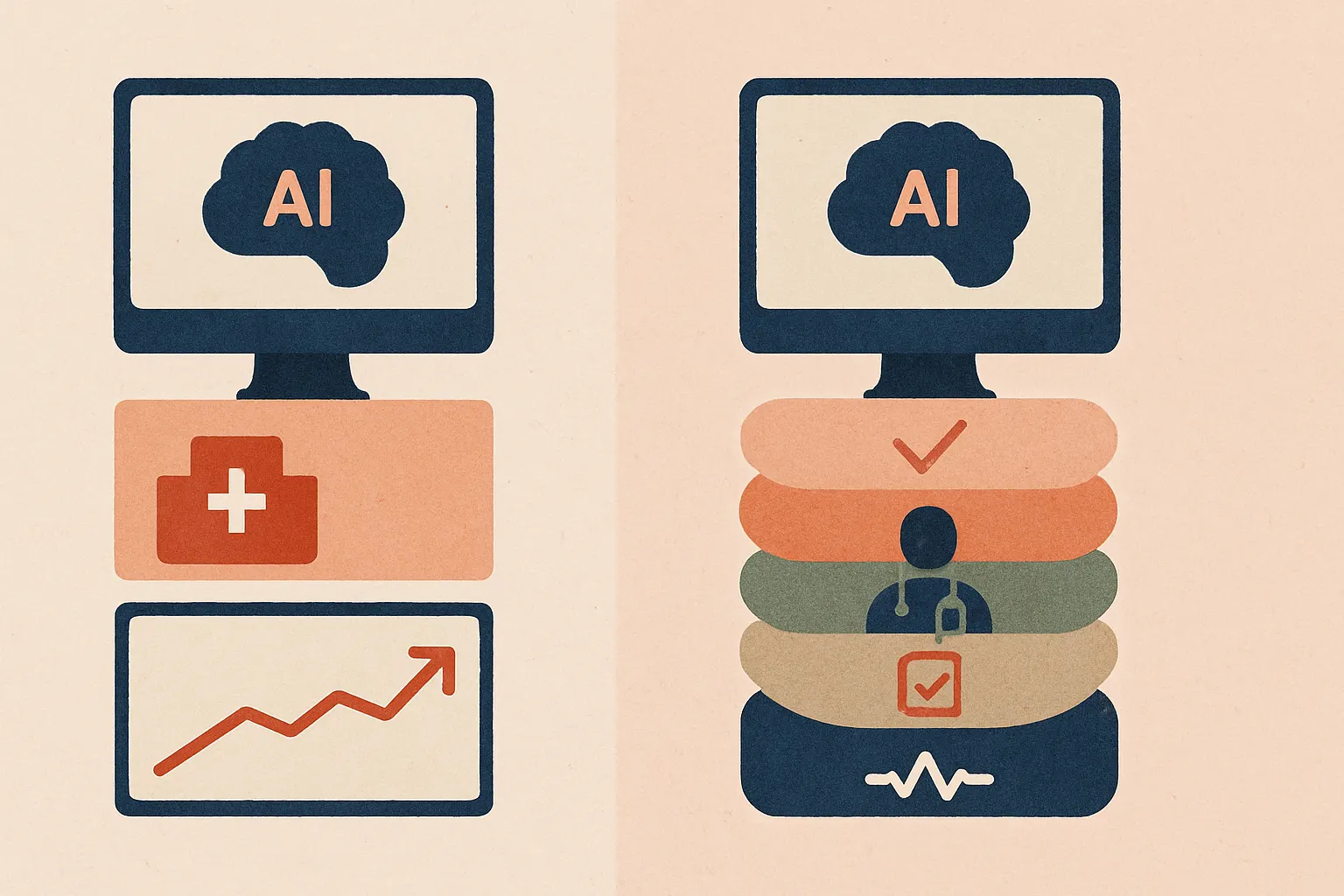
A benchmark-winning model might be enough for a paper. A production-safe clinical assistant needs wrappers, constraints, and a way to fail gracefully.
And graceful failure is the whole game.
Why “AI Beat Doctors” Is a Bad Deployment Plan
We’ll say the quiet part out loud: headlines are optimized for clicks, not implementation.
Coverage around results like in Harvard study, AI beating physicians tends to flatten the most important nuance: what exactly was the AI allowed to see, what task was it solving, how was correctness measured, and what happened when the input was incomplete or ambiguous? Those details decide whether you have a useful co-pilot or an expensive hallucination machine.
This is where the “jagged frontier” idea matters. Ethan Mollick and co-authors popularized the concept that AI capability is uneven across tasks in “Navigating the Jagged Technological Frontier” Science, 2023. AI can look superhuman on one slice of work and weirdly incompetent on the next.
That’s not a bug you can ignore. That’s the map.
One minute the model catches a subtle differential diagnosis. Next minute it confidently anchors on the wrong condition because one lab value was missing and the triage note said “stable” when the patient was very much not stable.
We’ve seen versions of this outside healthcare too. A model can be astonishingly good inside a narrow lane, then drift into nonsense the second the lane markings disappear. Fine-tuning helps, prompt engineering helps a little, but neither magically creates clinical judgment.
And clinical judgment isn’t just diagnosis accuracy. It’s also knowing when not to answer.
What Actually Breaks in the ER
The model usually isn’t the only problem.
It’s the stack around it.
When an ER diagnosis system goes from study to production, failures tend to cluster in five ugly places:
1. Input quality falls off a cliff
Studies often use cleaner, more structured cases than live hospital data. Real-world records have missing allergies, contradictory timestamps, copy-pasted notes, and abbreviations that should honestly be banned.
If your model needs pristine inputs, it’s dead on arrival.
2. The task gets fuzzier
“Provide the most likely diagnosis” sounds neat. Real care is messier: prioritize differential diagnosis, recommend next questions, flag red-alert conditions, suggest tests, and do it all without delaying treatment.
That’s not one task. That’s six.
3. Confidence is fake unless you calibrate it
A model saying “I’m 92% sure” means almost nothing unless that confidence has been tested against real outcomes. Calibration is boring, and because it’s boring, teams skip it.
That’s a mistake.
4. Workflow integration is usually terrible
If the AI lives in a separate tab, needs manual copy-paste, or spits out walls of text during triage, clinicians will ignore it. They should.
A good clinical system respects the actual tempo of care. Fast in, fast out, clear recommendation, explicit uncertainty, and one-click escalation.
5. Nobody designed the failure mode
This is the big one. What happens when the model sees incomplete data? What if the chief complaint is high-risk but the model output is low-confidence? What if the recommendation conflicts with protocol?
If the answer is “the doctor will figure it out,” then congratulations, you’ve built a liability generator.
But that’s only half the problem.
Safe Clinical AI Is Mostly About Restraint
Hot take: the safest medical AI is often the one that does less.
Not less capability. Less autonomy.
The fantasy version of ER AI is a fully autonomous diagnostician. The safer version is a tightly scoped assistant that helps with triage support, differential generation, missing-data prompts, red-flag detection, and protocol reminders — then hands control back to the clinician with a complete audit trail.
That’s not sexy enough for LinkedIn. It is, however, how you avoid disaster.
Here’s how a sane flow looks:
flowchart TD
  A[Patient arrives] --> B[Triage data captured]
  B --> C[Input validation and completeness check]
  C --> D[AI generates differential + risk flags]
  D --> E{High risk or low confidence?}
  E -- Yes --> F[Escalate to clinician review]
  E -- No --> G[Show ranked suggestions with rationale]
  F --> H[Clinician decision]
  G --> H[Clinician decision]
  H --> I[Audit log + outcome monitoring]
Notice what’s missing? Autonomous discharge decisions.
Good.
In our work on production AI systems, not specifically ER diagnosis tools, the biggest improvement usually comes from narrowing the blast radius. You decide exactly where the model is allowed to help, where it must defer, and how every interaction gets logged. That’s the difference between “useful system” and “cool demo.”
If you’re building healthcare AI, this is where AI consulting actually matters. Not for slide decks. For the ugly implementation questions nobody can hand-wave away.
The Safety Stack Nobody Wants to Talk About
Everybody wants to talk about the model. Almost nobody wants to talk about the plumbing.
The plumbing is the product.
A safe ER diagnosis AI needs at least these layers:
Data validation before inference
Don’t let the model infer from garbage without saying so. Missing vitals, impossible timestamps, contradictory medication lists — these should trigger warnings or block outputs entirely.
Scope control
The system should know what it is and what it isn’t. “Suggest likely causes of abdominal pain and recommend next information to collect” is a better scope than “diagnose emergency patients.”
Narrow beats vague every time.
Retrieval from current protocols
Clinical policy changes. Local hospital pathways differ. If the model can’t reference the right protocol version, you’re asking for stale recommendations.
This is one reason custom systems beat generic chatbots. If you’re exploring that route, custom models and AI agents are usually more relevant than just slapping a frontier model behind a chat box.
Human-in-the-loop review
Not as a slogan. As an enforced product behavior.
There should be explicit thresholds where the system must escalate: low confidence, pediatric cases, sepsis indicators, neurological symptoms, pregnancy, medication conflicts, or simply insufficient context.
Logging and auditability
Every input, output, retrieval source, and clinician action should be traceable. If you can’t reconstruct why the system suggested something, don’t deploy it in medicine.
Outcome monitoring after launch
This is where most teams get lazy. They launch, watch uptime, and call it observability.
Uptime is not safety.
You need to track disagreement rates, override patterns, delayed-correction cases, subgroup performance, and drift over time. The real surprise usually comes after week three, when the system starts seeing edge cases the study never covered.
Why On-Device and Voice Matter More Than People Think
A lot of ER AI discussions assume a cloud chatbot with a web interface. That’s fine for a demo. It’s not always fine for a hospital.
Latency, privacy, resilience, and workflow matter. If the assistant takes too long, nobody uses it. If speech capture is clunky, nobody uses it. If connectivity blips break the experience, definitely nobody uses it.
That’s why we’re opinionated about deployment architecture. In some environments, on-device AI and voice AI aren’t nice extras; they’re what make the system usable at all. We learned a lot of this building low-latency voice systems like RunHotel, where the difference between “feels instant” and “feels broken” is often a few hundred milliseconds and one badly timed handoff.
Healthcare has different constraints, obviously. But the lesson transfers: if the interface fights the user, the model quality barely matters.
Here’s where it gets weird.
Sometimes a slightly smaller model with tighter routing, better retrieval, and cleaner UX beats a larger model in actual practice because clinicians can trust when it speaks and ignore it when it shouldn’t. That doesn’t make for a glamorous press release. It makes for a safer system.
What a Hospital Should Ask Before Piloting Anything
If you’re evaluating vendors after reading that in Harvard study, AI outperformed doctors, don’t start by asking for benchmark scores.
Start here:
- What exact clinical task is the system scoped to support?
- What data does it require, and what happens when that data is missing?
- When does it refuse to answer or force escalation?
- How are recommendations grounded in current protocols?
- What gets logged for audit and incident review?
- How is post-deployment performance monitored across patient subgroups?
- How does the system fit into existing triage and documentation workflows?
If a vendor can’t answer those clearly, walk away.
Also, ask them to show failure cases. Not the polished ones. The ugly ones.
We trust teams more when they can say, “This category is bad for us right now, and here’s how we contain it.” That’s not weakness. That’s engineering.
The Real Path From Study Result to Clinical Safety
The path is less “train a smarter model” and more “build a stricter system.”
You start with a narrow use case. You define clear escalation rules. You validate on local workflows, not just public datasets. You run shadow mode before any clinician-facing recommendation. You monitor outcomes. You retrain or re-scope when reality punches you in the mouth.
Because reality will punch you in the mouth.
That’s true even if in Harvard study, AI looked incredible. Studies are necessary. They’re not sufficient. The moment you move into live care, you’re no longer proving intelligence. You’re proving reliability under pressure.
Those are different sports.
If you’re budgeting this work, use something like our AI cost estimator early. Not because it’ll tell you whether the model is safe — it won’t — but because teams routinely underestimate the cost of integration, monitoring, and governance. The model bill is often the least surprising part.
FAQ
Does a strong study mean ER diagnosis AI is ready for hospitals?
No. A strong study shows promise, not deployment readiness. Hospitals need evidence that the system works with messy real-world data, local protocols, human workflows, and safety controls.
Why does medical AI often fail after promising benchmarks?
Because benchmarks simplify the task. Real care includes missing information, interruptions, conflicting records, edge cases, and legal accountability that a study setup often can’t fully simulate.
What makes an ER AI system safer?
Tight scope, clear escalation rules, clinician oversight, protocol-grounded retrieval, audit logs, and continuous monitoring. If any of those are missing, safety gets shaky fast.
Should ER diagnosis AI be fully autonomous?
Usually no. In our view, autonomy is overrated in high-risk clinical settings. A well-designed assistant that flags risk, suggests differentials, and knows when to shut up is far more useful.
What should a healthcare team do next?
Run a narrow pilot in shadow mode first. If you want help designing the architecture, validation plan, or deployment constraints, talk to us through Cropsly contact.
Don’t Ship the Headline
The biggest mistake in healthcare AI is treating a study result like a product requirement.
It’s not.
It’s the starting gun.
If you want ER diagnosis AI that actually helps, build the boring parts with almost obsessive care: validation, escalation, auditability, workflow fit, and post-launch monitoring. That’s what turns “interesting model” into “safe clinical system.”
And if your current plan is basically “the model is smart, so it’ll be fine,” we’ll save you some time.
It won’t.
Sources
- Harvard University News / Harvard Gazette: https://news.harvard.edu/
- Futurism coverage of Harvard emergency diagnosis AI study: https://futurism.com/
- Dell’Acqua, F., et al. “Navigating the Jagged Technological Frontier.” Science (2023): https://www.science.org/doi/10.1126/science.adh2586