


Why Security Agents Fail the Tests That Matter Most
Hitesh Sondhi · July 1, 2026 · 11 min read
We’ve seen teams get weirdly confident after an agent solves a benchmark task, then watch that same agent faceplant on a real patch triage queue by Tuesday afternoon.
That’s the problem with security-agent hype right now. A lot of demos look like a magician forcing the card. The benchmark says “find or exploit the bug,” the model does something clever in a sandbox, and everyone claps. Then you hand it a crusty monorepo, a half-written Jira ticket, three stale dependencies, and an nginx config from 2019, and suddenly the “autonomous security engineer” turns into an intern with root access.
That’s why cve-bench: testing llm agents is useful — and also why people keep overreading it.
Key Takeaways
- CVE-Bench is valuable because it tests agents against real vulnerability scenarios, not toy puzzles, but it still measures a slice of the security workflow, not the whole thing.
- High benchmark performance does not mean an agent is safe to auto-patch production systems.
- The real enterprise use case isn’t “let the agent fix everything.” It’s constrained patch triage, reproduction, evidence gathering, and draft remediation under human review.
- If your workflow doesn’t include sandboxing, diff review, test gates, and rollback plans, your security agent isn’t brave. It’s reckless.
- The hot take: exploit benchmarks are better at measuring offensive persistence than defensive usefulness.
What CVE-Bench actually is — and why people keep misusing it
CVE-Bench, from Giovanni Gatti’s project page, is positioned as a benchmark around real-world CVE scenarios for evaluating AI agents on software vulnerability tasks, with a focus on realistic environments rather than multiple-choice nonsense Source.
That matters.
A benchmark built from real CVEs is already more honest than the usual benchmark slop where the model wins because it memorized a pattern from GitHub and regurgitated the answer with confidence. CVE-style tasks force the system to inspect code, reason about attack paths, and interact with an environment. That’s closer to actual security work.
Closer, not identical.
Here’s where it gets weird.
Security work in production is rarely just “identify the vulnerable component” or “produce an exploit path.” The ugly part is deciding whether the issue is reachable in your deployment, whether the patch breaks backward compatibility, whether the vulnerable package is vendored in some cursed internal fork, whether your test suite is lying, and whether legal or compliance needs a paper trail before you touch anything.
Benchmarks don’t feel that pain. Engineers do.
The benchmark is measuring capability, not trustworthiness
This distinction gets lost constantly.
If an agent performs well on CVE-Bench, that suggests it can navigate a vulnerability task under benchmark conditions. Great. That tells you something about capability: code navigation, tool use, reasoning over exploit or remediation context, maybe persistence across a multi-step task depending on the setup Source.
It does not tell you:
- whether the agent knows when it’s uncertain
- whether it will make a “fix” that quietly introduces a worse bug
- whether it can distinguish exploitable from non-exploitable findings in your environment
- whether it can survive bad docs, missing tests, or bespoke infrastructure
- whether you should let it commit to
main
Those are different questions. Important ones.
We’ve found this gap shows up fast in real delivery work. An agent can look sharp in a constrained task and still become a chaos goblin when the repository has five services, two dead ones, one “temporary” script from 2021, and a CI pipeline held together by fear.
Why exploit-style benchmarks are useful — but slightly dangerous
I like exploit-oriented benchmarks more than feel-good “secure coding assistant” demos because they force the model to prove it understands the vulnerability deeply enough to do something concrete.
That’s good pressure.
If an agent can’t reason from code to exploit mechanics, I don’t trust it to suggest a fix either. Defensive understanding without offensive grounding is like claiming you can coach boxing because you’ve watched a lot of footwork videos. Get in the ring first.
But exploit benchmarks also create a trap: they reward determination and task completion, not necessarily restraint.
And restraint is half the job in security.
A useful remediation agent needs to know when not to patch automatically. It should say, “This looks like a deserialization issue in a reachable path, but the fix changes message handling semantics and needs a regression test around legacy clients.” That’s the kind of answer that saves your weekend.
“Successfully exploited target” is impressive.
“Safely reduced risk without breaking the business” is what gets funded.
Here’s what CVE-Bench probably tells you best
If you’re evaluating cve-bench: testing llm agents for your own stack, here’s the practical read.
It’s strongest as a signal for four things:
1. Can the agent stay on task across multiple steps?
Single-shot code suggestions are cheap. Real vulnerability work isn’t.
An agent has to inspect files, run tools, interpret outputs, revise hypotheses, and avoid getting lost. Benchmarks like CVE-Bench are useful because they punish systems that only look good in one prompt window Source.
That’s a real capability.
2. Can it connect abstract vulnerability knowledge to actual code?
A lot of models can define SQL injection. Fewer can trace an unsafe query builder through indirection, framework glue, and helper functions.
That’s where benchmarks based on real CVEs earn their keep.
3. Can it use tools without immediately driving into a ditch?
Tool use is where many agents become comedy.
They grep the wrong directory. They run the wrong test target. They misread stack traces. They fix the symptom instead of the sink. If a benchmark requires interaction with a realistic environment, you get a better sense of whether the agent can operate with tools instead of just talking about them Source.
4. Can it persist when the first answer is wrong?
This is underrated.
Good security engineers are stubborn in a disciplined way. They don’t stop at the first plausible explanation. Benchmarks that require iterative reasoning can reveal whether the agent can recover after a bad initial guess.
That’s useful.
But that’s only half the problem.
What CVE-Bench does not tell you about production remediation
This is the part buyers, founders, and overexcited demo-watchers need tattooed on the wall.
A benchmark result does not tell you if the agent is safe in a production remediation workflow.
Those workflows have failure modes benchmarks barely touch:
Environment-specific reachability
A CVE may be real and severe, but not reachable in your deployment because of routing, auth boundaries, feature flags, or compensating controls.
Agents are often bad at this unless you provide deployment context explicitly. And if you don’t, they’ll happily produce a dramatic answer with the confidence of a man explaining wine he’s never tasted.
Patch blast radius
A fix can be correct and still be operationally stupid.
We’ve seen “good” code changes break old clients, invalidate assumptions in downstream services, or tank latency because the patch moved work onto a hot path. Security remediation isn’t just “make warning disappear.” It’s “reduce risk without detonating everything nearby.”
Evidence quality
Security teams need artifacts: reproduction steps, affected versions, proof of reachability, patch rationale, test results, rollback plans.
Benchmarks usually score outcomes. Real teams need receipts.
Governance and auditability
If you work in regulated environments, “the agent thought this looked right” is not an approval workflow.
You need traceability: what the model saw, what tools it ran, what changes it proposed, what human approved it, and what tests passed before deployment. That’s not benchmark glamour. That’s adult supervision.
The safest use of coding agents in security isn’t full autonomy
Hot take: fully autonomous patching is overrated, and for most teams it’s a bad idea.
Not forever. Right now.
The sweet spot is narrower and much more useful: use agents for patch triage and remediation support, not unsupervised production changes.
That means the agent can:
- ingest a CVE advisory and map it to affected repos or services
- identify likely vulnerable code paths
- attempt controlled reproduction in a sandbox
- draft a patch with a clear explanation
- generate targeted tests
- summarize uncertainty and risk
- prepare a human-review packet
That workflow is boring compared to “AI hacked and fixed our app end-to-end.”
It’s also the one we’d trust.
Here’s how that safer loop usually looks:
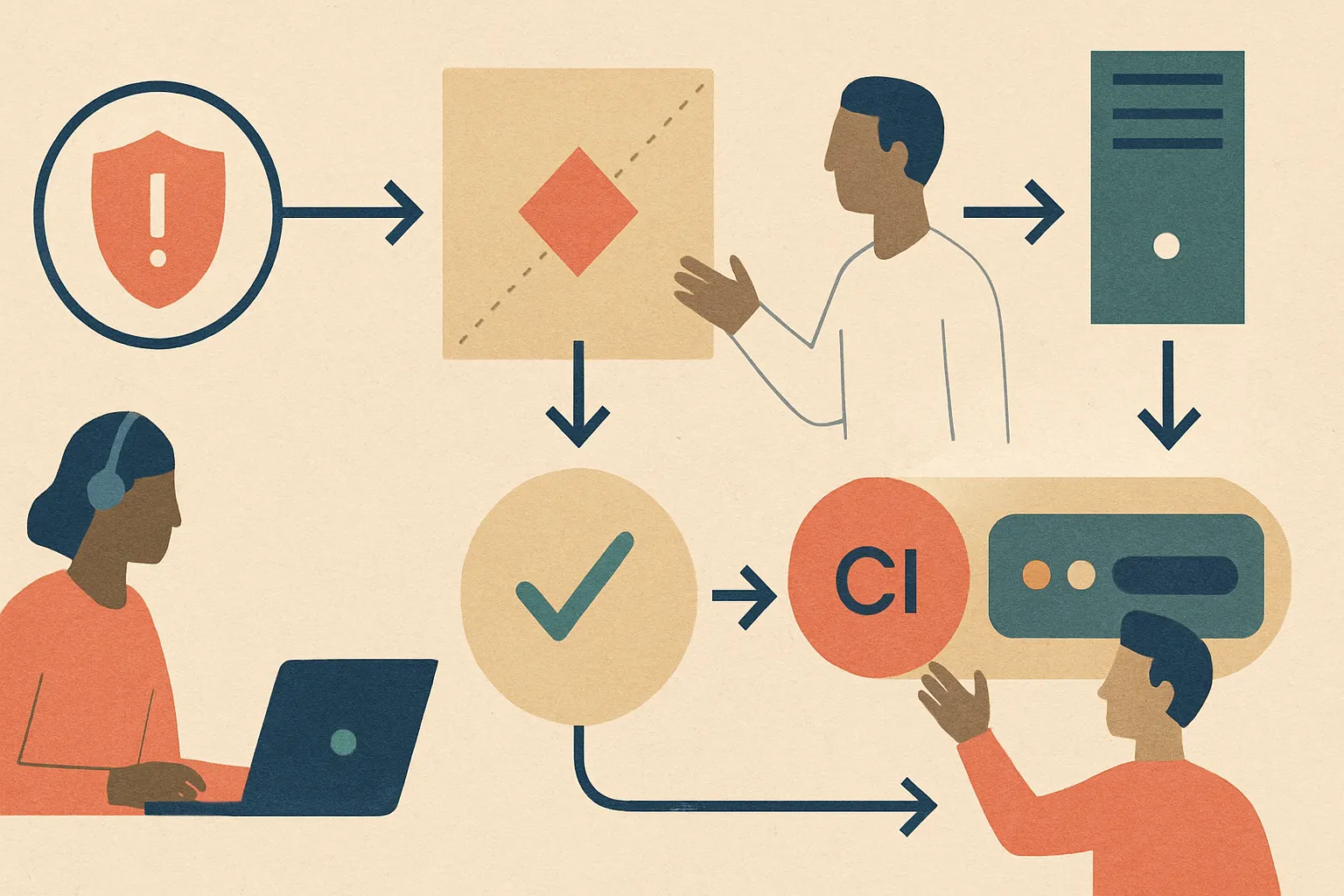
The point is simple: the agent does the expensive detective work, and humans keep authority over the final move.
A practical workflow that won’t ruin your Friday
If you’re considering security agents, start with a constrained pipeline.
Not “give Claude root and pray.”
A real pipeline.
Here’s a sane version:
flowchart TD
  A[CVE advisory or alert] --> B[Agent maps affected repos and versions]
  B --> C[Sandbox reproduction attempt]
  C --> D[Draft patch + targeted tests]
  D --> E[Human security review]
  E --> F[CI validation and regression checks]
  F --> G[Staged deployment with rollback plan]
This structure matters because every stage catches a different kind of stupidity.
The sandbox catches fake exploitability. Human review catches dumb code changes. CI catches obvious breakage. Staged deployment catches the weird stuff that only appears under real traffic. You want all of them.
If you skip two of those layers because the benchmark score looked good, you’re not moving fast. You’re just borrowing outages from the future.
How we’d evaluate a security agent beyond the benchmark
If we were assessing an agent for a client, CVE-Bench would be one input, not the verdict.
We’d also test:
Repository realism
Can it handle your actual repo shape, not a benchmark package laid out for convenience?
Monorepos, generated code, stale docs, internal frameworks — that’s where confidence goes to die.
Diff quality
Does the patch minimize changes, preserve style, and explain tradeoffs?
A one-line fix that’s precise is often better than a 200-line “hardening refactor” the agent invented because it got excited.
Test discipline
Does it write the right tests, or just enough tests to make itself look correct?
We’ve tried agent-generated test suites that were basically cardboard cutouts. Green CI, broken behavior. A disaster.
Uncertainty reporting
Does it say when it’s guessing?
This is a huge separator. Agents that surface uncertainty are usable. Agents that bluff are dangerous.
Cost and latency
Can the workflow run cheaply enough to matter at scale?
If every triage task spins up a giant model, multiple tool calls, and 20 minutes of sandbox time, you don’t have automation. You have a very expensive ritual. If you’re modeling that tradeoff, our AI cost estimator is a decent place to start.
Where smaller, specialized systems can beat giant general agents
Another unpopular opinion: bigger models aren’t automatically better for security workflows.
For patch triage, a smaller system with tight tool access, constrained prompts, retrieval over your internal codebase, and hard execution limits can outperform a larger “generalist” agent in practice. Not because it’s smarter. Because it’s less likely to improvise nonsense.
That’s the same reason a checklist beats charisma in aviation.
If you’re building these systems, this is usually where custom models, carefully designed AI agents, and strong AI consulting beat off-the-shelf demos. The benchmark might celebrate broad capability. Production rewards controlled behavior.
And yes, the same lesson shows up outside security too. We’ve seen it in on-device and voice systems where reliability matters more than theatrical intelligence — the kind of work behind RunHotel, our hotel voice AI product, and other on-device AI and voice AI deployments. Different domain, same rule: if the system can’t behave predictably under constraints, the demo doesn’t matter.
So, should you trust CVE-Bench?
Yes — as a measuring stick.
No — as a permission slip.
CVE-Bench is useful because it drags evaluation closer to reality than toy benchmarks do Source. That’s a real contribution. It can help you compare agents on vulnerability-oriented tasks and expose whether they can reason through realistic security problems.
But it won’t tell you the thing executives actually want to know: “Can we safely let this touch production remediation?”
Not by itself.
For that, you need workflow design, guardrails, auditability, human review, and brutal testing against your own repos. Benchmarks tell you whether the athlete can run drills. They don’t tell you whether you should hand them the ball in the final minute.
That’s your job.
If you’re building or evaluating a secure remediation workflow, start narrow. Use agents for triage, reproduction, evidence gathering, and draft fixes. Put them in sandboxes. Force them through CI. Review every diff. Then expand only after they’ve earned trust the boring way.
That’s how you avoid turning “helpful security automation” into a very expensive incident report.
If you want help designing that kind of pipeline, talk to us. We like agents. We just don’t believe in letting them cosplay as adults before they’re ready.
Sources
- CVE-Bench project page: https://giovannigatti.github.io/cve-bench/