


SQLite Is Usually the First Database Your AI Agent Needs
Hitesh Sondhi · June 21, 2026 · 12 min read
The moment an agent can retry a hotel booking, send an email, update a CRM, or call a payment API, its prompt history stops being enough.
Prompt history won't reliably tell you what the agent intended, what it tried, what succeeded, what failed, what it shouldn't try again, or what a human approved. If that data only lives in logs, Redis keys, vector chunks, or a framework callback, you don't have an agent system. You have a demo with amnesia.
Often, the boring answer is SQLite.
Not always. Not forever. Far more often than people expect.
A recent developer post, Why AI Agents Make Me Reach for SQLite, makes the same practical observation: agents need durable state, and SQLite gives you a small, local, queryable place to put it without turning every prototype into a distributed systems project.
We agree with the instinct. Treating SQLite as a toy database is a mistake. Treating every agent state problem as a vector database, workflow engine, or cloud queue problem is a bigger one.
The real problem is not agent memory
Most agent writeups talk about memory as if the hard part is remembering user preferences.
Remembering preferences is easy.
Operational facts are harder:
- Did we already call this tool?
- Which arguments did we pass?
- Did the user approve the action?
- Was the API response final, partial, or ambiguous?
- Which model version produced the decision?
- Can we replay the sequence without guessing?
- What should happen after a process crash?
An agent that can't answer those questions will eventually repeat side effects. It might email the same customer twice, re-open a closed ticket, overwrite a user preference, or keep retrying a failing API because the LLM has no durable concept of "already tried".
Prompt context is not state. It's a scratchpad.
Vector memory is not state either. It's useful for fuzzy retrieval, but it's the wrong place to store whether invoice INV-1842 was approved at 14:03 by user u_91. Transactional facts belong in transactional tables.
SQLite earns its keep here. Durable rows, transactions, indexes, constraints, and local reads solve a surprisingly large share of early agent problems.

If you're building agents for internal tools, customer operations, voice workflows, or device-local automation, separate semantic memory from operational state early. Put fuzzy knowledge where fuzzy retrieval helps. Put facts where facts can be queried and audited.
Where SQLite fits in the agent stack
An AI agent usually has four moving pieces: the model, tools, memory, and control logic. The model decides or drafts. Tools touch the outside world. Memory gives context. Control logic decides what gets retried, approved, cancelled, or escalated.
SQLite fits under the control logic.
Here's the shape we use as a starting point:
flowchart TD
  U[User request] --> P[Planner]
  P --> S[SQLite state check]
  S --> M[Model call]
  M --> T[Tool execution]
  T --> W[SQLite write]
  W --> R[Response or next step]
  W --> A[Audit view]
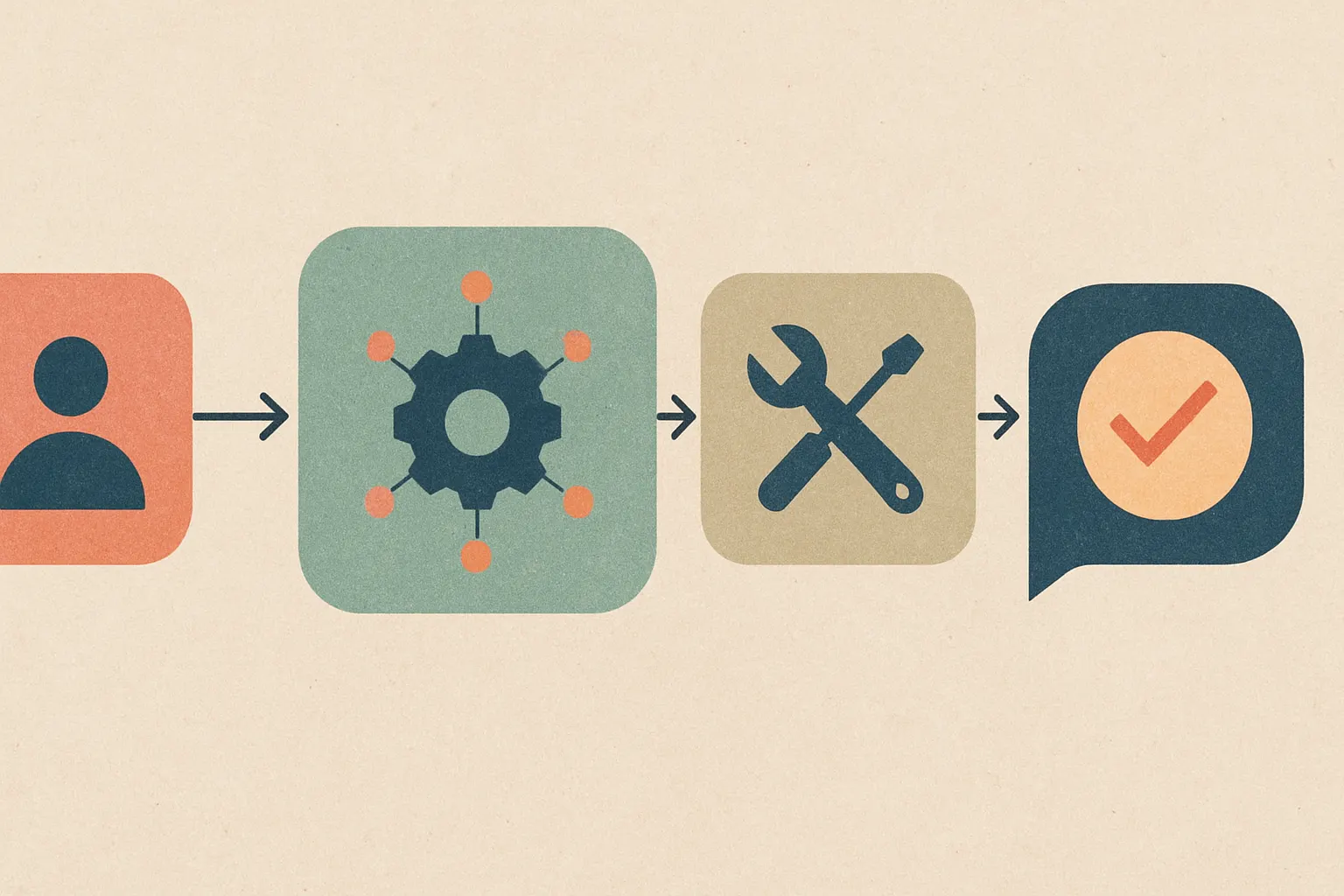
Notice the loop through SQLite before and after tool execution. Before a tool call, the agent checks prior attempts, policy decisions, and locks. After a tool call, it records the outcome before generating the next step.
That ordering sounds boring. It's the difference between an agent that survives a crash and an agent that improvises after losing its place.
ACID transactions let you group related state changes and avoid half-recorded decisions when the process dies mid-action SQLite Transactions. Write-ahead logging can improve read and write concurrency for many local workloads SQLite WAL.
For a production agent, you can keep deployment small without giving up transactional discipline.
Durable state: the part frameworks hide too well
Agent frameworks are good at making tool loops feel simple. They often hide the unpleasant bits behind callbacks, traces, sessions, and memory abstractions.
Useful, until a customer asks why the agent cancelled a booking.
If the answer requires stitching together console logs, LLM traces, HTTP request IDs, and a vector memory hit, operational control is already gone. The agent might be technically impressive, but the business can't trust it.
A durable state table doesn't need to be complex.
You might start with tables like:
agent_runs: one row per user-visible taskagent_steps: model calls, tool calls, decisions, and errorstool_invocations: idempotency keys, arguments, responses, statusapprovals: human approvals, denials, timestamps, actor IDsfacts: compact structured memory the agent can rely onoutbox: pending side effects waiting to be dispatched
Developers, support staff, and auditors can inspect that working memory with SQL.
For our AI agents work, this is usually where we draw the line between prototype and production. A prototype can use framework memory. A production agent needs its own state model.
Unable to draw the tables? You probably don't understand the workflow yet.
SQLite as agent memory, but not the only memory
The phrase "agent memory" causes bad architecture because it collapses several storage needs into one word.
Three categories matter.
Structured memory is factual and compact. User preferences, account mappings, workflow status, permissions, tool results, and extracted fields belong here. SQLite is excellent for this.
Episodic memory is event history. Previous runs, decisions, errors, and user feedback need filtering, joins, and replay. SQLite is also a good fit.
Semantic memory is fuzzy recall. Policies, help documents, transcripts, product manuals, and historical examples often belong in embeddings plus a vector index.
Don't force SQLite to be a vector database just because it's convenient. JSON support is real SQLite JSON Functions, but similarity search over large corpora is a different access pattern.
Metadata around semantic retrieval belongs in SQLite: document IDs, chunk versions, source URLs, ingestion status, and retrieval decisions. When nearest-neighbor search is central to the product, use a vector store.
Cleaner architecture treats SQLite as the ledger and the vector database as the library.
SQLite as a queue, with limits
Many production agents need a queue before they need Kafka.
Deferred tool calls, failed-work retries, webhooks, notifications, and long-running workflow resumes can often start with a SQLite-backed queue. For a single service or a small fleet, that's a reasonable business decision.
A basic outbox table can hold:
idrun_idtask_typepayload_jsonstatusattempt_countavailable_atlocked_bylocked_untillast_error
A worker claims rows in a transaction, marks them as locked, executes the task, then records completion or schedules a retry. Unglamorous. Effective.
Failure modes decide the limit.
SQLite allows many concurrent readers, but only one writer at a time SQLite Transactions. WAL mode helps many read-heavy local workloads, but it doesn't turn SQLite into a distributed queue SQLite WAL.
One process, one device, one tenant, or a small number of workers on one machine is a good fit. With hundreds of workers across multiple hosts competing for jobs, use Postgres, Redis Streams, SQS, Pub/Sub, or a workflow engine.
Don't cosplay as Netflix when you're automating a 12-person back office process.
Measure queue depth, lock wait time, retry rate, and job age. Boring numbers mean SQLite is doing its job.
Audit is not optional once agents touch real systems
Connector catalogs don't create transparency. Evidence does.
Each meaningful agent action needs a durable record of:
- input snapshot
- retrieved context IDs
- model name and version
- tool selected
- arguments passed
- policy checks applied
- approval state
- external response
- final user-facing message
Storing every token forever isn't necessary. Enough evidence to reconstruct the decision is.
Risk rises in regulated, customer-facing, or high-friction workflows. An agent updating a healthcare record, changing a hotel reservation, modifying an invoice, or sending a contractual email can't leave behind "the model decided" as its audit trail.
In RunHotel, our on-device voice AI product for hotels, this design pressure shows up quickly. Voice interactions are messy. Guests interrupt. Staff override. Connectivity can be unreliable.
A local durable store is not just a developer convenience. It's part of making the product operable at the property level.
Same instinct applies to voice AI and on-device AI projects generally. If the agent runs near the user, SQLite is often the simplest way to keep local truth close to the interaction.
Audit tables also improve product development. You can sample failed runs, identify bad tools, tune prompts, compare model versions, and decide where custom models are worth the cost. If you're considering that path, our custom models work usually starts with this question: do you have enough clean operational history to train or evaluate anything meaningful?
Why AI agents make SQLite look better than Redis
Redis is excellent for ephemeral coordination. Caches, rate limits, short-lived locks, pub/sub, and hot counters are natural fits.
Misuse happens because Redis is easy.
Problems appear later. You want to inspect a week of decisions, join tool calls with approvals, replay a failed run, run migrations, enforce constraints, and know whether a missing key means "never happened" or "expired".
SQLite gives you the boring database properties you should've wanted from the start.
Chatbots can forget. Agents need accountable continuity.
Pair Redis with SQLite if you need fast ephemeral coordination. Treat Redis as the system of record for agent decisions only if you've deliberately built persistence, schema discipline, and audit workflows around it.
Most teams haven't.
The local-first case is underrated
Cloud-first architectures assume stable connectivity, centralized control, and enough volume to justify managed infrastructure.
Many agent deployments don't look like that.
A retail kiosk, hotel front desk, field service tablet, warehouse workstation, call center desktop helper, or factory floor assistant may need to keep operating when the network is weak. It may also need low-latency access to recent context without round trips to a central database.
Embedded SQLite is strong here. No server. No network hop. No separate database container to monitor. You ship a file and a library.
Deployment risk drops.
In AI consulting work, we often see teams overbuild the first version of an agent platform. They start with Kubernetes, a workflow orchestrator, a vector database, a tracing vendor, a queue, Postgres, Redis, and an agent framework. Then the pilot stalls because the infrastructure footprint is bigger than the workflow.
A local database lets you defer those decisions until the workload earns them.
Use the AI cost estimator for model spend, but remember that infra and operations cost can dominate early pilots. Small agents that use SQLite well are easier to ship, observe, and replace if the workflow turns out to be wrong.
Schema beats prompt cleverness
A good schema forces you to name the workflow.
Mundane, but useful. Explicit fields for requires_approval, approval_actor_id, idempotency_key, and external_status let the control loop make deterministic decisions before asking the model to reason.
Query the table to see whether the email was sent.
Human approval for a refund belongs in durable state, not in the LLM's memory.
Retry policy belongs in attempts and timestamps, enforced by code.
The model should handle ambiguity, language, planning assistance, and adaptation. Business invariants shouldn't live only in prompts.
One practical pattern is to make the agent write proposed actions into SQLite before execution. Deterministic code then validates policy, checks idempotency, asks for approval if needed, and only then dispatches the tool call.
Testing gets easier too. Seed the database with known states and verify what the agent would do.
When SQLite is the wrong choice
A SQLite database is not a badge of simplicity you apply to every system.
Move away from SQLite when the write path becomes genuinely concurrent across many machines. Multiple app servers writing the same agent state at high frequency should use Postgres. Postgres gives you stronger operational tooling, better concurrent write behavior, access control, replication options, and a cleaner path for multi-tenant administration.
Central analytics is also a bad fit. Export events into a proper analytical store if product, finance, or operations teams need cross-customer reporting.
Shared queues for large distributed worker pools are another bad fit. The locking model will become the bottleneck, and worse, it will fail in ways that look like random latency spikes.
Permission boundaries matter too. File-level access is not the same as database-level access control. If you need tenant isolation enforced by the database server, pick a server database.
Product decisions don't disappear because storage is simple. Human review, compensation logic, and legal retention rules still need to be modeled.
Clean migration starts with repository boundaries. Keep SQL explicit, but don't scatter raw queries through every tool implementation. Success should make moving the same schema concepts into Postgres feel like an engineering task, not a rewrite.
The production default we recommend
Our default for a new production agent is simple.
Use SQLite for local durable state, run history, tool invocation records, approvals, small queues, and audit trails. Use a vector store only for semantic retrieval. Use Redis only for ephemeral coordination. Move to Postgres when shared concurrent writes, centralized administration, or tenant-scale reporting justify it.
Simplicity isn't nostalgia for small tools. It's budget control.
Every database, queue, tracing layer, and orchestration product adds failure modes. Some are worth it. Many are rented complexity. While the workflow is still proving that it can save staff time, reduce response delays, or complete tasks safely, SQLite helps you spend risk on tool design, policy enforcement, evaluation, and human handoff.
Before picking infrastructure, model the state tables. We can help with that through AI agents, on-device AI, or a short architecture review via contact.