

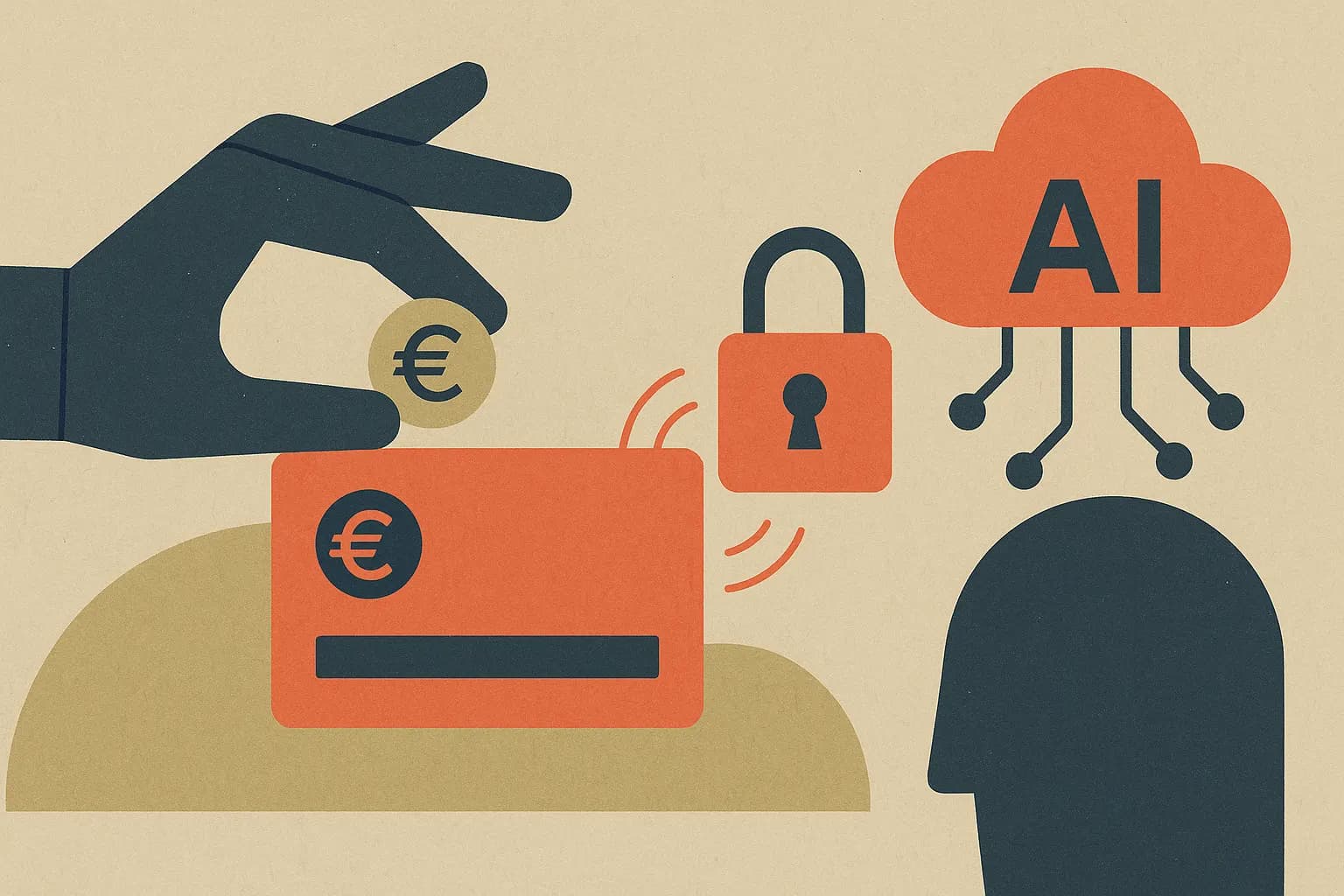
Why a €0.01 Bank Transfer Exposes AI Agent Security Gaps
Hitesh Sondhi · June 11, 2026 · 12 min read
A €0.01 bank transfer sounds harmless. That's exactly why it's dangerous.
The nasty part isn't the cent. It's what that cent can mean inside an AI-driven workflow: account verification, trust escalation, tool invocation, or a clever prompt injection hiding in transaction metadata. If your agent can read banking events, interpret them, and take actions, then a €0.01 bank transfer is no longer a tiny payment. It's an input vector.
We’ve seen teams obsess over model choice, latency, and shiny agent demos while treating tool permissions like an afterthought. That's backwards. In agent systems, the model is rarely the real problem. The dangerous part is what the model is allowed to touch.
And here's where it gets weird.
A recent write-up from Blue41 on securing bunq’s financial AI assistant shows the exact shape of the problem: seemingly benign financial events can become attack surfaces when an AI assistant is allowed to reason over them and trigger actions Blue41. That’s the lesson worth stealing.
Key Takeaways
- A €0.01 bank transfer isn't risky because of the amount; it's risky because agents may treat it as a trusted signal.
- AI agent security starts with [tool permission boundaries](/blog/ai-agent-cluster-admin), not prompt polishing.
- Transaction metadata, payment references, and external messages should be treated like hostile user input.
- High-risk actions need deterministic validation layers the model can't bypass.
- If you aren't adversarially testing workflows, your agent is probably one weird edge case away from doing something stupid.
The Real Problem Isn't the Payment. It's the Workflow Around It
Banks, fintech apps, and payment platforms have used tiny transfers for years.
Sometimes it's account verification. Sometimes it's a “penny drop” style check. Sometimes it's a code embedded in the statement description for account confirmation. PayPal, for example, says it may deposit €0.01 and include a 4-digit code in the bank statement for confirmation PayPal.
So no, a one-cent payment isn't inherently suspicious.
But once you bolt an AI agent onto financial operations, that same tiny event can become a trigger, a message carrier, or a social engineering payload. Blue41’s bunq case is valuable because it moves the conversation away from vague “AI safety” hand-wringing and into the ugly mechanics of real systems: tools, workflows, permissions, and attack paths Blue41.
That’s the part too many teams skip.
They build an agent that can:
- read transaction history,
- parse payment references,
- answer user questions,
- initiate actions,
- and maybe even move money.
Then they act surprised when untrusted external data starts steering the system.
That's not an AI problem. That's a security architecture problem wearing an AI nametag.
Why a €0.01 Bank Transfer Is Such a Good Attack Vehicle
Attackers love boring things.
A €0.01 bank transfer is boring enough to slip through human attention and structured enough to enter trusted systems. It can appear as:
- account verification noise,
- an “unknown small transaction” that a user asks the assistant to explain,
- a transaction with crafted reference text,
- a precursor event that changes confidence or trust state in an agent workflow.
If your agent reads transaction descriptions and uses them as context, you've already opened the door.
If your agent can also call tools based on that context, you've opened the door and handed over the keys.
Here's the mental model we use: an agent is a junior employee with root access and poor impulse control. You don't solve that by giving better motivational speeches. You solve it by limiting access, checking every important action, and assuming weird inputs will happen.
Because they will.
Where AI Agents Usually Fail First
Most insecure agents don't fail in one dramatic Hollywood moment. They fail in layers.
First, the model ingests untrusted text from somewhere dumb: payment reference, email body, CRM note, support ticket, uploaded PDF, or transaction memo.
Then it blends that text with system instructions and user intent.
Then it calls a tool.
Then everyone has a bad afternoon.
We’ve found the first serious mistake is usually collapsing interpretation and authorization into one model decision. In plain English: the same LLM that “understands” the request is also allowed to decide whether a sensitive action should happen.
That is bad.
Very bad.
A model can help classify or draft. It should not be the final authority on whether funds move, account settings change, or trust levels increase.
The Secure Agent Pattern We Recommend
If you're building financial agents, support agents with payment access, or anything adjacent, split the system into hard layers.
The model can suggest. Deterministic systems decide.
Here's how the pipeline should work:
flowchart TD
  A[External input: user message or transaction data] --> B[LLM interpretation layer]
  B --> C[Proposed action + structured arguments]
  C --> D[Policy engine]
  D --> E[Deterministic validation rules]
  E --> F[Human approval if high risk]
  E --> G[Tool execution if low risk and valid]
  F --> G
This isn't glamorous. It also works.
The LLM should output a proposed action in a constrained schema. Then a policy engine checks:
- Is this tool allowed for this user?
- Is this action allowed in this context?
- Does the amount exceed limits?
- Is the destination account already verified?
- Did the request originate from a trusted channel?
- Is the transaction reference trying to inject instructions?
- Do we need step-up authentication or human approval?
The agent doesn't get to freestyle past these checks.
If you're serious about AI agents, this is the line between “useful automation” and “we accidentally built a fraud intern.”
Treat Transaction Metadata Like User Input From the Internet
Because that’s what it is.
Payment descriptions, remittance fields, account names, and transfer references often get treated as harmless strings. For AI agents, they are prompt-shaped attack surfaces.
A crafted payment reference could try to manipulate downstream summarization, fraud review, or support workflows. Even if the model doesn't literally “obey” the text, it can still be nudged into the wrong interpretation.
Think of it like airport security letting a stranger write on your boarding pass and then asking an overconfident intern to decide whether you should enter the cockpit.
Not ideal.
So sanitize and compartmentalize:
- strip or isolate free-text transaction metadata before passing it to action-capable agents,
- classify it separately from control instructions,
- never let transaction text directly define tool parameters,
- log raw input and model interpretation separately for audits.
This is also where smaller, tightly scoped systems often beat giant general-purpose agents. In some cases, especially for privacy-sensitive deployments, on-device AI or task-specific custom models can reduce exposure by narrowing what the system sees and does.
Hot take: the best secure agent is often a mediocre-sounding agent with boring permissions.
The all-powerful assistant demo is usually the one that bites you later.
Tool Permissions: Stop Giving the Model a Skeleton Key
Here's the mistake we keep seeing: one payments.execute_transfer() tool with broad access, wrapped in a nice natural-language interface.
That’s not a tool. That’s a breach waiting for a calendar invite.
Break tools into narrow capabilities:
payments.list_recent_transactionsaccounts.check_verification_statuspayments.prepare_transferpayments.submit_transfersecurity.request_step_up_authcases.create_review_ticket
The model can use read-only tools more freely. Write tools should be scarce, parameter-constrained, and guarded by policy.
For example:
prepare_transfercan create a draft onlysubmit_transferrequires a signed approval token from a deterministic service- destination account IDs must come from verified records, not free text
- references must pass content filters and length limits
- transfers above threshold require human review
This is the same reason we don't hand a new hotel receptionist the master key, the payroll terminal, and the fire alarm controls on day one. We learned that lesson the hard way in software long before AI showed up.
If you're building voice AI, double these precautions. Voice adds ambiguity, transcription errors, and social engineering pressure. A polite-sounding request over the phone can still be a malicious workflow trigger.
Validation Should Be Deterministic, Annoying, and Unskippable
Founders sometimes worry that validation layers make the agent feel less magical.
Yes.
Good.
Magic is overrated when money moves.
For any financial action, we recommend a deterministic validation service outside the LLM loop. It should verify things the model is not trusted to infer:
- user identity and session trust
- beneficiary verification state
- transfer amount thresholds
- velocity and anomaly checks
- channel consistency
- required approvals
- policy exceptions
- fraud flags from upstream systems
The model can explain the result to the user. It should not manufacture the result.
We’ve had similar conversations in product teams building operational AI: everyone wants the assistant to “just handle it.” Then you map the failure modes and realize “just handle it” is how you end up explaining unauthorized actions to legal, compliance, and angry customers.
That meeting is never fun.
Adversarial Workflow Testing Is the Part Everyone Pretends to Do
Most teams say they test security. What they mean is they tried five prompts in staging and nothing exploded.
That's not testing. That's wishful thinking with a Jira ticket.
Real adversarial workflow testing means you attack the system, not just the prompt:
- malicious payment references,
- conflicting user instructions,
- poisoned CRM notes,
- fake verification sequences,
- edge-case transaction chains,
- partial tool failures,
- retries with stale state,
- multilingual prompt injection,
- voice transcript ambiguity,
- user requests that are valid individually but dangerous in sequence.
Here's a simple red-team loop:
sequenceDiagram
  participant A as Adversarial Input
  participant L as LLM Agent
  participant P as Policy Engine
  participant T as Tool Layer
  participant H as Human Reviewer

  A->>L: Crafted transaction/reference/request
  L->>P: Proposed action
  P->>T: Allow only if policy passes
  T-->>P: Execution result or denial
  P-->>H: Escalate if risky
  H-->>P: Approve or reject
  P-->>L: Final status
Notice what's missing? Blind trust.
At Cropsly, when we estimate AI system complexity for clients, the hidden cost is rarely the model bill. It's the layers around it: observability, policy enforcement, fallback paths, and abuse testing. If you're budgeting an agent project, our AI cost estimator can help frame the real build, not the fantasy version.
A Practical Secure-Agent Checklist for Financial Workflows
If you want the short version, here it is.
1. Separate read, recommend, and act
Your model can read data. It can recommend actions. It should not directly execute sensitive operations without external checks.
2. Require structured outputs
No free-form “the model decided to send money.” Force action proposals into schemas with typed fields and confidence markers.
3. Put a policy engine in front of every write tool
Every sensitive tool call should be approved by deterministic logic, not model vibes.
4. Treat all external text as hostile
Transaction descriptions, uploaded documents, chat messages, and support notes all need isolation and filtering.
5. Use step-up authentication for risky actions
New beneficiary, unusual amount, unusual device, unusual channel? Pause and verify.
6. Add human review where the blast radius is high
Humans are slow and expensive. Fraud is slower and more expensive.
7. Test workflows, not just prompts
Attack the full chain: ingestion, memory, tool selection, retries, escalation, and audit logs.
8. Keep audit trails model-readable and human-readable
You need to know what input the model saw, what it proposed, what policy allowed, and what tool actually executed.
This is where experienced AI consulting matters. Not because the concepts are mysterious, but because teams under deadline pressure consistently skip the boring controls that prevent expensive incidents.
What This Means Beyond Banking
The lesson from a €0.01 bank transfer applies far beyond fintech.
Any tiny external event can become a lever if your agent treats it as trusted context:
- a hotel booking note in a voice workflow,
- a support ticket with hidden instructions,
- a CRM contact field poisoning a sales agent,
- a document upload steering an internal assistant.
We’ve seen this pattern across operational AI systems, including products like RunHotel, where voice interfaces and real-time actions demand strict boundaries between what the model hears, what it infers, and what the system is actually allowed to do. The domain changes. The rule doesn't.
Small input. Big consequence.
That’s the whole story.
The Design Rule We'd Bet On
If an AI agent can move money, change account state, or trigger sensitive workflows, assume every external input is trying to trick it.
That sounds paranoid until you ship.
Then it sounds like engineering.
A €0.01 bank transfer isn't scary because of the money. It's scary because it reveals whether your system understands the difference between observing an event and trusting an event. Weak agents blur that line. Secure agents enforce it ruthlessly.
If you're building agents that touch financial or operational workflows, start with permissions, validation, and adversarial testing before you start arguing about which model has better benchmarks. If you want help designing one without giving it a loaded nail gun and a vague mission statement, talk to us through Cropsly’s contact page.
Because the cheapest incident you'll ever handle is the one you kill in architecture review.