


What Midjourney v. Studios Means for Enterprise AI Auditability and IP Risk
Hitesh Sondhi · October 30, 2026 · 11 min read
A demand from an AI vendor asking Hollywood studios to disclose their AI usage sounds like a legal problem. It's actually an API contract problem.
When Midjourney wants Hollywood studios to reveal the details of their AI usage, the request implicitly demands something most enterprise AI pipelines cannot produce: a complete, auditable record of every model invocation, prompt, input asset, and output artifact across months of production work. Source: TechCrunch
That gap between what's being asked and what systems can deliver is where the real engineering work lives.
- Midjourney's disclosure demand to studios signals that AI auditability is becoming a contractual requirement, not a nice-to-have.
- Most enterprise AI pipelines lack the [logging granularity to reconstruct which model generated which output](/blog/opentelemetry-cncf-graduation-ai) and when.
- Vendor contracts will need explicit data flow, model versioning, and provenance clauses to survive IP disputes.
- The infrastructure cost of auditability is non-trivial: think [API gateway logging](/blog/ai-gateway-llm-apps) on steroids, not a config toggle.
What the Disclosure Demand Actually Requires
"Reveal the details of their AI usage" could mean several things. Which models did you use? Which prompts did you send? Which training data touched which outputs? Which third-party APIs processed your assets? Which version of each model was active at each invocation?
For a studio running a pipeline that touches dozens of tools across pre-production, VFX, marketing, and post, that's not a query. It's a forensic reconstruction.
Most pipelines we've seen in production don't log at this granularity. They log API errors and billing events. They don't log the full prompt payload, the model version hash, the input asset checksum, and the output artifact hash in a way that's queryable months later.
If you're a studio general counsel reading about this demand, your first call isn't to legal. It's to your engineering team asking whether you can actually produce this data. The answer, in most cases, is no. Not without retrofitting.
The Audit Trail Problem at the API Layer
Think of AI auditability like a payment processing system. Every transaction needs an immutable record: who initiated it, what was sent, what was returned, which service processed it, and a timestamp. Payment systems have had this for decades. AI pipelines mostly don't.
The problem starts at the API gateway. When a creative team member sends a prompt to an image generation API, the request passes through a gateway that might log the endpoint, the response time, and the status code. It rarely logs the full request body. Storing full prompt payloads for every API call is expensive in storage and raises its own privacy concerns.
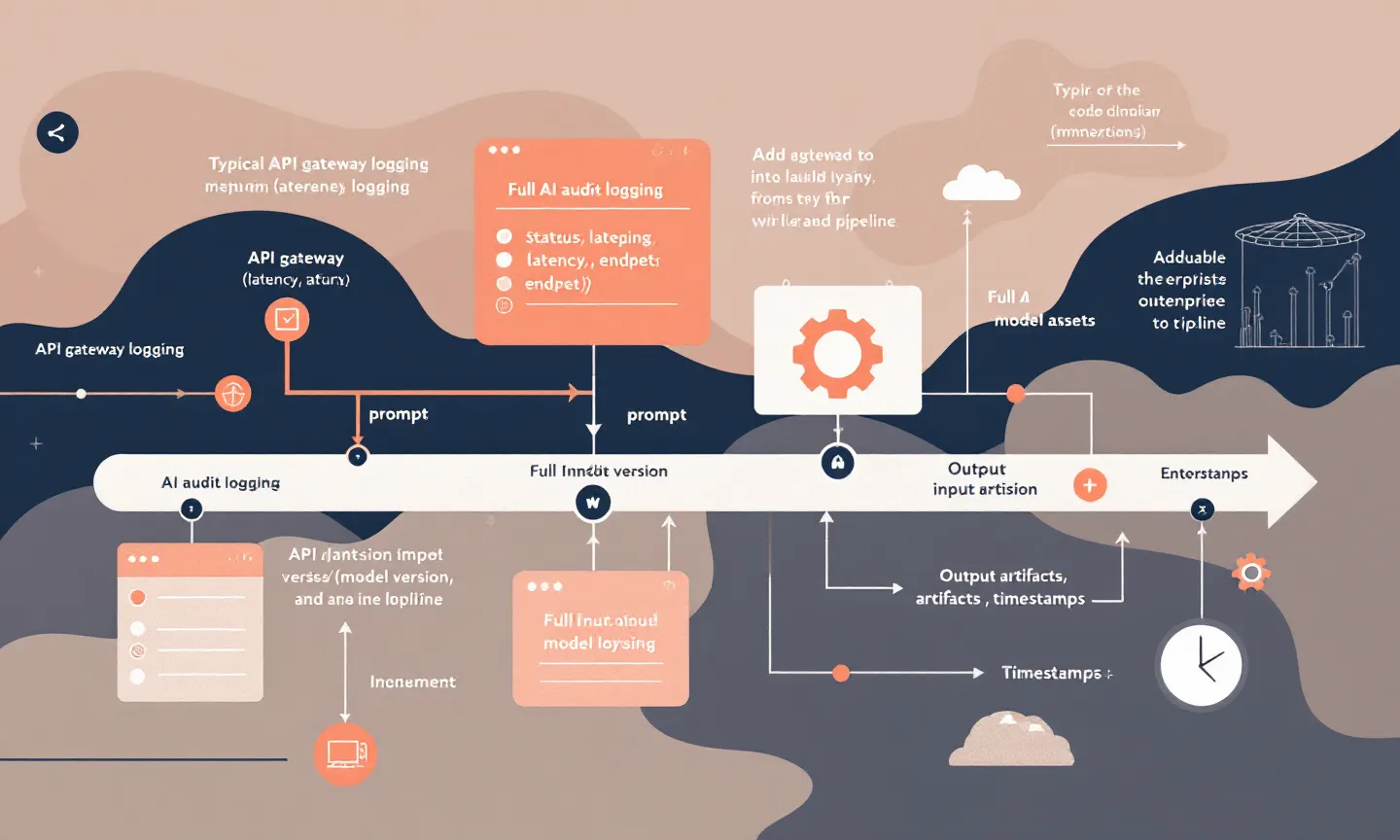
But that's exactly what an auditability requirement demands. You need the prompt, the model version, the input references, and the output artifact stored in a way that survives staff turnover, vendor API changes, and model deprecations.
We've been building AI agents for clients who need this kind of traceability, and the pattern we keep arriving at is an append-only event log that sits between the application layer and the model API. Every call gets a request ID, a timestamp, the full prompt, the model identifier, the model version, and a hash of the output. The output itself goes to object storage with the request ID as metadata.
This isn't exotic engineering. It's standard event sourcing applied to AI calls. The cost is in storage and in the discipline of never bypassing the log. One developer who calls a model API directly from a script, bypassing the gateway, creates a gap in the audit trail. That gap is where IP risk lives.
Why Vendor Contracts Need to Change
The current standard for AI vendor contracts is roughly: you send us prompts, we return outputs, here's the pricing. That contract doesn't survive an IP dispute.
If Midjourney is asking studios to disclose AI usage, studios will need to ask their vendors the same questions. Which model version processed this asset? Was the model fine-tuned on copyrighted material? Can you provide an audit trail of our API calls for the last 18 months? Does your API log the full prompt payload, and for how long?
Most vendor terms of service don't address these questions. They address uptime, data retention for training purposes, and rate limits. They're silent on provenance.
The contract changes needed are specific. You need a clause requiring the vendor to maintain call logs with model version identifiers for a defined retention period. You need a data processing addendum that specifies whether your prompts and outputs are used for training. You need a right-to-audit clause that lets you verify the vendor's logging claims. And you need an indemnification clause that allocates risk if the vendor's model was trained on copyrighted material without proper licensing.
Midjourney's demand to studios is a signal that the IP litigation layer of the AI stack is becoming active. Studios that can't answer "what AI did you use and how" will be at a disadvantage in any dispute, whether they're plaintiffs or defendants.
IP Risk Lives in the Data Flow, Not the Model
Here's what trips people up: IP risk in AI pipelines isn't just about which model you used. It's about the data flow.
A studio might use a properly licensed model from a reputable vendor. But if that model was fine-tuned on scraped images without proper licensing, every output it generates carries IP risk. The studio's contract with the vendor might say "you indemnify us for IP claims," but that clause is only as good as the vendor's ability to pay and their own legal exposure.
Then there's the input side. If a studio feeds a copyrighted reference image into a model's image-to-image endpoint, the output might be considered a derivative work. The audit trail needs to capture not just the prompt but the input assets and their provenance. Where did the reference image come from? Was it licensed? Was it in the public domain? Was it scraped?
We've seen this pattern in custom model work where clients want to fine-tune on their own proprietary data. The first question we ask is whether they have clear provenance for every asset in the training set. If the answer is "mostly," that's not good enough. One unlicensed asset in a training set of tens of thousands creates IP exposure for every output the fine-tuned model generates.
The auditability infrastructure needs to track provenance on both sides: what went into the model (training data and prompts) and what came out (generated artifacts). That's a data lineage problem, not a logging problem.
Building the Auditability Stack
Building AI auditability infrastructure is not a config change. It's a system.
The core component is an immutable event log. Every AI API call writes to it: request ID, timestamp, user ID, model ID, model version, full prompt, input asset references, output artifact hash, and latency. The log is append-only and stored separately from the application database so it survives schema changes and application refactors.
On top of the log, you need a query layer. When legal asks "show me every AI-generated image that touched this project in the last six months," you need to answer in minutes, not days. That means indexing by project ID, user ID, model version, and date range.
You also need a retention policy. Storing full prompt payloads for every API call is expensive. At a studio generating tens of thousands of AI images per week with prompts averaging hundreds of tokens, you're looking at a substantial storage cost over an 18-month retention period, and it's all potentially discoverable in litigation. Source: TechCrunch
The retention policy needs to balance auditability against storage cost and legal exposure. Keeping logs too long means more data to produce in discovery. Keeping them too short means you can't answer the audit question. There's no universal right answer here. It depends on your jurisdiction, your industry, and your risk tolerance.
For teams building on-device AI pipelines, the auditability challenge is harder. If inference happens on a user's device, the audit trail needs to sync back to a central log without compromising user privacy. We deal with this in RunHotel, our on-device voice AI for hotels, where every interaction needs to be traceable without recording guest audio. That's a design constraint, not an afterthought.
The Cost Question Nobody Wants to Answer
Auditability infrastructure has a real cost, and most AI budgets don't include it.
The storage cost for full-prompt logging is the obvious one. Less obvious is the engineering cost of retrofitting auditability into existing pipelines. If your team has been calling model APIs directly from application code for months, wrapping every call in an audit layer means touching every integration point. It's not hard, but it's tedious and error-prone.
Then there's the latency cost. Adding an append-only log write to every API call adds latency to the critical path. If you're using a synchronous log write, you're adding the round-trip time to your log service to every model call. If you're using async logging, you risk log gaps if the log service is down or the application crashes before the log flushes.
We've dealt with this in voice AI systems where latency is critical. The pattern that works is a fire-and-forget log write with a local buffer that retries on failure. The log write doesn't block the response, and the buffer ensures the log entry survives transient failures. The tradeoff is a small window where a crash can lose log entries, which you mitigate with a periodic checkpoint.
For teams trying to estimate the cost of auditability before committing, our AI cost estimator can help model the storage and compute overhead. If you need help scoping the full infrastructure, contact us. But the bigger cost is organizational: someone has to own the audit trail, maintain it, and be responsible for producing it when demanded. That's a role, not a task.
Platform Providers Need to Build This
If you're building an AI platform or API, Midjourney's demand to studios is a preview of what your enterprise customers will ask you. The studios being asked to disclose their AI usage will turn around and ask their vendors for the same information.
Platform providers need to offer audit logging as a first-class API feature, not a support ticket. That means an API endpoint where customers can query their own call history by date range, model version, and project tag. It means storing full prompt payloads with customer consent for a defined retention period. It means providing model version identifiers that are stable and queryable.
The providers who build this into their API will win enterprise contracts. The ones who treat auditability as a support burden will lose to competitors who treat it as a product feature. We're already seeing this in AI consulting engagements where enterprise clients ask us to evaluate vendor audit capabilities before committing.
Auditability is a feature that's invisible until someone needs it, and then it's the only feature that matters.
The Real Unresolved Question
Midjourney's demand to Hollywood studios is a specific instance of a broader pattern. Regulators, litigants, and business partners are all moving toward requiring AI pipeline transparency. The technical infrastructure to deliver that transparency doesn't exist in most enterprise AI deployments.
Building it is straightforward engineering. The hard part is the policy layer: what do you log, how long do you keep it, who has access to it, and what are you legally obligated to produce when asked?
Those questions have different answers depending on your industry, your jurisdiction, and your risk posture. But the engineering team needs to be in the room when those questions get answered, because the answers determine what you build.
If your legal team asked you tomorrow to produce a complete record of every AI model invocation across your organization for the past 12 months, including prompts, model versions, input assets, and output artifacts, could you deliver it? And if the answer is no, what's the gap between what you have today and what you'd need, and who in your organization is going to own closing it?