

From LIMS to Launch: Building production AI for specialty-chem R&D
Hitesh Sondhi · November 11, 2026 · 8 min read
The chromatography software writes peaks into a proprietary binary format. The spectroscopy instrument appends results to a shared network drive that someone remounts every Monday. The LIMS exports CSV files with no schema documentation and a timestamp column that switched timezones in 2021 without anyone noting it.
This is the actual data substrate for innovating with AI in specialty chemicals. It's where every production system either gets built or dies.
We've worked with R&D teams who have decades of formulation data locked in instruments, notebooks, and half-migrated LIMS instances. The gap between that data and a model that can recommend a polymer additive or predict a reaction yield isn't a model problem. It's a pipeline problem.
- LIMS integration is the real bottleneck, not model selection. Budget most of your effort here.
- [Domain-aware fine-tuning on smaller models](/blog/small-vs-large-llms) like Qwen3 or Phi-3 outperforms generic LLMs for chemistry reasoning.
- Versioning formulations alongside model outputs is non-negotiable for regulatory auditability.
- [Start with a read-only ingestion contract](/blog/apis-for-ai-agents) before building any write-back to lab systems.
What your LIMS API actually looks like
Most LIMS platforms weren't built with AI in mind. They were built for compliance, sample tracking, and human-readable reports. When you ask for an API, you get one of three things: a REST endpoint that returns samples by ID, a SOAP service that hasn't been updated since 2015, or an ODBC connection someone in IT will grudgingly open on a VPN.
One client's LIMS vendor offered a "REST API" that was actually a single endpoint returning a paginated dump of the entire sample table. No filtering. No joins. No datetime range parameters. You fetched everything and filtered client-side. That's not an API contract, that's a fire hose.
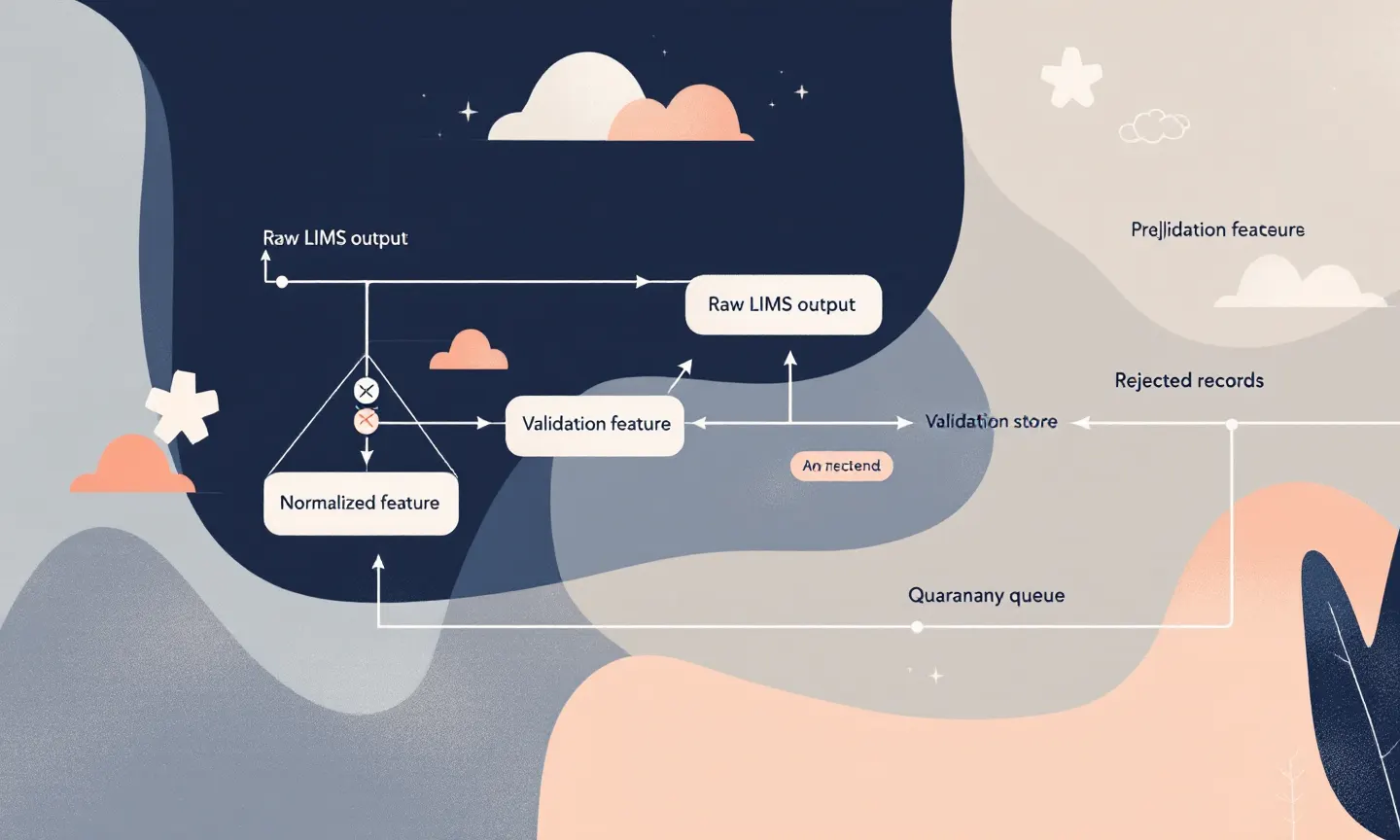
Our first step is building an ingestion layer that treats the LIMS as an untrusted data source. Don't trust its schema, its timestamps, or its unit conventions. The ingestion pipeline validates every field against a strict contract before it enters our feature store.
Here's what that contract looks like in practice:
class SampleRecord(BaseModel):
    sample_id: str
    formulation_id: str
    timestamp: datetime
    instrument: Literal["HPLC", "GC-MS", "FTIR", "UV-Vis"]
    peak_data: list[Peak]
    units: Literal["mg/L", "ppm", "wt%"]
    operator: str | None
Every field is typed. Units are explicit, not inferred. Operator is nullable because half the records predate the field's addition. This contract catches the silent failures that poison model training data: a column that switched from weight percent to parts per million in 2019, a timestamp field that stores local time without timezone info, a peak integration algorithm that changed when the vendor pushed a firmware update.
Where the data actually breaks
Failure modes in LIMS-to-model pipelines aren't glamorous. They're silent schema drift, unit inconsistencies across instruments, and orphaned records from projects that were cancelled but never flagged in the LIMS. We found a client's training set contaminated with results from a discontinued product line because the LIMS didn't enforce project status fields. The model learned patterns from formulations that would never ship again.
MIT Technology Review recently highlighted how specialty chemical companies are innovating with AI in R&D, noting that the biggest barrier isn't algorithmic sophistication but data readiness and integration with legacy lab systems. MIT Technology Review
Which matches our experience exactly. Model selection is the easy part. Getting clean, consistent, version-controlled data out of a LIMS that was never designed to feed one is where projects stall.
Building domain-aware models that don't hallucinate reactions
Once you have clean data, the model question becomes interesting. Generic LLMs are dangerous in chemistry R&D because they hallucinate plausible-sounding but wrong reactions. A model that confidently suggests a reagent that's incompatible with your solvent system isn't a minor bug. It's a safety issue.
For chemistry reasoning, we avoid large generic models. We fine-tune smaller, domain-specific models on the client's historical formulation data, reaction outcomes, and spectroscopy results. A Qwen3 model fine-tuned on your own reaction database will outperform a much larger generic model on yield prediction and formulation recommendation because it's learned your specific chemistry, not the internet's average chemistry.
If you're evaluating this path, our custom models service covers the fine-tuning pipeline from data prep to deployment. What to fine-tune on is the key decision: not just successful formulations, but failed ones too. The model needs to learn what doesn't work, not just what does.
For teams that want to explore the cost tradeoffs before committing, our AI cost estimator can model the inference economics of different model sizes on your expected query volume.
MLOps for formulations: versioning everything together
In specialty chem R&D, a model output is a formulation recommendation. That recommendation might get tested in a lab, adjusted by a chemist, and eventually become a product. Your audit trail needs to connect the final product back to the model version, the training data version, and the LIMS records that informed the prediction.
We use a three-layer versioning system. The data layer tracks LIMS snapshots with content-addressed storage. The model layer tracks weights, training configs, and evaluation metrics. The output layer links each prediction to both. When a regulatory body asks why a formulation was recommended, you can trace it back to the exact model state and data snapshot.
This is where most MLOps tools fall short. They version models but not the domain data that produced them. In chemistry R&D, the data and the model are inseparable. A model trained on data from before an instrument recalibration is a different model, even if the weights are identical.
Most off-the-shelf MLOps platforms abstract away the data layer behind feature store APIs and dataset versioning primitives. Those abstractions assume your data comes from a clean pipeline with consistent schemas. In specialty chem, your data comes from a LIMS that changes its export format when the vendor pushes an update. Behind that abstraction hides the cost of maintaining that contract, and you pay for it in silent data corruption.
For teams building agent systems on top of these models, our AI agents service handles the orchestration layer. But the versioning discipline has to come first.
From lab prediction to commercial product
Going from "model works in evaluation" to "model is part of a commercial product" is where most specialty-chem AI projects fail. Your model needs to integrate into chemists' workflows, not replace them. That means building interfaces that surface predictions alongside the data the chemist already trusts.
Successful deployments we've seen put the model output next to the LIMS data in a side-by-side view. Chemists see the historical formulation data, the spectroscopy results, and the model's recommendation in one screen. They can override, adjust, or reject. Every interaction is logged as training signal.
This creates a feedback loop that most teams overlook. Chemist overrides are more valuable than the model's correct predictions because they reveal where the model's reasoning diverges from domain expertise. Those overrides get fed back into the training set with explicit labels, so the model learns from its mistakes in the context where they actually matter.
For on-device scenarios where latency matters, like a tablet-based lab interface that needs to work offline, we deploy models using our on-device AI service. A quantized Phi-3 model running on a lab tablet can provide formulation suggestions in under a second without a network round-trip.
What to measure before you scale
Don't measure model accuracy in isolation. Measure the chemist's acceptance rate of model suggestions. That's the metric that tells you whether the model is actually useful in the workflow. A model with strong accuracy metrics that chemists override most of the time is worse than a less accurate model that chemists trust.
Track the time from sample ingestion to model prediction. If your pipeline takes hours to process new LIMS data, the model is stale by the time anyone looks at it. We target sub-minute latency from LIMS write to feature store update for near-real-time use cases.
Measure data quality drift, not just model drift. When a new instrument comes online or a reagent supplier changes, your input distribution shifts. Without monitoring the ingestion pipeline for schema violations and unit anomalies, you won't catch these changes until the model starts producing bad recommendations.
The decision you need to make
If you're starting a specialty-chem AI project, the first decision isn't which model to use. It's whether your LIMS data is clean enough, accessible enough, and consistent enough to train on. Audit your data before you write a single line of model code. Talk to us about your LIMS integration and model deployment needs through our AI consulting service. Our team will help you map the data flow from instruments to inference and identify where the pipeline will break before you invest in models.
Pull the last thousand records from your LIMS export this week and verify three things: unit consistency, timezone-aware timestamps, and no orphaned records from discontinued projects. When any check fails, fix the ingestion contract before writing a single line of model code.
Sources: